Future-Proofing Your Strategy With Trends and Marketing
Stay ahead with our guide on current trends and marketing. Learn how to transform insights into qualified leads with high-converting interactive content.
The ground has shifted. The old marketing playbook—gate your best content behind a form and hope for the best—is officially broken. Why? Because today’s buyers are tired of one-way conversations. They won't trade their email for a generic PDF that might not even solve their problem.
This isn't just a trend; it's a fundamental change in what people expect. If they're giving you their time and data, they want instant, personalised value in return. And that’s exactly where the opportunity is.
Why Today’s Marketing Demands You Go Interactive

We're moving out of the era of passive content consumption. People are drowning in blog posts and ebooks. They don't want to read about a solution; they want to experience it. This creates a huge gap between what most businesses offer and what prospects are actually looking for.
This shift isn’t random. It’s driven by powerful forces, and if you’re not paying attention, you’re already falling behind. The new expectation is a value exchange, right here, right now.
The Move Towards AI-Powered Personalisation
At the heart of all this is the concept of dynamic content for personalization and engagement. Instead of blasting everyone with the same generic message, interactive tools adapt in real-time based on a user's answers. It creates a unique, one-to-one experience that feels less like marketing and more like a helpful consultation.
And now, AI is throwing fuel on this fire. AI isn’t just some buzzword; it’s reshaping marketing strategies from the ground up. We’re talking about embedding intelligence directly into your quizzes, audits, and calculators. This is how you automate the scoring, segment new leads on the fly, and deliver that hyper-personalised feedback people crave.
It's precisely this combination that drives the high 40-55% conversion rates we see with these tools.
The core idea is simple but powerful: stop asking prospects to download your expertise and instead let them interact with it. An interactive tool doesn't just tell them you're an expert; it proves it by delivering a personalised solution on the spot.
By embracing this, you're not just collecting a lead anymore. You're starting a real conversation by providing immediate value, instantly elevating your relationship from transactional to consultative.
From Static to Strategic: Making the Shift
The table below really drives home the difference. We’re not just talking about a new format; we’re talking about a completely different approach to lead generation.
Shifting From Traditional To Interactive Lead Generation
| Attribute | Traditional Lead Magnet (e.g., PDF) | Interactive Lead Magnet (e.g., Quiz/Calculator) |
|---|---|---|
| Value Delivery | Delayed. The user has to download, open, and read to find value. | Instant. The user gets personalised results immediately. |
| User Experience | Passive and one-size-fits-all. | Active, engaging, and tailored to the user. |
| Data Collection | Minimal. You get a name and an email. | Rich. You get an email plus deep insights into their needs and goals. |
| Lead Quality | Low to medium. "Tyre-kickers" are common. | High. Users are actively engaging to solve a specific problem. |
| Conversion Rate | Typically low (2-5%). | Typically high (40-55%). |
| Sales Handoff | Cold. Sales has little context beyond the download topic. | Warm. Sales gets a full report on the lead's answers and needs. |
See the difference? One is a dead end, the other is the start of a meaningful sales conversation.
This strategic response to buyer behaviour is what separates the marketers who are winning from everyone else. The goal is to build a system that turns passive website visitors into actively engaged, qualified leads. If you want to dive deeper into the different formats, check out our guide to interactive marketing. This isn't about chasing shiny objects. It's about rethinking lead generation as a service you provide to your audience.
The Big Shift to Zero-Party Data

Let's explore the reality of modern data collection: the era of third-party cookies is over. Privacy laws are getting tighter and people are (rightfully) tired of being tracked across the web. This isn't a bad thing. In fact, it's forcing us to get smarter and more honest in our marketing.
The future is zero-party data — information that your customers choose to share with you.
This is a complete mindset shift. Instead of secretly gathering data, you’re just asking people what they want and need. It’s a transparent conversation, and it builds a foundation of trust that you just can't get from tracking pixels.
But here's the catch: people won't give you their data for free. You need to offer a fair trade. This is where interactive content like quizzes, calculators, and assessments come in. They turn data collection into a genuinely helpful experience.
From Form Fill to Consultation
Your goal is to make the experience feel less like a lead form and more like getting expert advice. You want prospects to want to answer your questions because they know they'll get something valuable and personalised in return.
Every single question needs to pull double duty. It has to provide instant value to the user while simultaneously gathering the critical intelligence your sales team needs to qualify them. It's a tricky balance, but when you get it right, it's marketing gold.
Think about a SaaS company that sells project management software. They could offer another boring ebook on "5 Project Management Tips," which tells them almost nothing about the person who downloaded it. Or, they could create an interactive "Project Management Maturity Assessment" that uncovers a prospect's exact pain points.
The SaaS Maturity Assessment Blueprint
Here's a practical walkthrough of how this would work. This isn't just a random set of questions; it's a strategic flow designed to diagnose problems and flag high-intent leads.
The Question Flow:
- The Easy Opener: Start with something low-commitment. "What's your primary role in managing projects?" (e.g., Project Manager, Team Lead, Executive). This is a simple click that immediately starts the segmentation process.
- Pinpoint the Pain: Get straight to the point. "What's the single biggest challenge your team faces with projects right now?" (e.g., Missed deadlines, Budget overruns, Poor communication). This uncovers their primary motivation for seeking a solution.
- Quantify the Problem: "On average, how many hours per week does your team lose due to inefficient processes?" (e.g., 1-5 hours, 6-10 hours, 10+ hours). This puts a real number on their pain, which is incredibly powerful for a sales conversation.
- Get the Context: Ask about their current setup and budget. "What tools are you currently using to manage projects?" and "What's your approximate annual budget for new software?" This qualifies them based on tech-fit and purchasing power.
- Check for Urgency: "How soon are you looking to implement a new solution?" (e.g., Within 3 months, 3-6 months, Just researching). This final question tells you exactly where they are in the buying cycle.
See what happened there? In five simple questions, you've moved from a faceless contact to a detailed prospect profile. You know their role, their pain, their budget, and their timeline.
This is how you stop wasting your sales team's time. Instead of a cold follow-up like, "I saw you downloaded our ebook," they can lead with, "I see your team is losing over 10 hours a week to communication issues; I have a few ideas on how we can fix that." It completely changes the conversation. If you need some inspiration for your own interactive tool, a good lead magnet generator can help get the ideas flowing.
At the end of the day, this approach is a win-win. The user gets immediate, personalised value, and you get the rich, first-party data you need to have meaningful conversations. It builds trust and delivers high-quality leads that are practically begging to talk to sales.
Creating Marketplace-Style Personalisation
Think about the last time you used Airbnb or Uber. The experience was seamless, right? It didn't just dump a list of random options on you. It curated choices based on what it already knew, making you feel like it understood exactly what you needed.
That’s the new standard. Your customers are now wired to expect that same level of guided, curated experience. The challenge for B2B marketers is to stop thinking like a brochure and start acting like a matchmaker—an engine that intelligently guides prospects to the perfect solution.
This is where interactive tools come in. Powered by smart scoring, they can turn a generic website visit into a personalised consultation.
Building Your Dynamic Scoring System
The real magic of any marketplace is the logic running in the background. For your interactive tool, that logic is its scoring system. It’s simply a way to assign points to a user's answers, building a quantitative profile that tells you everything you need to know about their needs, intent, and fit.
Let’s get practical. Imagine a marketing agency building a 'Digital Marketing ROI Calculator' for potential clients. The goal isn't just to spit out a number; it's to qualify the lead and figure out if they're the right kind of client.
The scoring logic is designed to flag high-value prospects who are ready to talk.
Example Scoring Logic for an ROI Calculator:
- Company Size: How established are they?
- 1-10 employees = +5 points (Small, maybe not the best fit yet)
- 11-50 employees = +10 points (Getting warmer)
- 51+ employees = +20 points (Ideal client profile)
- Monthly Marketing Budget: Can they afford your services?
- Under $5,000/month = +5 points
- 10,000/month = +15 points
- Over $10,000/month = +30 points (Bingo!)
- Biggest Marketing Challenge: Do you solve their primary pain point?
- Brand Awareness = +5 points
- Lead Generation = +20 points (This is our sweet spot)
- Customer Retention = +10 points
Each answer adds another piece to the puzzle. A company with 50+ employees, a budget over $10k, and a focus on lead generation? They'll rack up a high score, instantly flagging them as a prime candidate for the agency's core services.
From Score to Segmented Action
Once you have that score, you can stop treating every lead the same. This is where the real work begins. You define specific thresholds that trigger completely different outcomes. It's about creating unique paths for different types of prospects based on the data they just handed you.
Sticking with our agency example, they could set up automated pathways based on the calculator's final score.
A well-designed scoring system does more than just qualify leads; it acts as a digital triage nurse, diagnosing a prospect's needs and routing them to the precise resource or person best equipped to help them. This creates massive efficiency for your sales team.
Threshold-Based Outcomes:
- High-Intent Leads (Score: 45+)
- Outcome: These are your slam dunks. The results page shows their projected ROI and a big, bold CTA to book a strategy call with a senior consultant. The lead is instantly fired over to the sales CRM, tagged as "Hot," and the team gets a notification.
- Medium-Intent Leads (Score: 25-44)
- Outcome: These folks are a good fit but might need a little more convincing. Their results page offers a detailed, personalised report based on their answers and invites them to download a relevant case study. They get dropped into a targeted email nurture sequence focused on their stated challenges.
- Low-Intent Leads (Score: 0-24)
- Outcome: These might be smaller businesses, students, or just tyre-kickers. The results page provides genuinely useful tips and links to free blog resources. They’re added to a general monthly newsletter to keep them warm for the long term, without eating up precious sales time.
This model perfectly mimics the matchmaking effect of a great marketplace. It analyses what the user tells it and immediately presents the most relevant next step.
This isn’t just a nice-to-have; it’s catching up with consumer behaviour. The explosive growth of online marketplaces proves this. According to recent McKinsey findings, the rise of curated digital platforms reflects a broader consumer demand for personalised, guided experiences. Interactive funnels capture the essence of this trusted experience, boosting trust and conversions.
If your current lead magnets feel more like static PDFs than dynamic consultations, it might be time for a rethink. A service like the free lead magnet audit from Magnethive can generate a comprehensive report with AI-powered ideas to help you build something that actually performs.
100% Free Lead Magnet Audit
Our AI analyzes your website and delivers custom growth strategies in seconds.
Automating Qualification With AI Workflows
So, you’ve built an interactive tool that’s pulling in rich zero-party data and scoring leads on the fly. Awesome. But that data is useless if it just sits there. The next move is to make that information do something. This is where automation and AI step in, turning intelligent data collection into a hands-off, efficient machine. This is one of the biggest trends and marketing right now—transforming a manual, tedious follow-up process into something that just works.
The real aim here is to build a system that completely removes the human bottleneck. Forget manually sifting through submissions to decide who's worth a call. The system should do that for you, instantly, making sure your best prospects get the attention they deserve with zero delay.
Designing Your Post-Submission Blueprint
The second a user hits that "submit" button, your automated workflow needs to fire up. Think of this workflow as a simple set of rules that routes leads based on the score you just calculated and the specific answers they gave. It's the bridge connecting your lead magnet directly to your sales team.
For instance, a lead your scoring logic flags as 'Enterprise-Ready' shouldn't just land in a general inbox and wait. That trigger should set off a chain reaction in your CRM.
Here’s what that might look like in practice:
- Create a New Deal: An opportunity pops up automatically in your CRM pipeline, right in the "New Qualified Lead" stage.
- Assign Ownership: The deal is immediately assigned to a senior sales rep who knows how to handle enterprise accounts.
- Schedule a Task: A task appears on that rep's calendar: "Initiate personalised outreach within 24 hours."
- Send a Team Alert: A notification gets pushed to your
#hot-leadsSlack channel with a quick summary of the lead's answers and their high score.
This infographic lays out a simple decision tree for routing leads based on their score. It’s a great visual for the basic logic driving this whole process.
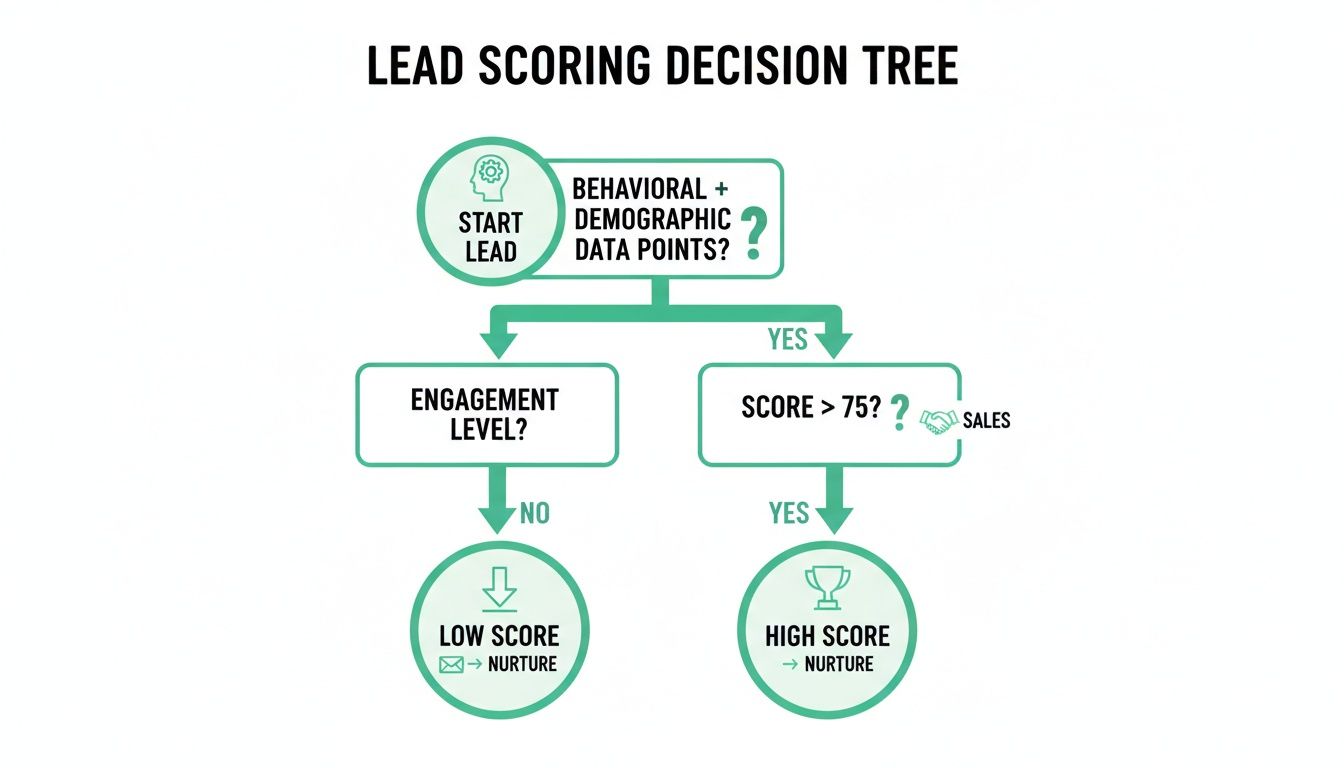
As you can see, the score acts as an immediate fork in the road. High-potential leads go straight to sales, while everyone else can be moved into a long-term nurture sequence.
Leveraging AI for Personalised Follow-Up
Automation isn't just about moving data around; it's about creating relevant conversations at scale. One of the most powerful ways to use AI here is to generate that very first follow-up email. Instead of a bland, generic "Thanks for your submission," AI can write something personal based on what the user just told you.
Let's go back to that marketing agency with the ROI calculator. If a lead says their biggest challenge is "Lead Generation," the AI-generated email should hit that point hard.
Your system can take the user's answers—company size, industry, main challenge—and feed them as prompts to an AI model. The result is a highly relevant, contextual opening email. It's the perfect mix of automation and personalisation.
Example of an AI-Generated Snippet:
"Hi [Name],
Thanks for using our ROI calculator. I saw your main focus is on improving lead generation for your 50+ employee company in the B2B tech sector.
Based on what you shared, companies like yours often get the best returns by optimising their top-of-funnel strategy. I have a few initial thoughts on how you could tackle this..."
This message is infinitely more powerful than a template. It proves you were actually listening and immediately pushes the conversation forward. This kind of responsiveness used to require a ton of manual work, but now it can be completely automated.
Building a Seamless Handoff to Sales
The last piece of the puzzle is making sure the handoff to your sales team is completely smooth. The workflow should arm your reps with all the context they need to have a smart first conversation.
When a sales rep gets that new lead notification, they shouldn't just see a name and an email address. They need a full briefing that includes:
- The Final Score: A quick, at-a-glance sign of how hot the lead is.
- All User Answers: The complete transcript of their inputs from your tool.
- The Recommended Segment: The bucket the system dropped them into (e.g., "Enterprise-Ready," "Mid-Market Fit").
When you engineer a system like this, you stop just generating leads and start manufacturing qualified opportunities. It’s a setup that not only capitalises on current trends and marketing but also gives you a huge advantage through speed and a better customer experience. The end result is a predictable pipeline of high-quality leads who are actually ready to talk.
Measuring What Actually Matters (Hint: It’s Not Conversions)
Let’s be honest. A high number of downloads or form fills looks great on a weekly report, but it tells you almost nothing about whether your marketing is actually working. It’s a vanity metric. Real success isn't measured in clicks; it's measured in pipeline, revenue, and how fast you can generate both.
This means you have to shift your thinking away from surface-level stats and towards pipeline-centric KPIs. The beauty of the interactive tools we've been talking about is they are built for this. They capture intent and qualification details in a way a simple PDF download gate never could. It's time to draw a straight line from your marketing efforts to sales outcomes.
Building Your Performance Dashboard
First things first: you need a single source of truth for your interactive funnel's performance. Stop bouncing between your analytics platform, your CRM, and a dozen spreadsheets. A dedicated dashboard gives you an at-a-glance view of the metrics that actually move the needle.
This isn’t about tracking every single data point you can find. It’s about focusing on the critical few that tell a story about lead quality and sales velocity.
Here’s a blueprint for the essential KPIs you should be tracking:
- Total Completions: The raw number of people who finished your interactive tool. Think of this as your top-of-funnel volume.
- Lead-to-MQL Conversion Rate: What percentage of those completions actually meet your definition of a Marketing Qualified Lead (MQL)? This is your number one indicator of lead quality.
- MQL-to-SQL Conversion Rate: Of those MQLs, how many did your sales team accept as Sales Qualified Leads (SQLs)? This tells you point-blank if marketing and sales are aligned on what a "good lead" even is.
- Average Sales Cycle Length: How long does it take for a lead from this specific tool to become a customer? You’ll often find that leads from interactive tools close much faster because they're better qualified from the start.
- Pipeline Contribution: How much potential revenue have these leads added to the sales pipeline? This is where you start speaking the language of the CFO.
- Closed-Won ROI: The ultimate metric. This calculates the actual revenue generated against the cost of creating and promoting your tool.
This focus on measurable, hard outcomes is becoming the standard. A massive pivot towards performance-based channels where ROI can be clearly tracked is underway globally. For context, you can dig deeper into these European digital marketing statistics and their implications.
Using Data to Actually Get Better
Your dashboard isn't just a report card; it's a diagnostic tool. Once you have a few weeks of data flowing in, you can start digging for gold—the opportunities for improvement. The goal here is continuous optimisation based on real user behaviour and lead quality, a core principle of modern trends and marketing.
Start by looking for the drop-off points. Are people abandoning your tool after a specific question? That question is probably too complex, too personal, or just plain confusing. A few A/B tests on the phrasing or question type can make a huge difference to your completion rates.
The most powerful insights don't come from looking at the overall numbers. They come from segmenting your performance data. Break down your conversion rates by the answers people gave. You'll quickly see which user profiles are generating your highest-quality leads.
For instance, you might discover that leads who select their company size as "100-500 employees" have a 3x higher MQL-to-SQL conversion rate than any other segment. That’s pure gold.
This one insight gives you a clear action plan:
- Refine Your Promotion: Go all-in on your ad spend targeting companies of that size.
- Personalise the Experience: Build a slightly different question path or a custom results page just for this high-value segment.
- Arm Your Sales Team: Let them know they need to prioritise follow-up with leads from this group, immediately.
This level of analysis turns your interactive tool from a static asset into a dynamic, self-optimising lead generation machine. By tying every interaction to a pipeline metric, you stop just chasing trends and start driving real, measurable business growth. And if you need a truly comprehensive look at your brand's presence and impact, you might even consider specialised services from LLM visibility tracking agencies.
Your Questions About Interactive Marketing, Answered
Shifting from static content to interactive tools brings up a ton of questions. I hear them all the time from marketers making this exact jump. It's totally normal to wonder about the nitty-gritty details when you're moving into a new way of doing things.
My goal here is to give you some straight, no-fluff answers to get you building interactive funnels that don't just look cool, but actually drive serious results.
What's The Best Interactive Format For a B2B SaaS Company?
The real answer? "It depends." I know, I know, not what you wanted to hear. But the "best" format really hinges on your goal and where someone is in their journey. There’s no silver bullet, but there are smart choices.
Think of it like this: for someone just starting to explore a problem (top-of-funnel), an 'Audit Tool' or a 'Maturity Assessment' is killer. These tools act like a free consultation, diagnosing their pain points and subtly pointing out how your solution is the remedy. It’s value-first, sales-second.
But for a prospect who’s much closer to buying? Go with a 'Calculator'. I’m talking ROI, pricing, or savings calculators. These folks are already thinking about the financial impact. Your tool gives them the hard numbers they need to build a business case and sell your solution internally. A quiz can work too, but only if it solves a real business problem, not just for kicks.
How Much Technical Skill Do I Actually Need to Build These?
The barrier here has completely crumbled. Five years ago, you'd need a developer on speed dial. Today, not so much.
Sure, a fully custom-coded solution gives you endless flexibility, but it's overkill for most. There are now fantastic no-code platforms built specifically for this stuff. They’ve got drag-and-drop editors and plug right into your CRM and marketing automation stack. This means marketers can launch a pretty sophisticated funnel without writing a single line of code.
Honestly, the most important skill isn't coding; it's strategy. You need to focus on crafting the right questions, designing clever scoring logic, and mapping out the user’s path. The tech is just the vehicle for your strategy.
So, How Do I Promote an Interactive Lead Magnet?
Your promotion strategy needs a simple mindset shift: stop pushing old, static calls-to-action and start swapping them with your new tool. You’re not offering another piece of content; you’re offering a valuable utility, a free diagnosis.
Here are a few plays that work every time:
- On Your Website: Hunt down your high-traffic blog posts and landing pages. See that tired "Download Ebook" button? Swap it for a link to your interactive tool.
- Paid Campaigns: When you run ads on places like LinkedIn, drive traffic directly to the tool. Skip the boring landing page. The ad promises value, the tool delivers it instantly.
- Email and Social: Make your interactive tool the star of the show in your newsletters and social posts. It’s far more compelling than another link to a blog post.
The whole game is about highlighting the immediate, personalised payoff they get for engaging.
How Do You Get People to Actually Finish The Thing?
To nail completion rates, you have to get obsessed with the user experience. Every single step has to feel effortless and rewarding.
Kick things off with a dead-simple, low-effort question to get them in the door. Then, add a progress bar. It's a simple psychological trick, but it works wonders by showing people the light at the end of the tunnel. And for the love of all that is holy, make sure your tool works flawlessly on mobile. A huge chunk of your audience will find it on their phones.
But at the end of the day, the single biggest driver of completion is the value you promise. If someone knows they’re going to get a genuinely insightful, personalised report that helps them solve a problem, they'll happily click through every step to get it.