Interactive Marketing: Drive Engagement with Two-Way Customer Dialogues
Interactive marketing creates a dynamic two-way dialogue with customers. Learn how interactive marketing works to boost engagement.
Interactive marketing is all about turning one-way brand messages into engaging, two-way conversations with your customers. Instead of your audience just passively reading an article or watching a video, they get to actively participate—clicking, answering questions, and exploring content that actually responds to what they do.
Moving from Marketing Monologues to Customer Dialogues

Traditional marketing often feels like a lecture. Brands get up on a digital stage and broadcast the same generic message to everyone, whether it's through a blog post, a whitepaper, or a webinar. It's a monologue—a one-way street where the audience is expected to just sit and listen.
Interactive marketing flips this whole model on its head. Think of it less like a lecture hall and more like a hands-on workshop. In this setup, your audience isn't just consuming information; they become part of the experience. Their clicks, choices, and answers shape what happens next in real time.
The Shift from Static to Dynamic
A static PDF guide on "improving your sales process" is a perfect example of a marketing monologue. Every single person downloads the exact same file, no matter their company size, industry, or the specific sales problems they're facing. It's a one-size-fits-all asset. Useful, maybe, but totally impersonal.
Now, imagine an interactive version of that same topic: a "Sales Process Grader." This tool would ask you a few targeted questions about your current sales cycle, your team structure, and maybe your conversion rates. Based on your unique answers, it spits out a personalised report with a custom score and concrete, actionable steps for improvement.
This dynamic approach delivers immediate, tailored value. It’s a genuine dialogue where you provide the context, and the tool offers a relevant solution. This is exactly what modern buyers want—not generic content, but personalised help. Many people don't understand the power of AI in interactive marketing, but it's what enables this level of personalization at scale. It completely changes the game compared to static lead magnets by ensuring every single user gets a result that feels like it was made just for them.
An interactive approach respects the user's time and intelligence. It’s a value exchange: they give you their attention and data, and in return, they get instant, personalised insights that help them solve a real problem.
Why This Dialogue Matters
Building a real dialogue instead of just delivering a monologue gives you benefits that go way beyond simple engagement numbers. This conversational method fundamentally changes the relationship between your brand and your potential customers.
- Deeper Connection: By asking questions and actually listening to the answers, you show you understand and care about your user's specific challenges.
- Enhanced Brand Recall: People are far more likely to remember an experience they participated in than one they just passively watched.
- Valuable Data Collection: You get zero-party data—information people willingly share with you—which is infinitely more powerful and insightful than just guessing based on their browsing behaviour.
This conversational method is the bedrock of effective interactive marketing. By inviting your audience into a dialogue, you don't just capture another lead; you start building trust and proving your expertise from the very first click. You can explore more about adding interactivity on websites to see just how big of an impact it can make.
How AI Transforms Interactive Content into a Powerhouse
A lot of marketers write off interactive tools as simple quizzes or calculators. They’re fun, sure, but not serious business. That’s a huge mistake. The real magic in interactive marketing happens when you mix in artificial intelligence. AI takes these tools from being mildly entertaining novelties and turns them into incredibly sharp personalisation engines.
This completely flips the script on static lead magnets. Instead of offering every visitor the exact same PDF download, an AI-powered tool can have a one-on-one conversation, delivering immediate, personal value that a fixed asset just can't touch. It’s how you have thousands of individual conversations with prospects, all at the same time.
From Generic Responses to Personalised Results
The real strength of AI is its knack for analysing user inputs on the fly and generating genuinely custom outputs.
Let's explore a practical example. A financial advisory firm's traditional lead magnet might be a PDF called "5 Tips for Retirement Planning." Every single person who downloads it gets the same five tips, whether they're 25 or 55, with a low or high income.
Now, imagine an AI-powered assessment. It would ask specific questions about those variables. Based on the user's unique answers, the AI instantly generates a personalised report with specific strategies, potential investment ideas, and a retirement timeline built just for them. This isn't just content anymore; it's a consultative experience.
The core function of AI in interactive marketing is to move beyond simple logic paths ("if this, then that") to a system that understands nuance and context. It can weigh multiple variables to create a unique result for every single user, delivering a level of personalisation that was once impossible to achieve at scale.
This is the fundamental difference: static content speaks to an audience, but AI-driven interactive content speaks to an individual. It answers their specific questions and solves their distinct problems, which builds trust and shows off your expertise from the get-go.
Unlocking Deeper Audience Insights
Beyond giving the user a great experience, AI-powered interactions hand marketers a backstage pass into their audience's minds. A standard quiz might tell you that 70% of your audience struggles with "time management." That's useful, but it’s pretty broad.
An AI-driven diagnostic tool digs way deeper. By analysing complex combinations of answers, it uncovers insights you'd otherwise miss.
- Pain Point Correlation: It could reveal that users who struggle with time management also tend to use outdated software and manage teams larger than ten people. Suddenly, you have a much clearer picture of your ideal customer.
- Intent Signals: The AI can spot users whose answers scream "ready to buy," flagging them as hot leads for your sales team to prioritise.
- Content Gaps: By identifying common challenges your current content doesn't cover, it hands you a ready-made roadmap for your next blog post or webinar.
This kind of detailed analysis helps you sharpen your marketing messages, improve your product, and just plain understand your customers better. To see how companies are adopting this technology, you can explore the three levels of AI adoption and figure out where your own efforts fit in.
The Scalable Conversation Engine
At the end of the day, AI makes personalised marketing at scale a real thing. It lets your marketing act like your best salesperson—asking smart questions, actually listening to the answers, and then making a helpful, relevant recommendation. It doesn't matter if you have a hundred website visitors or a hundred thousand; each person gets a unique experience tailored just for them.
This is what turns interactive marketing from a clever tactic into a core strategic advantage. It shifts your lead generation from passively collecting email addresses to actively qualifying prospects and delivering value upfront. For a closer look at a common application, check out this guide on how to harness the power of an AI-driven chatbot for your website.
Choosing the Right Interactive Formats for Your Funnel
Now that we've covered the 'why', it is time for the 'what'. This is where your strategy starts feeling real. But picking the right format isn't about chasing the latest shiny object; it’s about matching the right tool to the right job at each stage of your customer’s journey.
The real magic of modern interactive marketing—and the part most people still miss—is its power to deliver a genuinely personalised result. A static PDF lead magnet gives the same generic information to everyone. An AI-powered interactive tool? It can create a unique, valuable output for every single person who uses it. That's the difference between shouting a message from a stage and having a real one-on-one conversation, but at scale.
Top-of-Funnel: Grabbing Attention and Sparking Curiosity
At the top of the funnel (ToFu), your only goal is to attract a wide audience, grab their interest, and teach them something without being pushy. Your interactive content needs to be fast, fun, and easy to share.
Personalised Quizzes: These are absolute gold for getting attention. But forget the generic "What kind of pizza are you?" quizzes. Think strategically. For example, a B2B software company could create a "What's Your Leadership Style?" quiz. The results subtly connect different leadership styles to the problems your software solves. The user gets a cool, shareable insight about themselves, and you get a peek into their professional mindset.
Interactive Infographics: A static infographic is a poster. An interactive one is an exploration. Imagine an infographic on industry trends where people can click on different data points to uncover deeper stats, case studies, or related content. You're turning passive scrolling into active discovery.
Middle-of-Funnel: Building Trust and Qualifying Leads
In the middle of the funnel (MoFu), people know they have a problem and are actively looking for solutions. Your job is to build trust, show you're the expert, and prove your solution's worth. This is where AI-driven personalisation really starts to cook.
The best middle-funnel tools don't sell; they act like expert consultants. They help prospects diagnose their own problems and see a clear path forward, making your brand an indispensable guide, not just another vendor.
Diagnostic tools or graders are perfect for this. They ask a series of questions to analyse a user's situation and spit out a custom score or report. A cybersecurity firm, for example, could offer a "Security Risk Assessment" that checks a company's current setup and generates a report flagging specific weak spots.
This approach delivers massive value right away, giving the user personalised insights they could never get from a generic blog post. And the data you get back? It's incredibly rich, giving you a deep-dive into each lead's specific pain points and sophistication level.
Bottom-of-Funnel: Closing the Deal
At the bottom of the funnel (BoFu), your prospect is on the verge of making a decision. Your goal here is to knock down any last-minute barriers, justify the price tag, and make an undeniable case for your solution. The content has to be laser-focused on results.
ROI Calculators: A classic BoFu tool for a reason—they work. An ROI calculator lets a prospect plug in their own numbers—team size, current software spend, inefficiency costs—and see a concrete projection of the financial return your product will deliver. It shifts the conversation from fuzzy benefits to hard data.
Solution Builders or Configurators: Got a complex product? A configurator is a sales powerhouse. It lets users build their own custom package or solution to fit their exact needs and budget. This creates a sense of ownership and hands you a perfectly qualified lead whose specific requirements you already know inside and out.
The table below breaks down how these formats stack up against each other.
Comparing Interactive Marketing Formats
| Format Type | Primary Goal | Engagement Level | Best For |
|---|---|---|---|
| Quiz | Attract & Engage | High | Top-of-Funnel lead capture & audience segmentation. |
| Diagnostic/Grader | Nurture & Qualify | Very High | Middle-of-Funnel value delivery & deep data collection. |
| ROI Calculator | Justify & Convert | Medium | Bottom-of-Funnel decision-making & sales enablement. |
| Solution Configurator | Close & Customise | Very High | Bottom-of-Funnel for complex B2B products/services. |
As you can see, there's a tool for every job.
Picking the right format comes down to knowing your audience and what you want to achieve at each step. For more ideas, check out these other powerful interactive marketing examples that are crushing it right now. When you align the tool with what the user needs at that exact moment, you create a smooth journey that educates, qualifies, and ultimately converts.
100% Free Lead Magnet Audit
Our AI analyzes your website and delivers custom growth strategies in seconds.
Building a Full-Funnel Interactive Marketing Strategy
An interactive tool on its own is just a gimmick. A cool party trick, maybe, but not a strategy. To get real results with interactive marketing, you need a blueprint that weaves these experiences through the entire customer journey, pulling prospects from casual curiosity all the way to a sales call.
This isn't about just dropping a random calculator onto your homepage. It’s about strategically placing the right kind of interactive content at each stage of the funnel. You need to meet your audience where they are, offering the right value at the right time.
Let's break down what that actually looks like.
Top of Funnel: Attracting and Engaging Your Audience
At the top of the funnel (ToFu), your only job is to get noticed. You're trying to attract a broad audience, grab their attention, and maybe even introduce them to a problem they didn't know they had. The interactive content here needs to be light, fun, and super shareable.
- Engaging Quizzes: Think of a B2B software company creating a "What's Your Team's Productivity Score?" quiz. It asks a few simple questions about daily workflows and common headaches. At the end, it spits out a score with a couple of quick tips. This gets the user thinking about the very problem your software solves, but without a heavy-handed sales pitch.
The magic here is the immediate, personal insight. A good quiz makes the user feel seen and gives them a small, useful nugget of information they can act on right away.
Middle of Funnel: Nurturing and Educating Prospects
Once someone's in your world, the middle of the funnel (MoFu) is all about building trust and proving you know your stuff. They're aware of their problem now, and they're actively looking for solutions. Your interactive content has to deliver serious value and showcase your expertise.
- Value-Driven Calculators: An insurance agency could offer a "Business Interruption Calculator." A prospect plugs in their revenue, fixed costs, and industry to see the potential financial damage of a shutdown. This tool turns an abstract risk into a cold, hard number, making the need for their service crystal clear.
This kind of tool positions you as a helpful advisor, not just another vendor. You're giving them the power to understand their own situation better, which is a massive credibility booster.
This diagram shows how different interactive tools fit into the marketing process to keep people engaged.
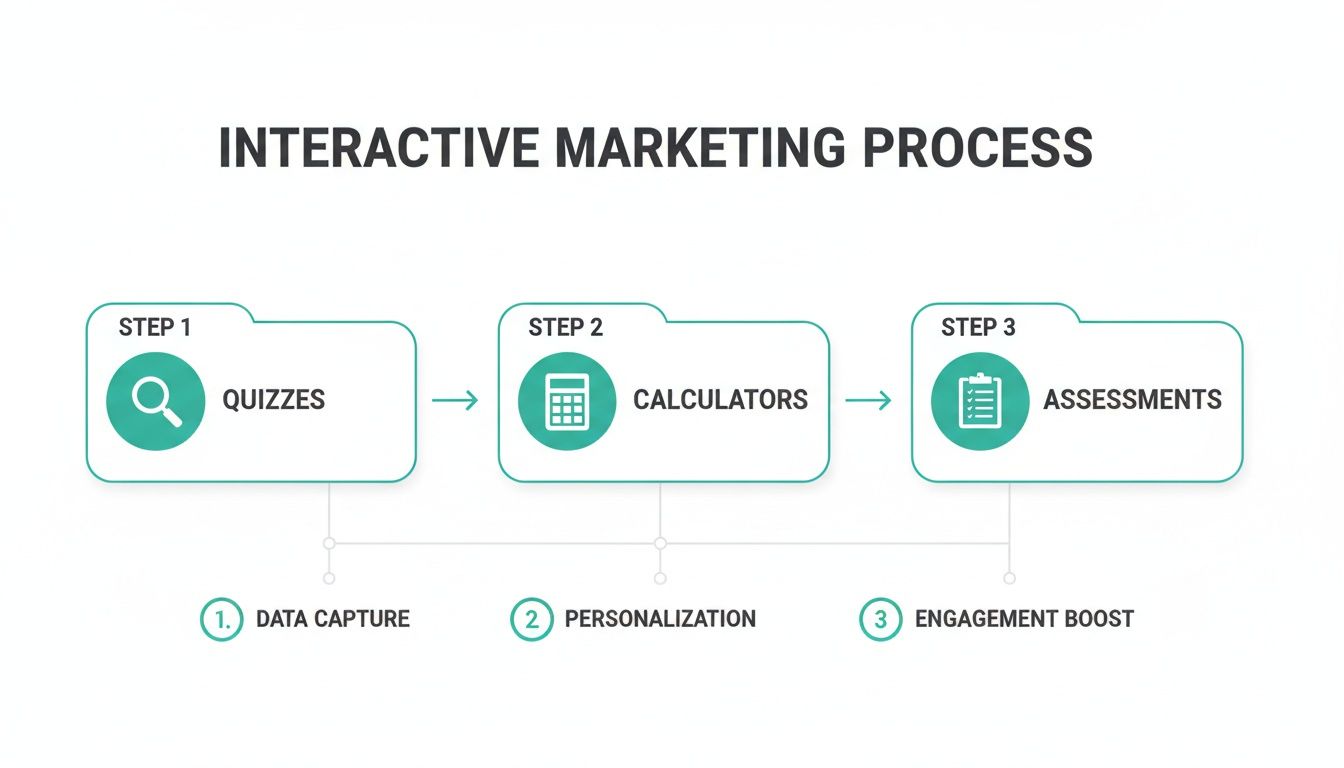
You can see how a prospect moves from a broad, engaging quiz to more specific, high-value interactions like calculators and detailed assessments.
Bottom of Funnel: Converting High-Intent Leads
Down at the bottom of the funnel (BoFu), prospects are on the verge of making a choice. Your interactive tool should tackle their final questions head-on and build an undeniable case for your solution. This is where you connect your product directly to their specific needs.
- Personalised Assessments: A marketing agency could build a "Digital Marketing Maturity Assessment." It digs deep, asking detailed questions about a company's current strategies, tools, and results. The output isn't a generic PDF; it's a custom report that benchmarks them against their industry and lays out a tailored roadmap for improvement—a roadmap that just so happens to lead directly to the agency's services.
This is worlds more effective than a generic case study. It’s a solution designed just for them, making the decision to buy feel less like a purchase and more like the obvious next step.
After the Interaction: Turning Data into Action
Look, the interaction itself is only half the job. The real power of a full-funnel strategy comes from what you do with the data you collect. This is where AI completely changes the game, allowing for a level of personalisation that was unthinkable with old-school, static tools.
Many people don't fully grasp the power of AI in interactive marketing. It's the engine that turns a simple quiz into a dynamic diagnostic tool, delivering personalised results that make each user feel seen and understood. This is how you scale one-on-one conversations.
Every answer a user gives you is a goldmine of data. This zero-party data—information they willingly hand over—is the secret to smart, effective follow-up.
- Lead Scoring: You can assign points to answers. A user whose assessment reveals a huge budget and an urgent problem? They get a high score and are flagged as a hot lead.
- Audience Segmentation: Users get automatically sorted into different lists based on their challenges, company size, or goals. This means you can send them hyper-relevant email nurture sequences instead of one-size-fits-all spam.
- Sales Routing: High-intent leads can be sent straight to the right salesperson's calendar for an immediate call. The sales rep gets the prospect's full assessment results beforehand, letting them walk into the first conversation fully prepared and incredibly relevant.
This systematic approach makes sure no lead gets lost and that your sales team is only spending time on the most qualified, ready-to-buy opportunities. If you're curious how your own lead magnets are performing, you can get a practical analysis with Magnethive's free lead magnet audit. This free tool uses AI to generate a comprehensive report on your current assets, suggest new ideas, and show potential ROI impact.
How to Measure Your Interactive Marketing Success
Proving the value of any marketing campaign boils down to the data. But with interactive marketing, the real goal is to get past fluffy vanity metrics like completion rates or social shares. While those numbers are nice to look at, they don't tell you the full story about what’s actually impacting the business.
Real success is measured by tracking how these engaging experiences directly influence lead quality and, ultimately, revenue.
To do this right, you absolutely have to connect your interactive tools to your analytics and CRM systems. This is the only way to follow a lead from their first click on a quiz all the way through to a closed deal. Nailing this setup is non-negotiable if you want to prove the ROI of your interactive campaigns.
Key Performance Indicators That Actually Matter
Let’s talk about the metrics that truly show if your interactive content is working. These KPIs are all about business outcomes, not just surface-level clicks and views.
Lead-to-Customer Conversion Rate: This is the big one. It answers a simple but critical question: "Of the people who engaged with our interactive tool, how many became paying customers?" A high number here is the clearest signal that your tool is pulling in and qualifying the right kind of audience.
Lead Quality Score: Let's be honest, not all leads are created equal. By assigning points to specific answers within your quiz or calculator, you can automatically score leads based on their fit and intent. Someone whose answers show a big budget and an urgent problem should get a much higher score than a student just browsing. Tracking the average lead score from your interactive content shows you exactly how well it's attracting high-value prospects.
Sales Pipeline Influence: How many opportunities sitting in your sales pipeline right now were sourced or touched by an interactive tool? By tagging these leads in your CRM, you can draw a straight line from your interactive marketing efforts to actual revenue. This makes for a pretty powerful conversation with your boss.
Setting Up Your Analytics for Success
To track these more advanced metrics, your setup has to be solid. You need to make sure the data from your interactive forms, quizzes, and calculators is flowing correctly into your analytics platforms. This lets you see what users are doing, track submissions as actual conversion events, and understand where they go on your site after they've interacted.
To really get a handle on engagement and conversions from these tools, you have to track their performance properly. This is where a detailed Google Form Google Analytics tracking guide can be a lifesaver, giving you a clear roadmap for connecting the dots. The principles in a guide like that apply to almost any interactive format, ensuring you don’t miss a single valuable data point.
The Untapped Goldmine of Qualitative Data
Beyond the hard numbers, interactive marketing gives you something incredibly valuable: a treasure trove of qualitative data. The answers people give you are direct, unfiltered insights into their biggest challenges, goals, and priorities. And the best part? They are willingly giving you this information.
This qualitative feedback is arguably as valuable as the quantitative metrics. It’s a direct line into the customer’s mind, offering rich insights that can guide everything from product development to future content strategy.
This is what's known as zero-party data. It allows you to fine-tune your messaging, come up with new features, and create content that actually hits the mark. You’re no longer guessing what your audience wants; they are telling you, loud and clear. This feedback loop is essential for staying aligned with the market and constantly improving your entire approach to marketing.
Got Questions? We’ve Got Answers
To wrap things up, let’s tackle some of the most common questions marketers have when they start exploring interactive marketing. Getting your head around these fundamentals is the first step to building a programme that actually moves the needle.
What's the Real Difference Between Interactive and Traditional Content?
It all comes down to one word: participation.
Traditional content, like a blog post or a whitepaper, is a monologue. You publish it, your audience passively consumes it, and that’s pretty much where the conversation ends.
Interactive marketing, on the other hand, is a two-way dialogue. It demands that the user actually do something. Instead of just reading a generic ebook about ROI, they get to plug their own numbers into an interactive calculator and see a personalised result pop out. The content literally changes based on their input.
This simple shift from passive reading to active doing is what leads to insane engagement, better knowledge retention, and a goldmine of first-party data that your audience gives you willingly.
Is Interactive Marketing Just for B2C Brands?
Not a chance. While you see a lot of fun quizzes from B2C companies, interactive marketing is an absolute powerhouse in the B2B world.
Think about it: B2B sales cycles are long and complicated. Interactive tools are perfect for educating prospects and weeding out the tyre-kickers. A B2B tech company could build a diagnostic tool that helps a prospect find vulnerabilities in their current system. Or a calculator that spits out the potential cost savings of switching to their solution.
These tools provide instant, concrete value in a way a static PDF never could. They position you as the expert and, more importantly, help you identify and score high-intent leads for your sales team. It's a non-negotiable part of a modern B2B strategy.
How Much of a Tech Whiz Do I Need to Be?
This is a big one. In the old days, building anything interactive meant you needed a developer on speed dial, which priced most marketing teams out of the game. That’s a common misconception that holds way too many people back.
Things have changed, big time. Today, there’s a whole ecosystem of no-code and low-code platforms built specifically for marketers. Tools like these let you build sophisticated quizzes, calculators, and assessments using simple drag-and-drop editors and pre-built templates. You can launch a seriously powerful campaign without writing a single line of code.
Sure, if you’re building a deeply customised, enterprise-level experience, you might still need some technical help. But the barrier to entry for creating effective interactive content has dropped to practically zero.
How Does AI Fit Into All of This?
This is where it gets really interesting. A lot of people don't see how AI and interactive marketing connect, but AI is what turns a simple tool into a lead generation machine. It's the engine that powers true personalisation at scale.
Without AI, an interactive quiz is just a series of simple "if-then" logic branches. With AI, that same tool can analyse complex patterns across dozens of user inputs to generate deeply personalised results, recommendations, and reports. It’s the difference between a basic quiz and a sophisticated diagnostic assessment.
This ability to deliver a unique outcome for every single user is what makes the experience feel genuinely valuable and consultative. It’s like having thousands of one-on-one conversations happening at the same time, all delivering tailored insights that build trust and drive people to take the next step.