10 Powerful Interactive Marketing Examples to Inspire You in 2025
Discover 10 real-world interactive marketing examples—from quizzes to calculators—that drive engagement and high-quality leads. Get actionable tips today.

In a marketing environment saturated with one-way communication, grabbing and holding audience attention is a significant challenge. Traditional, passive content like blog posts and static PDFs often struggles to engage, resulting in high bounce rates and minimal lead capture. This is precisely where interactive marketing fundamentally changes the dynamic. It transforms your audience from passive observers into active participants, creating memorable, two-way experiences that educate while generating valuable, high-intent leads.
The power of interactive marketing lies in its ability to create a two-way dialogue. By using tools like quizzes, calculators, and assessments, you move beyond simply broadcasting a message. Instead, you invite users to engage, share information about their needs, and receive personalised value in return. This dialogue-driven approach allows you to understand your customers on a much deeper level, segment them accurately, and deliver highly relevant solutions. It's about building relationships, not just collecting clicks.
This article will explore ten powerful interactive marketing examples that demonstrate how businesses, from agile startups to established enterprises, are achieving remarkable results. We will dissect the strategy behind each campaign, breaking down what makes it effective and providing a blueprint of actionable takeaways. You will see firsthand how to move beyond static content and implement interactive experiences that capture attention, qualify leads, and drive measurable growth. We will analyse everything from the initial hook to the final call to action, equipping you with the insights needed to build your own high-performing interactive campaigns.
1. Interactive Quizzes and Assessments
Interactive quizzes and assessments are powerful tools that transform passive content consumption into an active, engaging experience. By asking a series of questions, businesses can deliver personalised results, product recommendations, or knowledge scores, making them a cornerstone of modern interactive marketing examples. This two-way dialogue captures valuable zero-party data directly from the user, providing deep insights into their needs, preferences, and pain points.

From BuzzFeed's viral personality quizzes to Sephora's product finder assessments, this format excels at lead generation and audience segmentation. A B2B SaaS company, for example, could create a "Maturity Assessment" to help prospects self-identify their needs, while a marketing agency might develop a "Digital Marketing Audit Quiz" to pinpoint a potential client's weaknesses. These tools not only educate the user but also pre-qualify them, delivering warmer, better-informed leads to the sales team. The key is to provide genuine value in the results, which builds trust and encourages the user to take the next step.
Actionable Takeaways for Implementation
To successfully implement quizzes, focus on creating an experience that is both entertaining and insightful. Keep the quiz concise, ideally under 10 questions, to maximise completion rates on both desktop and mobile devices.
- Design for Segmentation: Structure your questions and scoring logic to segment users into distinct buckets. This allows you to follow up with highly relevant content, offers, or personalised email nurture sequences.
- Create a Compelling CTA: The results page is your most valuable real estate. Instead of just showing a score, guide the user toward a clear call-to-action, such as "Book a Demo," "Download Your Personalised Report," or "Shop Your Recommended Products."
- Promote Social Sharing: Design shareable results with catchy titles and visually appealing graphics. For more ideas on how to craft engaging questions and results, you can explore in-depth guides about creating a fun personality quiz on interactiveleadgen.com. This encourages organic reach and turns your audience into brand advocates.
2. Gamification Mechanics
Gamification infuses game-like elements such as points, leaderboards, and rewards into non-game marketing contexts to drive user engagement and influence behaviour. It taps into our innate desires for achievement, competition, and status, transforming mundane interactions into motivating and memorable experiences. This approach is a powerful example of interactive marketing, as it creates a continuous feedback loop that keeps users returning.
From the Duolingo language app's "streak" system to the Starbucks Rewards programme's tiered progression, gamification excels at fostering loyalty and repeat activity. A SaaS startup could implement a points system for completing onboarding tasks, while a small business could run a "check-in" challenge on social media with badges for top participants. The goal is to make progress visible and rewarding, encouraging users to invest more time and effort into the brand ecosystem, which ultimately boosts retention and lifetime value.
Actionable Takeaways for Implementation
To successfully deploy gamification, you must align the game mechanics with your business objectives and your audience's motivations. The experience should feel rewarding and natural, not like a chore.
- Offer Tangible Value: Ensure the rewards, whether they are discounts, exclusive content, or status symbols, are genuinely valuable to your target audience. The incentive must be strong enough to motivate a change in behaviour.
- Keep it Simple and Transparent: The rules and point systems should be easy to understand. Users need to clearly see how their actions lead to rewards, otherwise they may become frustrated and disengage.
- Foster Community and Competition: Incorporate social elements like leaderboards or team challenges to amplify engagement. For marketers looking to integrate these interactive elements, exploring strategies for community gamification can transform a passive audience into an active, buzzing hub.
3. Interactive Videos
Interactive videos transform the passive viewing experience into an active, choice-driven journey. By embedding clickable elements such as hotspots, polls, quizzes, or branching narratives directly into the video player, marketers can capture viewer attention and guide them through a personalised path. This format turns a one-way broadcast into a two-way conversation, boosting engagement metrics and providing rich data on user behaviour and preferences.

From H&M's shoppable video campaigns to Netflix's groundbreaking 'Bandersnatch' series, this approach has proven effective across B2C and B2B sectors. A software company could use an interactive video for a product tour, allowing prospects to click on features they want to explore further. Similarly, a small business could create a branching "choose your own adventure" video to demonstrate different use cases for their product. These dynamic experiences not only hold viewer attention longer but also serve as powerful tools for lead qualification and direct response, shortening the path from discovery to conversion.
Actionable Takeaways for Implementation
To implement interactive videos effectively, your goal is to add value, not distraction. Each interactive element should serve a clear purpose, whether it's to educate, segment, or convert the viewer. Ensure the experience is seamless and intuitive, especially on mobile devices where most video content is consumed today.
- Map Out the User Journey: Before production, create a flowchart of all possible paths and outcomes. This helps identify potential dead ends or confusing loops and ensures every branch delivers a logical, satisfying experience for the user.
- Use Clear Visual Cues: Don't make users guess what's clickable. Use subtle animations, icons, or text overlays to signal interactive elements. The goal is to make interaction feel natural and instinctive, not like a chore.
- Embed a Strong CTA: Use the video's context to present a compelling call-to-action at the most impactful moment. This could be a link to "Book a Demo" after explaining a key feature or an option to "Shop This Look" as a product appears on screen.
4. Augmented Reality (AR) Experiences
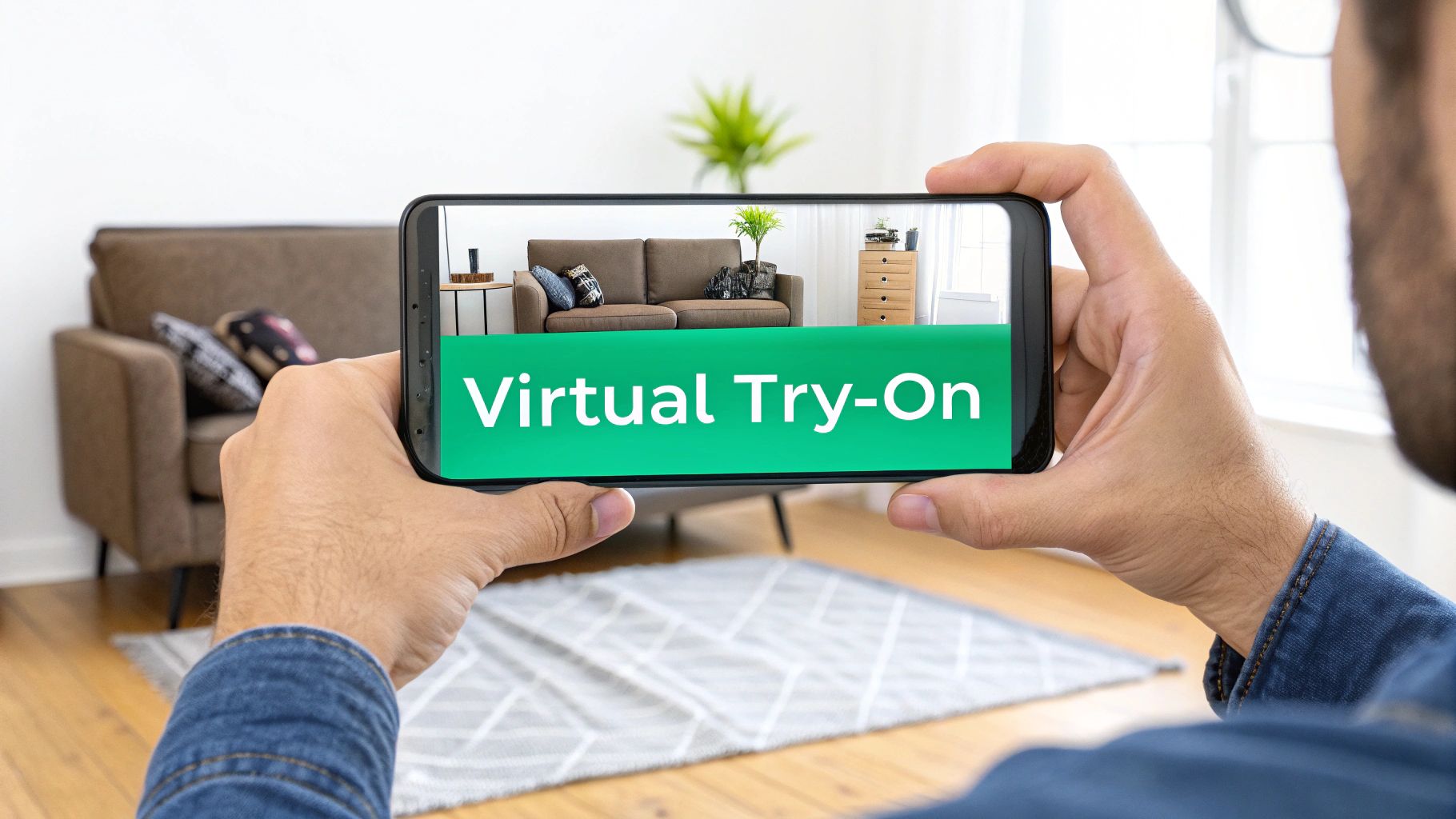
Augmented Reality (AR) experiences merge the digital and physical worlds, overlaying computer-generated images, sounds, and text onto a user's real-world view, typically through a smartphone. This technology transforms passive observation into an immersive, hands-on interaction, allowing customers to visualise products in their own space or virtually "try on" items. This powerful form of interactive marketing creates memorable brand encounters that can significantly reduce buyer hesitation and boost conversion rates.
From IKEA's Place app, which lets you see how furniture fits in your home, to Sephora's Virtual Try-On for makeup, AR solves a critical e-commerce problem: the inability to physically experience a product. This technology builds purchasing confidence and provides a utility that goes beyond novelty. A B2B company could use AR to showcase complex machinery on a factory floor, while a marketing agency could create a branded filter for an event to drive social engagement. The key is to provide a seamless and useful experience that enriches the customer journey, making the path from consideration to purchase more tangible and engaging.
Actionable Takeaways for Implementation
To implement AR successfully, prioritise utility and a smooth user experience over novelty. Your goal is to solve a customer problem or remove a friction point in the buying process, making the technology feel indispensable rather than gimmicky.
- Focus on a Clear Use Case: Don't use AR for the sake of it. Identify a specific problem it can solve, such as product visualisation, virtual try-ons, or interactive brand storytelling. For a deeper dive into visual interactive marketing, learn about how AI clothing try-on technology is transforming online shopping.
- Optimise for Performance: AR experiences can be resource-intensive. Ensure your app or web-based tool is optimised for fast loading times and works flawlessly across a wide range of devices to prevent user frustration and abandonment.
- Provide Simple Onboarding: Guide first-time users with clear, concise instructions. A quick tutorial or on-screen prompts can dramatically improve usability and ensure users can immediately see the value of the experience.
5. Live Chat and Chatbots
Live chat and AI-powered chatbots have revolutionised real-time communication, turning static websites into dynamic conversational platforms. This technology offers immediate, one-to-one interaction, guiding visitors, answering queries, and capturing leads 24/7. As one of the most direct interactive marketing examples, chatbots create a personalised journey by engaging users based on their on-site behaviour, providing instant support and tailored guidance. This immediate feedback loop not only enhances the customer experience but also gathers crucial data on user intent and needs.
From Domino's enabling pizza orders via a Facebook Messenger bot to Bank of America's virtual assistant, Erica, helping millions with banking tasks, the applications are vast. In the B2B space, companies like Drift and Intercom use chatbots to qualify website visitors in real-time, book meetings for sales reps, and route high-intent leads instantly. For a small business, a simple chatbot can handle frequently asked questions about opening hours or services, freeing up human resources. For a marketing agency, a chatbot could engage potential clients by asking initial qualifying questions about their goals and budget, turning passive web traffic into active sales conversations. The key to their success is delivering speed, convenience, and relevance right when the user needs it.
Actionable Takeaways for Implementation
To implement chatbots effectively, focus on creating a helpful, human-like dialogue that solves problems efficiently rather than creating friction. A well-designed conversational flow feels natural and guides the user toward their goal.
- Design Intelligent Conversation Flows: Map out common user journeys and questions. Use this to build conversational paths that feel intuitive. Ensure there is always a clear and simple option to escalate to a human agent for complex issues.
- Personalise the Interaction: Use data like the visitor's source, the page they are on, or past behaviour to tailor the chatbot's opening message and conversation. A message like "Seeing you're checking out our pricing? Have any questions?" is far more effective than a generic "How can I help?".
- Integrate with Your Tech Stack: Connect your chatbot to your CRM and marketing automation platforms. This allows you to capture lead information, create new contacts, and trigger personalised follow-up sequences automatically, ensuring no lead falls through the cracks.
6. Interactive Infographics and Data Visualisations
Interactive infographics and data visualisations transform static data into a dynamic, explorable experience. Instead of passively reading a report, users can click, hover, filter, and drill down into information, making complex datasets digestible and memorable. This approach is a standout among interactive marketing examples because it boosts user engagement, increases time on page, and positions a brand as a knowledgeable authority in its field.
This method moves beyond simple charts to create a narrative that users actively participate in. For instance, a marketing agency could create an interactive report on industry ad spend, allowing clients to filter by platform and region. A SaaS company might visualise customer usage data to highlight product value, while a non-profit could use an interactive map to showcase the impact of its initiatives. The power lies in making the user the protagonist in their own data discovery journey, leading to deeper understanding and higher retention of the information presented.
Actionable Takeaways for Implementation
To create impactful interactive visualisations, your primary goal should be to enhance understanding, not just to add novelty. Every interactive element must serve a clear purpose, guiding the user through the data story you are telling.
- Prioritise a Clear Narrative: Begin with a key insight or story you want to convey. Structure the visualisation to guide users logically from a high-level overview to more granular details, using clear labels and guiding text to provide context.
- Ensure Mobile Responsiveness: A significant portion of your audience will view the content on mobile devices. Design with touch-friendly controls and ensure the layout adapts seamlessly to smaller screens without losing functionality or clarity.
- Optimise for Performance: Large datasets and complex animations can slow down page load times, leading to high bounce rates. Optimise image sizes, lazy load elements, and simplify animations to ensure a smooth and responsive user experience. You can find more tips on building engaging digital experiences by exploring various approaches to interactivity on websites at interactiveleadgen.com.
100% Free Lead Magnet Audit
Our AI analyzes your website and delivers custom growth strategies in seconds.
7. Polls and Surveys with Instant Results
Interactive polls and surveys are a highly effective way to engage an audience by asking for their opinion and providing immediate, aggregated results. This form of interactive marketing transforms passive browsing into an active, community-driven experience. By allowing users to see how their answers compare to others in real-time, brands can generate a sense of participation and belonging, making the interaction far more memorable than a static piece of content.
This method excels at gathering quick audience sentiment and valuable zero-party data. For instance, a B2B SaaS company could use a LinkedIn poll to ask which feature their followers are most excited about, directly informing their product roadmap. Similarly, a marketing agency might run a poll in their newsletter asking, "What's your biggest marketing challenge this quarter?", using the results to create timely blog posts or webinars. From quick Instagram Stories polls to more formal event polling with tools like Slido, this format provides instant insights while boosting user engagement.
Actionable Takeaways for Implementation
To maximise engagement with polls, the key is to make them quick, relevant, and visually integrated into the platform where your audience resides. Focus on questions that spark curiosity and make users want to see the collective outcome.
- Keep it Simple and Swift: Limit polls to a single, compelling question with clear, mutually exclusive answer options. The low barrier to entry is crucial for high participation rates, especially on fast-paced social media platforms.
- Leverage High-Traffic Channels: Embed polls on your most visited web pages, within your email newsletters, or on your most active social media channels. Placing them where your audience already is removes friction and boosts response numbers.
- Use Insights to Inform Strategy: The data gathered, even from a simple poll, is a powerful resource. Use the results to validate ideas, segment your audience for future campaigns, or create follow-up content that addresses the opinions and pain points you’ve uncovered.
8. Interactive Webinars and Virtual Events
Interactive webinars and virtual events transcend traditional, one-way broadcasting by transforming presentations into dynamic, two-way conversations. By integrating features like live polls, Q&A sessions, breakout rooms, and real-time chat, businesses can create immersive experiences that hold audience attention and foster a sense of community. This high-engagement format is a prime example of interactive marketing, as it captures valuable participation data that signals audience interest and intent.
Platforms like HubSpot and Adobe have perfected this model with events like the Adobe MAX digital conference, which uses polls and live Q&A to keep thousands of attendees engaged. A small marketing agency could host a webinar with interactive breakout rooms for personalised strategy sessions, while a startup could run a live product demo with polls to gauge feature interest. The goal is to make attendees active participants rather than passive viewers. This not only improves knowledge retention but also provides rich behavioural data, helping to identify the most engaged and sales-ready leads for post-event follow-up.
Actionable Takeaways for Implementation
To elevate a standard webinar into a powerful interactive experience, focus on planning engagement points throughout the entire event. An engaged audience is more likely to convert, so make participation easy and rewarding.
- Structure for Interaction: Intentionally build engagement prompts into your presentation every 5-7 minutes. This could be a simple poll, a question for the chat, or a prompt to download a resource. This breaks up the monologue and keeps attention levels high.
- Leverage Post-Event Data: Analyse participation data after the event. Who asked questions? Who voted in polls? Use these insights to segment your audience for highly personalised follow-up emails, connecting them with relevant resources or sales contacts.
- Repurpose and Extend Reach: Record the session and repurpose it into smaller, digestible content pieces like short video clips, blog posts summarising key points, or quote graphics. This extends the life of your content and provides ongoing value long after the live event has ended.
9. Interactive Calculators and Tools
Interactive calculators and tools offer immediate, tangible value to users by answering complex questions like "How much can I save?" or "What is my potential ROI?". By turning abstract data into concrete figures, these tools serve as powerful lead-generation assets that demonstrate expertise and help prospects self-qualify. This approach is a cornerstone of effective interactive marketing examples because it solves a user's specific problem while simultaneously capturing high-intent data.
From HubSpot's well-known Advertising ROI Calculator to mortgage calculators on banking sites, these tools excel at attracting users actively searching for solutions. A B2B consultancy could create a "Cost of Inefficiency" calculator to highlight the financial impact of a prospect's problem, while a small business coach might develop a "Pricing Calculator" for freelancers. These tools don't just provide an answer; they frame the user's problem in a way that makes the provider's solution the logical next step. The value exchange is clear: the user gets a personalised calculation, and the business gets a highly qualified lead who understands the financial scope of their challenge.
Actionable Takeaways for Implementation
To create an effective calculator, focus on simplifying a complex decision for your user. The goal is to provide clarity and a credible answer that builds trust in your brand's expertise.
- Be Transparent with Your Formula: Clearly explain the assumptions and variables used in your calculation. This transparency builds credibility and helps users trust the results, making them more likely to take the next step.
- Gate Results Strategically: Offer a preview of the results on-screen, but require an email address to receive a detailed, downloadable PDF report. This strategy maximises lead capture without creating too much friction upfront.
- Guide Users to the Next Step: The results page should do more than display a number. Use a strong call-to-action like "Schedule a Call to Review Your Results" or "See How We Can Improve Your ROI" to connect the tool's output directly to your business solution. To explore this further, you can find helpful strategies for building an effective ROI calculator at interactiveleadgen.com.
10. User-Generated Content Campaigns
User-generated content (UGC) campaigns turn customers into brand storytellers, transforming one-way marketing into a powerful community conversation. This approach encourages your audience to create and share their own content, such as photos, videos, or reviews, that features your brand. It’s a stellar interactive marketing example because it builds profound trust and authenticity by leveraging social proof from real people, not just polished brand messages. This constant stream of genuine content provides an invaluable resource for marketing while deepening customer loyalty.
From GoPro’s thrilling customer-shot videos to Starbucks’ annual #RedCupContest, UGC excels at creating organic buzz and engagement. For a small business, this could be a local café encouraging patrons to share photos with a unique hashtag for a chance to be featured. A B2B software company might launch a campaign asking users to share case studies or video testimonials of how the tool solved their biggest challenges, offering premium features as a reward. The core principle is to empower customers to co-create the brand's narrative, which builds a highly engaged and invested community.
Actionable Takeaways for Implementation
To launch a successful UGC campaign, you must make participation irresistible and effortless. Focus on a clear theme and provide a compelling reason for your audience to contribute, whether it's a prize, recognition, or simply being part of a fun community movement.
- Create a Clear Branded Hashtag: Develop a simple, memorable, and unique hashtag for your campaign. This makes it easy to track submissions, measure engagement, and create a centralised hub for all the content.
- Provide Clear Incentives and Guidelines: Motivate participation with valuable incentives like discounts, prizes, or having their content featured on official brand channels. Accompany this with clear submission guidelines to ensure content quality and brand alignment.
- Amplify and Celebrate Your Community: Regularly feature the best UGC across your social media profiles, email newsletters, and website. This public recognition not only rewards participants but also encourages others to join in, creating a powerful feedback loop of engagement.
Interactive Marketing: 10-Example Comparison
| Item | Implementation Complexity 🔄 | Resource & Cost ⚡ | Expected Outcomes 📊 | Ideal Use Cases 💡 | Key Advantages ⭐ |
|---|---|---|---|---|---|
| Interactive Quizzes and Assessments | Medium — question logic & result mapping, mobile testing | Moderate — content design, analytics & lead-capture integration | High engagement and lead gen (40–65% completion typical) | Segmentation, product recommendations, lead magnets | Engaging, shareable, collects first‑party data |
| Gamification Mechanics | High — game loops, progression & balancing | High — development, ongoing content and reward management | Boosts repeat engagement and loyalty (avg ~48% uplift) | Loyalty programs, habit formation, retention campaigns | Drives repeat use, motivates behavior, rich engagement data |
| Interactive Videos | High — branching/storyboarding and interactive UI | High — production, specialized platforms, editing | 2–5× higher engagement than standard video; shoppable conversions | Product demos, immersive storytelling, shoppable ads | Immersive experience, direct purchases, detailed interaction insights |
| Augmented Reality (AR) Experiences | High — device mapping, 3D assets, cross‑device parity | Very high — AR development, 3D content, testing | Improves visualization, reduces returns, highly shareable | Virtual try‑on, furniture visualization, experiential marketing | Bridges online/offline, strong social virality, reduces purchase uncertainty |
| Live Chat and Chatbots | Medium — conversation design, escalation paths | Moderate — platform/subscriptions, AI training or staffing | Immediate support, higher conversions (influences ~34%), 24/7 availability | Customer support, lead qualification, onboarding flows | Real‑time assistance, personalizes experience, captures leads early |
| Interactive Infographics & Data Viz | Medium–High — UX, responsive interactions, data integration | Moderate–High — design, front‑end development, data sourcing | Increases dwell time (65–75%), improves comprehension and backlinks | Data storytelling, reports, thought leadership content | Clarifies complex data, shareable, demonstrates expertise |
| Polls & Surveys with Instant Results | Low — simple widgets; branching increases complexity | Low — fast to deploy, minimal tooling required | Quick audience insights; high completion for short polls (70%+) | Audience feedback, social engagement, quick market checks | Fast deployment, high response rates, encourages participation |
| Interactive Webinars & Virtual Events | High — live production, interactive feature orchestration | Moderate–High — platform fees, production staff, support | Generates qualified leads, scalable reach; high engagement if interactive | Training, product launches, large‑scale lead gen events | Scalable, recordable content, rich attendee behavior data |
| Interactive Calculators & Tools | Medium–High — accurate formulas, UI/UX, validation | Moderate — development, maintenance, verification | High‑intent leads (often 30–40%), strong perceived value | ROI, financial decision tools, pricing estimators | Self‑qualifies leads, demonstrates credibility, high conversion |
| User‑Generated Content Campaigns | Medium — campaign design, moderation & rights management | Low–Moderate — incentives, curation, moderation workflows | Authentic social proof, increased engagement and organic reach | Brand awareness, community building, social amplification | Scalable authentic content, trusted by audiences, cost‑effective |
Putting Interactive Marketing Into Action
Throughout this exploration of diverse interactive marketing examples, a consistent theme emerges: the most successful campaigns shift the marketing paradigm from a monologue to a dynamic dialogue. We've moved beyond simply broadcasting messages and are now inviting our audience to participate, to co-create their experience with our brand. This fundamental shift is the engine behind the remarkable conversion rates and deep engagement we've analysed.
From the diagnostic power of a well-crafted quiz to the instant utility of a financial calculator, each example demonstrates that value must precede the ask. The core principle isn't about deploying flashy technology for its own sake; it's about embedding genuine utility or entertainment into the discovery process. This approach respects the user's time and intelligence, transforming a passive prospect into an active participant.
Your Blueprint for Interactive Success
Distilling the strategies from the examples we've covered, from startups to established agencies, provides a clear blueprint for implementation. The most effective interactive experiences are not just creative ideas; they are strategic assets built on a foundation of audience understanding and clear business objectives.
- Start with a Problem: Don't begin with "let's make a quiz." Instead, start with "what is the most common, urgent question our ideal customer has?" Build your interactive tool to answer that question.
- Design for Segmentation: The true power of an interactive asset is its ability to self-segment your audience. As we saw with assessment tools, every answer a user provides is a data point that helps you understand their needs, challenges, and buying intent. This allows for highly personalised follow-up.
- Prioritise Instant Gratification: Whether it's a score, a personalised report, or access to a valuable resource, the user must receive immediate value in exchange for their time and information. This reciprocity is crucial for building trust and encouraging further action.
- Integrate Seamlessly: Your interactive tool should not be an isolated island. It must connect directly to your CRM, email marketing platform, and sales funnels to ensure every lead is nurtured effectively based on their results.
Moving from Inspiration to Implementation
The journey to implementing powerful interactive marketing begins with a single, focused step. You don't need to launch a complex augmented reality campaign tomorrow. Instead, identify one key friction point in your customer journey. Is it lead qualification? Is it communicating your product's ROI? Is it simply capturing attention in a crowded market?
Once you've identified that challenge, you can select the right interactive format to address it. For many businesses, the most accessible and impactful starting point is optimising their lead magnet strategy. An interactive assessment or calculator often outperforms a static PDF because it delivers personalised, tangible value. If you're unsure how to best approach this or want to analyse your current strategy, using a specialised audit tool can provide a data-driven roadmap. For example, Magnethive offers a free lead magnet audit tool that generates a comprehensive report with 3 AI-powered lead magnet ideas, analysis of your current lead magnet, and shows ROI impact. It is 100% free to use and provides a clear starting point for building a high-converting interactive asset.
Ultimately, the most compelling interactive marketing examples reveal that this approach is more than just a passing trend. It represents a more intelligent, respectful, and effective way to connect with modern buyers. By prioritising value and engagement, you not only generate more qualified leads but also build a stronger, more resilient brand that your audience actively wants to engage with. The tools and strategies are at your disposal; it's time to start the conversation.