Unlocking Demand with Pull Strategies in Marketing
Explore pull strategies in marketing designed to attract high-intent customers. Learn to build a demand engine that drives sustainable B2B growth.

Instead of blasting your message out to anyone who will listen, what if you could become a magnet for your ideal customers? That’s the core idea behind pull strategies—drawing people in organically, right when they need you most.
Forget the megaphone. Think magnet. This approach is all about creating real value and making sure you’re easily found the moment a potential customer starts looking for a solution to their problem.
What Are Pull Strategies in Marketing

Picture this: a potential customer is wrestling with a problem and types a question into Google. A pull strategy is the reason your super-helpful blog post pops up as the top result. You’re not interrupting their day; you’re becoming the answer they were actively searching for.
This is the complete opposite of traditional "push" marketing, which relies on outbound tactics like paid ads or direct mail to shove a product in front of people. While pushing can generate a quick spike in awareness, pulling builds a rock-solid foundation of trust and authority that pays off for years.
We break down the fundamental differences between push marketing and pull marketing in our other guide if you want to dive deeper.
The Psychology Behind Attraction
Pull marketing works so well because it perfectly aligns with how people actually buy things today. Modern customers are researchers. They want to educate themselves and feel in control before they even think about talking to a salesperson. They’re hunting for information, solutions, and genuine expertise.
A solid pull strategy taps directly into that existing intent. By creating valuable, discoverable content, you meet customers on their own terms, offering help without a heavy sales pitch. The whole dynamic shifts from an interruption to an invitation.
A pull strategy isn’t about chasing customers—it’s about becoming the brand they want to find. It transforms marketing from an outbound expense into an inbound asset that builds trust and generates qualified leads organically.
This method naturally attracts high-quality leads. Why? Because the people finding you have already self-identified a problem and are actively looking for a fix. They show up with a much higher level of intent and are way more receptive to your message because you've already given them something valuable.
Key Components of a Pull Strategy
So, how do you actually build this magnetic force? It comes down to a few core channels working together to create a powerful engine for attracting and engaging your ideal audience.
- Search Engine Optimisation (SEO): This is the craft of making your content show up on search engines like Google when customers search for relevant terms. It's the foundation of being discoverable.
- Content Marketing: Think of this as the bait. Creating high-quality, problem-solving content—like blog posts, in-depth guides, and videos—is what attracts your target audience in the first place.
- Community Building: Engaging with your audience on social media and other platforms does more than just broadcast your message. It builds a loyal following and sparks word-of-mouth promotion, turning your customers into your best marketers.
When you weave these elements together, you create a self-sustaining system for generating demand. Great content fuels your SEO, and an engaged community amplifies its reach, creating a continuous flow of inbound interest.
Why Modern B2B Buyers Respond to Attraction Over Interruption
The old B2B playbook is broken. Nobody is waiting by the phone for your cold call anymore. Today’s buyers are deep in research mode, often consuming dozens of articles, videos, and reviews before they even think about talking to a salesperson.
This is a massive shift. Trying to interrupt this self-directed journey with a sales pitch is like showing up to a library and shouting. It's not just ineffective; it's annoying. This is exactly why pull strategies in marketing are winning. They don't interrupt; they attract. They work with the modern buyer's journey, not against it.
The Power of Being the Answer
At its core, pull marketing is about one simple thing: becoming the answer to your customer's most pressing questions.
Think about it. When someone in your target market has a problem, their first move is almost always a search engine. Your goal is to be right there, at that exact moment of need, with a genuinely helpful piece of content. You’re not selling; you're helping.
This completely flips the script. Instead of you chasing them, they find you. Every helpful blog post, every insightful guide, and every clear-cut tutorial builds a layer of trust. You're not just another vendor; you're the expert they turn to. This is how you build authority, one answer at a time.
For a great real-world example of this, look at a practical Reddit marketing strategy for SaaS. Instead of just blasting ads, the smart play is to become a trusted member of a community, offering real expertise where potential customers are already hanging out. That's attraction, not interruption.
Building a Sustainable Asset, Not Just a Campaign
Here’s where pull marketing really separates itself from the pack. A paid ad stops working the second you turn off the budget. It’s like renting attention. A pull strategy, on the other hand, builds a marketing asset that grows in value over time.
A well-executed pull strategy transforms your marketing function from a cost centre into a predictable revenue engine. You're not just renting attention; you're building an asset—a library of valuable content and a loyal audience that views you as their go-to resource.
Every piece of content you create is like planting a seed. That blog post that starts ranking for a key term, that video that gets shared in Slack channels—they all start compounding. This isn't a short-term sugar rush; it's a long-term growth engine with some serious benefits.
- Lower Customer Acquisition Cost (CAC): As your organic traffic grows, you become less reliant on expensive paid ads. Your cost to acquire a customer naturally drops.
- Higher Quality Leads: The people who find you through a pull strategy are worlds apart from a cold lead. They've already identified their problem and are actively looking for a solution. They're pre-qualified and pre-warmed up.
- Predictable Inbound Pipeline: Once you get this engine running, it doesn't just stop. It produces a steady, reliable stream of inbound leads who already know, like, and trust your brand.
Ultimately, you're not just trying to make a sale. You're building a relationship founded on genuine expertise and trust. By attracting buyers instead of ambushing them, you create a loyal base that doesn't just buy once but comes back again and brings their friends.
Your Toolkit for an Effective Pull Marketing Strategy

Alright, so how do you actually do pull marketing? It’s not about one magic trick. It's about building a system where different channels work together, creating this constant, valuable presence in your customer’s world. Think of it as a flywheel.
We'll break down the three core pillars that get this flywheel spinning: Search Engine Optimisation (SEO), content marketing, and community building. When you get these three working in harmony, you build a powerful, self-sustaining engine that pulls in your ideal customers.
Search Engine Optimisation The Foundation of Discovery
At its core, SEO is the art of being found. It's the plumbing that makes sure all the amazing content you create doesn't just sit on your website collecting digital dust. When a potential customer has a problem and turns to Google, SEO is what puts your solution right in front of them.
But modern SEO is way more than just stuffing keywords into a blog post. It’s about getting inside your customer's head and understanding their search intent—the real "why" behind their search. Are they just looking for information? Comparing different solutions? Or are they ready to buy right now?
Nailing this is what separates a top-ranking page from one that's buried on page ten. It means you’re not just visible; you're genuinely helpful at the exact moment they need you. If someone searches for "how to calculate marketing ROI," they want a guide. If they search for "marketing ROI calculator," they expect a tool. Simple, but so many get it wrong.
Content Marketing The Value You Provide
If SEO is the foundation, content marketing is the actual house you build on top of it. This is where you create the genuinely useful stuff that solves problems, answers questions, and quietly builds your authority. Your content is the tangible proof that you know what you're talking about.
This is not the place for thinly veiled sales pitches. We’re talking about creating resources so good that your audience would actively seek them out. It’s about giving value, value, and more value, long before you ever ask for anything in return.
An effective pull strategy hinges on one core principle: be so helpful that your audience can't ignore you. Your content should be the best, most comprehensive answer to their most urgent questions.
Here are a few content formats that absolutely crush it in a pull strategy:
- In-depth Guides: Massive, long-form articles that cover a topic from every possible angle. These position you as the go-to resource.
- Webinars and Workshops: Live or on-demand sessions that offer practical training and give people direct access to your experts. It builds a powerful educational bond.
- Case Studies and Success Stories: Real-world proof showing how you've solved similar problems for others. This is social proof on steroids.
- Interactive Tools: Calculators, quizzes, and assessments. These are lead-gen gold because they offer personalised value in exchange for an email.
Want to know if your lead magnets are actually working? A great way to find out is to run a quick audit. For example, a free tool like Magnethive can generate a comprehensive report with AI-powered ideas for new lead magnets and an analysis of your current ones, helping you see the potential ROI impact.
Community Building The Engine of Amplification
The final piece of the puzzle is community. This is where you stop broadcasting and start having actual conversations, mostly on social media and other relevant platforms. It’s about building relationships, but at scale.
Your job here isn't to constantly plug your products. It's to start discussions, share what you know, and create a space where your audience feels seen and heard. Do this right, and you’ll build a loyal following that not only consumes your content but shares it for you.
Think of your community as a living feedback loop. They’ll tell you exactly what they’re struggling with, giving you an endless supply of content ideas. And when you create that content, they'll be the first to share it, giving you organic reach that money just can't buy. Of course, once you've attracted these prospects, you need to keep the conversation going—which is why solid B2B lead nurturing strategies are a must-have in your toolkit.
When SEO, content, and community all click into place, they create a monster of a pull marketing engine. SEO gets you found, content proves your value, and community spreads your message. It’s a virtuous cycle that consistently draws in the people you want to work with most.
Using Interactive Tools as Powerful Pull Magnets
Sure, in-depth guides and SEO-rich blog posts are the bread and butter of any good pull marketing strategy. But there’s another level you can reach. This is where we stop just creating static content and start what I call "engineering as marketing"—building dynamic, interactive tools that pull in leads like nothing else.
Think about it for a second. A PDF download gives someone passive information. An interactive calculator or quiz? That delivers an immediate, personalised solution to their specific problem. You’re no longer just a resource; you’ve become an indispensable utility.
Why Interactive Tools Crush Static Content
The magic of interactive tools is their ability to deliver instant, bespoke value. When someone lands on your site, they aren't just browsing for general advice; they're trying to solve a very real, personal challenge. An interactive tool meets them right there, at that exact moment of need.
Instead of slogging through a 3,000-word article on lead magnet performance, a user can get a tailored analysis in seconds. This creates a powerful value exchange. In return for their contact info, they don't just get another document—they get a diagnosis, a calculation, or a personalised roadmap.
This simple shift accomplishes two massive goals for your pull strategy:
- It attracts high-intent leads: Anyone engaging with a tool is actively trying to solve a problem. That's a huge signal that they're much further down the buying path.
- It captures valuable zero-party data: The answers people provide give you direct insight into their specific challenges, budget, and needs. Your follow-up can now be hyper-relevant.
Types of High-Converting Interactive Tools
Let's break down a few practical examples. Each of these is designed to hook a specific type of user by solving a distinct problem, turning your website into a go-to destination for answers.
- Calculators: Think ROI calculators, pricing estimators, or savings calculators. These tools spit out tangible numbers that help your prospects build a business case for your solution internally.
- Quizzes: Diagnostic quizzes or maturity assessments are fantastic for helping users figure out where they stand. A "Marketing Automation Readiness Quiz," for example, can quickly pinpoint their strengths and weaknesses.
- Assessments and Audits: These tools analyse a user's current setup—like their website, a lead magnet, or an ad campaign—and generate a custom report with actionable steps for improvement.
Interactive tools are the ultimate form of pull marketing because they deliver utility, not just information. They answer the user's most pressing question: "What does this mean for me?" This personalisation is what drives conversion rates far beyond what traditional lead magnets can ever hope to achieve.
For instance, a company offering website design services could build a "Website Performance Grader" that provides an instant report on speed and SEO. This delivers immense value upfront and captures deeply qualified leads in the process. We've compiled even more compelling interactive marketing examples in our detailed guide.
100% Free Lead Magnet Audit
Our AI analyzes your website and delivers custom growth strategies in seconds.
The Strategic Advantage of Engineering as Marketing
Baking these tools into your pull marketing does more than just fill your pipeline; it fundamentally beefs up your brand's authority. You stop being just another content creator and become a genuine solution provider.
This approach builds a defensible marketing asset. Your competitors can easily rip off a blog post, but it's a whole lot harder for them to copy a well-built, valuable tool that's become part of your audience's workflow.
Ultimately, these tools create a self-qualifying machine. A prospect who uses your ROI calculator and sees a positive projection has already sold themselves on the value. This dramatically shortens the sales cycle, freeing up your team to talk to educated leads who already know your solution is a potential fit.
Your B2B Pull Strategy: A Step-by-Step Blueprint
So, you get the theory behind pull marketing. That's the easy part. Turning that theory into a machine that actually drives revenue? That's a different game entirely.
Let's break down the whole process into six concrete steps. No fluff, just a clear plan to build your B2B pull strategy from scratch. This is where we move from "what is it?" to "how do I do it?"
Step 1: Get Obsessed with Your Customer and Their Pain
Before you write a single word of copy or design a single graphic, you need to know exactly who you're talking to. The bedrock of any successful pull strategy is a deep, borderline obsessive understanding of your Ideal Customer Profile (ICP).
This goes way beyond job titles and company size. You need to get inside their head. What's their biggest professional headache? What problem keeps them staring at the ceiling at 2 AM? What are they trying to achieve, and what's standing in their way?
Nail this down first. These pain points are the raw material for your entire strategy.
Step 2: Dig Deep into Keywords and Topics
Once you know your ICP, you need to figure out the exact words they're typing into Google when that pain hits. This is where you put on your detective hat and do some serious keyword research.
The goal isn't just to find keywords; it's to build a whole universe of terms and questions your ideal customers are asking. Use your favourite SEO tool to look for:
- Problem-Aware Keywords: Think phrases like "how to reduce customer churn" or "b2b lead generation ideas." They know they have a problem.
- Solution-Aware Keywords: Now they're looking for answers. Terms like "best crm for small business" or "marketing automation software comparison."
- Long-Tail Questions: These are gold. Highly specific queries like "what are the best kpis for measuring content roi?" signal someone is deep in the research phase and ready to act.
This research ensures your content shows up the exact moment they need a solution. You're not interrupting them; you're answering a call for help.
Step 3: Build a Content Pillar Strategy
Throwing random blog posts at the wall and hoping something sticks is a recipe for failure. You need a structured approach to build authority. Enter the pillar page strategy.
A "pillar page" is a massive, comprehensive piece of content that covers a broad topic from top to bottom (kind of like this guide you're reading). It's your flagship.
Then, you create smaller "cluster" posts that dive deep into specific subtopics you touched on in the pillar. A pillar on "B2B Lead Generation" might have cluster content on "Using LinkedIn for Leads" or "High-Converting Landing Pages." This organised web of content tells search engines (and your audience) that you're the expert on this topic.
Step 4: Create High-Value Assets and Interactive Tools
Your content can't just be blog posts. While they're crucial for traffic, you need bigger, more valuable assets to actually capture leads. We're talking in-depth guides, webinars, or original research reports.
But here’s the real secret weapon: interactive tools. Calculators, quizzes, and self-assessments are absolute magnets because they provide instant, personalised value in a way a PDF never can. A static ebook is information. An ROI calculator is a result.
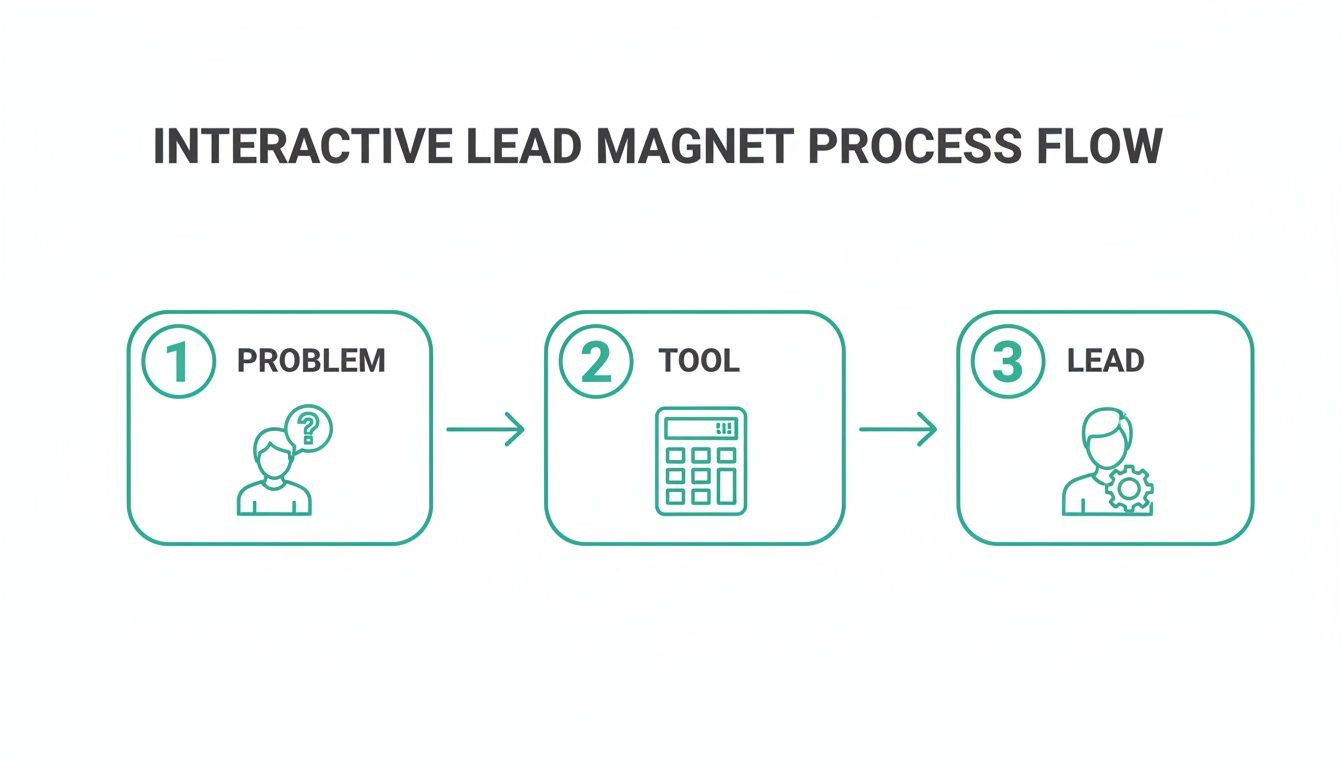
This simple flow says it all: a user has a problem, your tool gives them an instant answer, and in exchange, you get a highly qualified lead who has already experienced the value you provide.
Step 5: Nail Your Distribution and SEO Plan
Creating brilliant content is maybe 40% of the work. The other 60% is making sure people actually see it.
Your distribution plan needs to hit multiple channels. Blast it out to your email list. Share it on social channels—especially LinkedIn for B2B. Find relevant online communities and forums where your ICP hangs out and share it there (without being spammy).
At the same time, you need a rock-solid technical and on-page SEO plan. This means optimising your title tags, meta descriptions, and internal links. It means making sure your site is fast and works perfectly on mobile. Without this technical backbone, even the world's best content will get buried on page five of Google.
Step 6: Plug the Leaks with a Lead Nurturing System
Getting the lead isn't the finish line; it’s the starting gun. Now you need a system to follow up and nurture that interest without dropping the ball. This is where marketing automation becomes your best friend.
Set up automated email sequences that deliver more value based on what they did. The person who downloaded your SEO guide should get a different series of emails than the one who used your ROI calculator.
Don't leave this to chance. For a full breakdown, check out our detailed lead magnet funnel template to map out these crucial follow-up steps. This system ensures every lead is guided smoothly down the path to becoming sales-ready.
Measuring the Real Impact of Your Pull Marketing

Look, a pull strategy that isn't measured is just guesswork. If you want to justify the investment and actually make your approach better, you have to stop obsessing over vanity metrics like page views. It's time to focus on the key performance indicators (KPIs) that actually connect to business growth.
Measuring real impact means tracking how well you attract and convert the right audience.
It’s a mindset shift from sheer volume to proven quality. Sure, big traffic numbers look great in a report, but they’re worthless if those visitors aren’t a good fit for what you sell. Real success is pulling in prospects who are actively looking for a solution like yours and turning them into high-quality leads.
Core Metrics for Your Pull Strategy Dashboard
To get a clear picture of what’s working, you only need to focus on a handful of metrics. These KPIs don't just tell you what's happening; they reveal why it's happening, so you can stop guessing and start making decisions backed by data.
- Organic Traffic Quality: Forget total visitors for a second. Dig into metrics like time on page, bounce rate, and pages per session specifically for your organic traffic. High engagement is a dead giveaway that you’re attracting the right crowd and your content is hitting the mark.
- High-Intent Keyword Rankings: You need to obsessively track where you rank for keywords that scream "I'm ready to buy." Think phrases like "best software for X" or "[your brand] alternatives." Climbing the ranks for these terms has a direct line to lead quality.
- Visitor-to-Lead Conversion Rate: This is one of the most critical health checks for your pull strategies in marketing. It’s the percentage of people who land on your site and actually do something meaningful, like fill out a form. If this number is low, you likely have a mismatch between your content and your call-to-action.
Connecting Pull Efforts to Pipeline and Revenue
Ultimately, your pull marketing has to prove it’s making the company money. This means drawing a straight line from your content and SEO work to actual sales, getting way beyond top-of-funnel fluff to show real business value.
A successful pull strategy doesn't just generate traffic; it builds a predictable pipeline. The goal is to measure the entire journey, from the initial organic search to a closed deal, proving a clear return on your content investment.
Here are the business-level KPIs you should be watching:
- Lead Quality Score: Get in a room with your sales team and create a system to score leads based on their fit and engagement. If the average score from your pull channels is high, you're winning.
- Inbound Customer Acquisition Cost (CAC): This one's simple math. Add up the total cost of your pull marketing (salaries, tools, etc.) and divide it by the number of new customers you got from it. Your goal is to watch this number shrink over time as your organic engine gets stronger.
- Content ROI: You should be able to point to a specific blog post or interactive tool and say, "This asset generated X leads and Y in revenue." This is how you prove the direct financial impact of your work.
In markets where buyers are hesitant, hyper-personalised pull incentives are incredibly powerful. Tailored offers, often guided by data from interactive tools, cut through the noise far better than generic campaigns. As noted in a recent BCG report on European consumer optimism, today's consumers are increasingly selective, making personalised value a key differentiator for brands aiming to earn their business.
Common Questions About Pull Marketing (Answered)
We'll dig into a few of the questions that always come up when marketers start thinking seriously about pull strategies. We'll clear the air on timing, resources, and the classic mistakes people make.
How Long Until I See Results?
This is the big one, isn't it? Let's be straight: pull marketing is a long game, not a quick hack. It’s more like planting a tree than flipping a switch.
Unlike paid ads that deliver traffic the moment you pay, tactics like SEO and building a content library take time to gain traction.
You’ll likely see the first signs of life in 3-6 months. But the real, compounding results—the kind that builds a reliable, cost-effective stream of leads—that usually kicks in after the 6-12 month mark. The payoff for your patience is a marketing engine that grows stronger over time, not one you have to keep feeding money.
Can This Actually Work for a Brand-New Business?
Absolutely. In fact, it's probably one of the smartest moves a new business can make to carve out a space for itself.
When you’re new, you can’t compete on brand name. You compete on value. By zeroing in on niche topics and solving very specific problems for a well-defined audience, you become their go-to resource.
This isn’t about shouting louder than the established players. It’s about being more helpful and building trust from day one, which is how you attract those crucial first customers who believe in what you’re doing.
What's the Single Biggest Mistake to Avoid?
The most common mistake? Giving up too soon. It’s a classic story: a business gets excited, puts in the work for a couple of months, doesn't see an overnight explosion of traffic, and pulls the plug. Pull marketing is all about patience and consistency.
Another killer mistake is making all your content about yourself. A pull strategy crumbles if every article and guide is just a thinly veiled sales pitch. You have to build trust first. The entire approach is built on helping first, selling second. Once you get that sequence right, everything else starts to click.