Your Guide to a Powerful Pull Marketing Strategy
Discover how a modern pull marketing strategy attracts high-intent customers. Learn to build interactive funnels that convert and drive B2B growth.
A pull marketing strategy works like a magnet, not a megaphone. Instead of blasting a message at everyone, you create valuable content and tools that naturally pull in customers who are already looking for what you offer. It’s about building interest organically, making your brand the go-to resource when people need help.
Understanding the Core of Pull Marketing

Think about the last time you had a problem and typed it into Google. You probably clicked on a helpful blog post, a deep-dive guide, or a video that solved your exact issue. That resource didn't find you; you found it. That's pull marketing in a nutshell.
It's all about earning attention instead of buying it. The goal is to set your brand up as the go-to authority in your space. By consistently providing value, you build a foundation of trust long before anyone even thinks about buying something.
The Philosophy Behind the Magnet
The whole idea is to work with how people buy things today, not against it. Modern B2B buyers are researchers. They prefer to find solutions on their own time, on their own terms. Pull marketing respects that by focusing on three key things:
- Solving Problems: Creating content and tools that address the exact pain points your ideal customers are wrestling with. For example, a software company might create a detailed guide on "how to improve team productivity," attracting managers who are actively seeking solutions.
- Building Trust: Offering genuine help and expertise with no strings attached, which makes you credible. A law firm could publish articles explaining complex legal changes, establishing their authority.
- Generating Organic Demand: Making your brand so helpful and visible that customers seek you out on purpose.
This approach creates marketing assets that keep on giving. A high-ranking blog post or a popular tutorial can pull in qualified leads for years, delivering a strong return on the initial time investment.
Pull vs Push Marketing: A Clear Distinction
If pull marketing is the magnet, push marketing is the megaphone. Push tactics are all about broadcasting messages outward, interrupting people with promotional material whether they’re interested or not. For a deeper breakdown, check out our detailed comparison of push and pull marketing strategies.
To make it simple, let's examine the core differences.
| Attribute | Pull Marketing (The Magnet) | Push Marketing (The Megaphone) |
|---|---|---|
| Audience Intent | The customer is actively searching for a solution or information. | The customer is passive and might not even know your product exists. |
| Communication Flow | Two-way and interactive; the customer makes the first move. | One-way and broadcast-style; the brand starts the conversation. |
| Primary Goal | To educate, build relationships, and create long-term brand fans. | To create instant awareness and hit short-term sales targets. |
| Typical Channels | SEO, content marketing (blogs, guides), social media communities, webinars. | TV/radio ads, direct mail, paid social ads, trade show booths. |
Truthfully, the best marketing plans usually mix a bit of both. But understanding the foundational power of pull marketing is the key to building a resilient brand that customers actually want to engage with.
Why Pull Marketing Is a B2B Game-Changer
In the world of B2B, the sales cycle is a marathon, not a sprint. Your customers are researchers. They’re methodical. They’ll spend a huge chunk of time evaluating options on their own, long before they ever want to talk to a sales rep.
This is exactly why a pull marketing strategy works so well. It plays into the way B2B buyers already behave.
Instead of interrupting them with cold calls or yet another display ad, you become the trusted guide they find during their research. You create sharp, insightful content that hits on their specific problems and questions, attracting prospects who are already looking for answers. It’s a strategy built on respect and trust from the very first click.
You'll Start Attracting Smarter, Higher-Quality Leads
One of the biggest wins with a pull strategy in B2B is the sheer quality of the leads it brings in. Think about it. When a prospect finds you through an in-depth guide, a detailed case study, or a genuinely helpful webinar, they're not just a name on a list. They're an educated buyer who has already decided your expertise is worth their time.
These leads are a world apart from the ones you get through outbound tactics.
- They have way higher intent: They’re actively hunting for a solution, meaning they're much further down the buying path.
- They're better informed: They’ve already consumed your content, so they get your value proposition before the first call even happens.
- They cost less to acquire: Yes, there's an upfront investment in content and SEO. But once they're built, these assets work for you 24/7, pulling in leads organically without you having to constantly feed the ad machine.
This all leads to better conversations for your sales team and a pipeline that actually flows. To really dial this in, getting the fundamentals of B2B lead generation right is your critical next move.
You're Building Assets, Not Just Running Campaigns
A pull marketing strategy isn't a short-term fix; it's a long-term investment in a growth engine that gets more powerful over time. Unlike a paid ad campaign that dies the second you stop paying, pull marketing creates assets that actually appreciate in value.
A well-optimised blog post or a cornerstone guide can rank on search engines for years, continuously drawing in relevant traffic and leads long after it's published. This turns your marketing efforts into a compounding source of growth.
These sustainable assets build a serious competitive moat. As your library of helpful content grows, so does your authority. This translates to strong search engine rankings, a loyal audience, and a brand reputation that becomes incredibly difficult for competitors to copy.
An effective lead magnet is crucial for converting this inbound interest. To ensure yours is performing at its best, you can use Magnethive, a free lead magnet audit tool that generates a comprehensive report with AI-powered ideas, analysis of your current magnet, and its potential ROI impact.
Ultimately, pull marketing isn't just a tactic. It’s a strategic decision to build a brand that customers seek out on their own terms, trust, and choose.
Building an Interactive Pull Marketing Funnel
Blog posts and guides are great. They're the foundation. But if you really want to cut through the noise, you have to move beyond just publishing text. The sharpest pull marketing strategies today don't just inform; they invite people to participate. This is where an interactive funnel changes the game entirely, turning passive readers into active users by delivering instant, personalised value.
Instead of just telling prospects how to solve a problem, tools like quizzes, ROI calculators, and diagnostic assessments actually help them solve it, right on the spot. This grabs the attention of high-intent prospects in a way that a wall of text never could, creating a memorable and genuinely useful first impression. The whole dynamic shifts from "Here's some information for you to read" to "Let's figure this out together."
Designing Your Interactive Experience
First things first: you need to nail down a very specific, painful customer problem. What's that one burning question your ideal customer is always Googling? What calculation are they constantly trying to figure out on a spreadsheet? A great interactive tool gives a clear, instant answer to that single critical question.
Once you’ve got the problem, you can map out the experience. This isn't just about asking random questions; it's about creating a logical flow that gathers useful data while giving the user a personalised result that makes them go "aha!"
- Quizzes: These are perfect for segmenting your audience. A B2B software company could build a "What's Your Team's Productivity Score?" quiz to subtly guide different users toward the right product tier based on their answers.
- ROI Calculators: B2B buyers always, always need to justify their spending. An ROI calculator does the heavy lifting for them, instantly showing the potential financial return of your solution. It turns a vague benefit into a hard number they can take to their boss.
- Assessments or Audits: These tools are brilliant for positioning you as the expert. They diagnose a specific problem and spit out a custom report with actionable recommendations, delivering massive value before you've even had a conversation.
The goal is to create a "wow" moment—that point where the prospect gets a genuinely useful insight they didn't have five minutes earlier. That's what makes them far more likely to take the next step and actually talk to your team. To build an effective funnel, it's crucial to create content that addresses specific user needs, often by leveraging long-tail keywords to attract that high-intent traffic.
The visual below shows how this all connects. An effective pull strategy, often supercharged by interactive tools, leads directly to the business outcomes you actually care about.
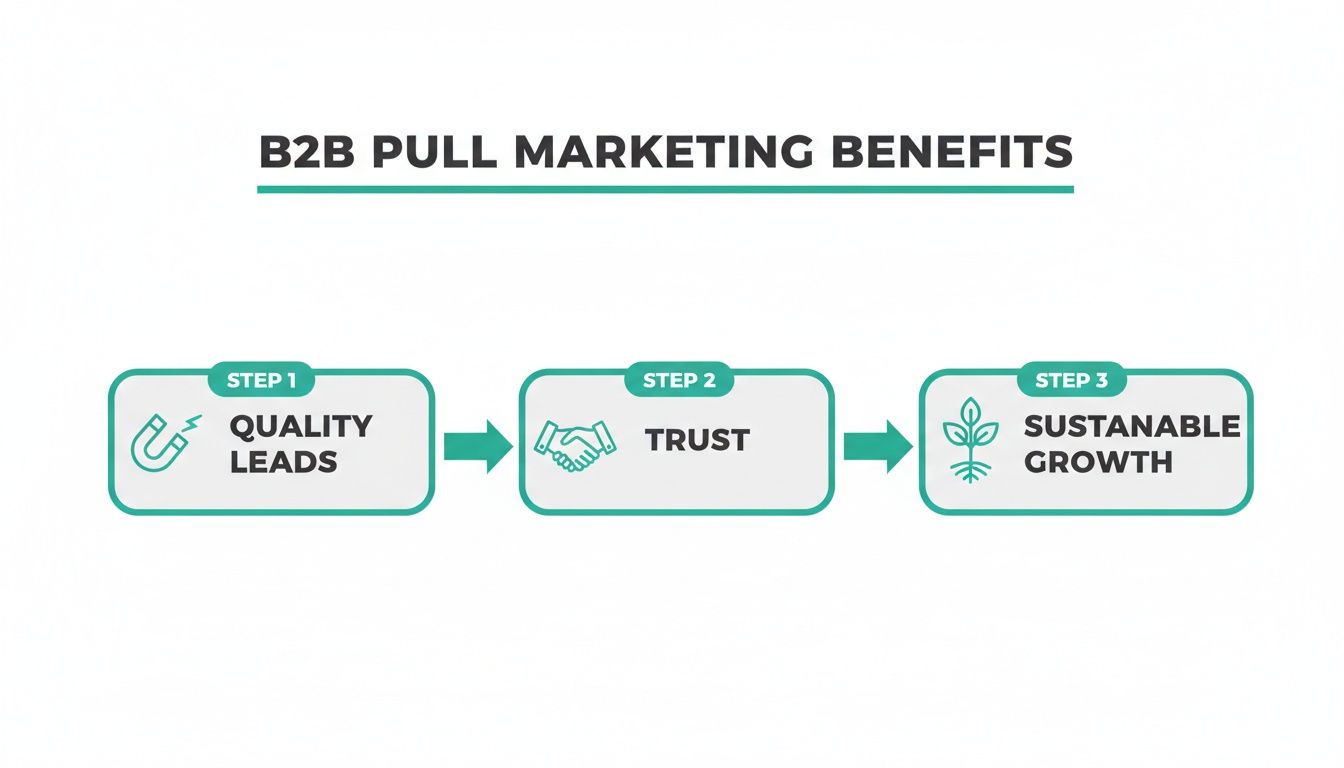
This process shows that when you attract the right people with valuable tools, you naturally build the trust needed for sustainable growth. It’s that simple.
From Interaction to Qualified Lead
An interactive tool isn't just a fancy gimmick on your website; it's a powerful lead qualification machine working for you 24/7. The data you get from the questions isn't just any data. It’s zero-party data—information that customers willingly and actively share. For your sales and marketing teams, this stuff is gold.
Based on the answers a prospect gives, you can score their responses to see just how good of a fit they are.
For example, imagine a diagnostic tool from a marketing agency. A user who says they have a budget over $10,000 and a team of 10+ marketers is a much, much hotter lead than a solo founder who's just getting started. This data lets you automate your follow-up intelligently.
High-scoring leads can be routed straight to your sales team for an immediate, personalised call. Your sales rep already knows the prospect's biggest pain points, their budget, and what they need help with. That makes for a far warmer and more productive conversation. Lower-scoring leads? They can be dropped into a nurture sequence with content that’s tailored to their specific challenges. For a deeper dive into structuring these conversion paths, you can learn more about building effective lead gen funnels that guide prospects from that first click all the way to a sale.
Where to Actually Do Pull Marketing
A brilliant pull strategy is just a nice-sounding idea on a whiteboard until you pick the right channels to make it happen. The secret isn't just listing platforms; it's getting them to work together. Think of it less like a checklist and more like a set of interconnected gears driving your entire inbound machine.
For B2B, there's a killer combo that just works: SEO, content marketing, and community building. When you get these three humming in sync, you create a powerful flywheel. SEO brings people in, your content proves you're the real deal, and your community turns casual visitors into die-hard fans who spread the word for you. It’s a seamless journey from "Who are these guys?" to "I need to talk to them."
SEO: Your Foundation for Getting Found
If people can't find you, you don't exist. Search Engine Optimisation (SEO) is the bedrock of any serious pull strategy. It’s how you make sure you show up the exact moment your ideal customer is frantically typing their problem into Google. Without a solid SEO foundation, even the most groundbreaking content will just gather digital dust.
The goal here isn't just ranking for random keywords. It's about capturing the right kind of traffic. That means getting obsessed with search intent—figuring out the "why" behind what someone is searching for. Are they just kicking tyres and looking for info, or are they ready to pull out the company credit card?
To build this foundation, you need to:
- Target problem-aware keywords: Forget generic terms like "CRM software." Instead, go after the long-tail phrases your customers actually use, like "how to reduce B2B customer churn." That’s where the real pain (and opportunity) is.
- Build topical authority: Don't just write one-off posts. Create clusters of content around your core expertise. This signals to search engines that you're not just a tourist in this topic; you live here. Over time, you'll start ranking for all sorts of related searches.
- Nail your technical SEO: A slow, clunky, mobile-unfriendly website is a non-starter. This isn't the sexy part of marketing, but it's non-negotiable if you want to play in the big leagues and hit those top spots.
Content Marketing: The Engine That Delivers Value
If SEO is the magnet that pulls people in, content is the high-octane fuel that makes them stick around. This is where you deliver on the promise you made in the search results. It’s your shot to prove you know your stuff, build real trust, and guide people toward your solution without being pushy.
Effective pull content doesn't sell—it serves. It answers questions, solves nagging problems, and brings clarity. It positions you as a trusted advisor long before a sales demo ever enters the picture.
Think about creating a massive cornerstone piece of content, like an ultimate guide or a deep-dive industry report. This single asset can become the hub of your whole strategy. It’ll attract backlinks, rank for those juicy keywords, and serve as the perfect entry point to get people using your more interactive tools, like quizzes or ROI calculators. You're moving them from passively reading to actively engaging.
Before we go on, it's helpful to see a direct comparison of where different tactics fall. Here’s a quick breakdown of push versus pull channels to make the distinction crystal clear.
100% Free Lead Magnet Audit
Our AI analyzes your website and delivers custom growth strategies in seconds.
Push vs Pull Marketing Channels At a Glance
| Attribute | Push Marketing | Pull Marketing |
|---|---|---|
| Primary Goal | Generate immediate demand; interrupt the audience. | Attract an interested audience; build long-term trust. |
| Communication | One-way broadcast (Company → Customer). | Two-way conversation (Customer ↔ Company). |
| Core Channels | TV/Radio Ads, Cold Calls, Print Ads, Display Ads, Cold Email Outreach. | SEO, Content Marketing (Blogs, Guides), Social Media Communities, YouTube. |
| Audience Intent | Low to non-existent; often unaware of the problem. | High; actively searching for solutions or information. |
| Typical Tactics | Paid ad campaigns, trade show booths, direct mail, pop-up ads. | In-depth blog posts, interactive quizzes, webinars, ebooks, case studies. |
| Measurement | Impressions, Reach, Click-Through Rate (CTR). | Organic Traffic, Keyword Rankings, Conversion Rate, Lead Quality. |
This table shows the fundamental difference in approach. Push marketing shouts to a crowd, hoping someone listens. Pull marketing sets up a lighthouse, guiding ships that are already looking for a safe harbour.
Social Media: Building Your Tribe and Turning Up the Volume
Finally, it's important to be clear about social media's role in a pull strategy: it's not for blasting your own horn. It's for listening. It's for engaging. It's for building a genuine community around your expertise. Platforms like LinkedIn or niche industry forums are goldmines for understanding what keeps your audience up at night.
Use these channels to share your best content, sure, but also to ask smart questions and just be genuinely helpful. When you consistently show up and solve small problems for free, you build a loyal following. That community then becomes your most powerful amplifier, sharing your stuff and vouching for you without you even having to ask.
The market is already shifting this way, especially for brands that build interactive, mobile-first experiences. It's projected that by 2029, a staggering 63% of all ad spending will be digital, with programmatic ads making up 83% of that revenue. And what does programmatic advertising run on? Relevance and intent signals—exactly what a great pull strategy creates. With 66% of online shoppers already using their phones for purchases, meeting them with valuable, easy-to-use content on their device isn't just a good idea; it's critical. You can explore more insights about digital marketing trends to see where this is all heading.
How to Measure Pull Marketing Success

So, you’ve built this awesome pull marketing machine. Your content is sharp, your interactive tools are bringing in your ideal audience, and things feel like they’re moving. But how do you actually know it’s working?
The success of a pull marketing strategy isn’t about likes, shares, or even raw page views. That’s the old way of thinking. Success today is measured in real, tangible business results.
To show the ROI, you have to look past the flashy, feel-good numbers and zero in on the key performance indicators (KPIs) that connect what you're doing directly to the sales pipeline and revenue. It's about telling the story from the first click all the way to a closed deal. That's how you prove your inbound engine is fuelling growth.
Moving Beyond Vanity Metrics
It's so easy to get distracted by numbers that look good on paper but mean absolutely nothing for the bottom line. Sure, high website traffic is nice, but it's worthless if none of those visitors are actually a good fit for what you sell. The real goal is to measure genuine engagement and conversion, not just eyeballs.
Focusing on the right metrics is everything. Learning how to measure social media success beyond vanity metrics is a great starting point for rethinking how you track your entire pull campaign. True success is all about attracting the right people and guiding them smoothly through your funnel.
These are the core KPIs you should live and breathe:
- Lead Quality: This is your north star. Are the people engaging with your tools and forms actual potential customers? You need a solid lead scoring system based on who they are and what they do to sift the hot prospects from the window shoppers.
- Visitor-to-MQL Conversion Rate: This number tells you how well your content and tools are doing their job—turning anonymous visitors into Marketing Qualified Leads (MQLs). If this rate is high, it means your pull assets are hitting the nail on the head with your target audience.
- Customer Acquisition Cost (CAC): A well-oiled pull strategy should actually drive your CAC down over time. Yes, there's an upfront investment in creating great assets, but their long-term, organic pull makes every new customer cheaper to acquire than if you were just burning money on ads.
Using Data from Interactive Funnels
The data you get back from interactive tools like quizzes, assessments, and calculators is a goldmine. It's way more powerful than just seeing who read a blog post. These tools hand you explicit, zero-party data that tells you a prospect's exact challenges, budget, and where they are in their buying journey.
This isn't just lead generation; it's lead intelligence. The answers a user gives you in a diagnostic tool let you instantly segment them and personalise every single touchpoint that follows. That's how you seriously boost your conversion rates.
You can use this data to create a powerful feedback loop. For instance, if you notice that prospects who answer a certain way in your ROI calculator have a much higher close rate, you can now tweak your content strategy to attract more of those high-value people. Your marketing stops being a guessing game and starts being a data-driven science.
Building Your Measurement Dashboard
To make any of this data useful, you need a single place to see it all—a dashboard that tells a clear story. This isn't just a random collection of charts. It’s a narrative that connects your pull marketing activities to actual business outcomes, from top to bottom.
Your dashboard should paint a picture of the entire funnel.
Here are the key parts to include:
- Top of Funnel (Attraction): Look at things like organic traffic growth, your keyword rankings for the terms that matter, and backlink acquisition. This shows you how well you're pulling in an audience in the first place.
- Middle of Funnel (Engagement): Keep a close eye on the conversion rates of your interactive tools and lead magnets. You'll also want to track MQLs generated per channel to see which platforms are sending you the best leads.
- Bottom of Funnel (Conversion): This is where you connect your marketing data to your CRM. Track your MQL-to-SQL (Sales Qualified Lead) rate, the pipeline generated from pull marketing sources, and, of course, the final ROI of your content.
When you set up a dashboard like this, you're not just reporting on numbers. You're showing everyone in the business how your pull marketing strategy is a predictable, scalable engine for growth. And that’s a conversation every stakeholder wants to have.
Common Pull Marketing Mistakes to Avoid
A pull marketing strategy isn't a quick fix; it's a long-term play. And because you’re building genuine trust and authority from the ground up, a few common mistakes can kill your momentum before you even get started.
Knowing these pitfalls is the first step to building an inbound engine that actually lasts.
The most common error? Impatience. SEO and content marketing are cumulative. They build value over time, like a snowball rolling downhill. Expecting the same instant gratification you get from a paid ad campaign is a surefire way to get disappointed and quit just before things start to compound.
Another critical mistake is creating content that just misses the point. This is what happens when you write about what you want to say, not what your audience needs to hear. Vague, generic content that doesn't solve a real, painful problem for your ideal customer won't attract anyone, no matter how perfectly you write it.
The "Build It and They Will Come" Fallacy
Creating a brilliant asset is only half the job. The idea that people will magically find your amazing work is a complete myth. A massive failure point for many is simply not having a plan to promote and distribute their content.
Without a real distribution strategy, even the best interactive tool or in-depth guide will just sit there collecting dust. You have to get out there and actively put it in front of the people it's designed to help.
- Social Media: Don't just dump a link on LinkedIn. Start conversations around the problem your content solves. Make it relevant.
- Email Newsletters: Your email list is gold. Share your new resources with them to nurture the relationship and encourage them to pass it on.
- Community Engagement: Hang out in the online communities and forums where your audience lives. When the time is right, offer your content as a helpful solution.
Promotion is what breathes life into your work. It's how you make sure all that effort actually finds an audience.
Forgetting to Tell Them What's Next
This last one seems obvious, but it's a killer. You attract thousands of visitors with an incredible blog post, but then... nothing. There’s no clear, compelling call-to-action (CTA) to guide them. All that traffic just hits a dead end.
Every single piece of content needs a logical next step.
Your goal isn't just to attract an audience; it's to guide them on a journey. Without a CTA, you’ve built a road to nowhere, leaving potential leads stranded.
This doesn't always have to be "Book a Demo." A great CTA might be to try your new interactive tool, download a more advanced guide, or subscribe to your newsletter. By giving them a clear path forward, you turn passive readers into engaged prospects and actually move them through your funnel.
Answering Your Burning Questions About Pull Marketing
As you start piecing together your own pull marketing strategy, a few big questions almost always come up. Getting these sorted out early on helps you set the right expectations and, more importantly, build an inbound engine that actually lasts.
Here are the three most common ones marketers ask when making the switch.
How Long Does This Stuff Actually Take to Work?
This is the big one, right? The honest answer is: it takes time.
A pull marketing strategy is a long-term investment, not a quick-win hack. It’s completely different from a paid ad campaign that can send traffic to your site the minute you turn it on. Pull marketing is all about building organic momentum, and that doesn't happen overnight.
You can usually expect to see the first glimmers of traction in about 3 to 6 months, especially if you're consistently creating valuable content and dialling in your SEO. But for your pull strategy to become a truly reliable, predictable source of leads? You need to be thinking in terms of 6 to 12 months, maybe even longer.
The good news is that the results are cumulative. The assets you build today—the quiz, the calculator, the blog post—will keep pulling people in and generating value for years to come.
Can Pull and Push Marketing Work Together?
Absolutely. In fact, the smartest marketing plans almost always blend the two. They aren't opposing forces; think of them as complementary strategies that can seriously amplify each other when used thoughtfully.
Here’s a classic example: You build an incredible, high-value interactive assessment tool (your pull asset). To get it off the ground, you run a highly targeted paid social media campaign (a push tactic) to drive the initial wave of traffic.
The push tactic gets immediate eyeballs on your tool, while the pull asset does the heavy lifting of capturing leads, delivering real value, and starting a long-term conversation. It's a perfect one-two punch that covers both immediate awareness and sustained growth.
What's the Single Most Important Thing to Get Right?
If you stripped everything else away, the one thing that makes or breaks a pull strategy is deep customer understanding. Every single successful pull marketing campaign is built on a rock-solid foundation of genuine empathy for what your customers are struggling with, the questions they're asking, and the goals they're trying to hit.
Without a sharp understanding of what your audience truly needs, your content will be generic, your SEO will target the wrong keywords, and your interactive tools will completely miss the mark. Value is in the eye of the beholder, and you can't create it if you don't know who you're creating it for.