Build High-Converting Lead Gen Funnels That Actually Work
Stop guessing and start converting. This guide breaks down how to build interactive lead gen funnels that attract high-quality leads and drive real growth.
A lead gen funnel isn't some rigid sales process. Think of it more as a guided journey you create for potential customers, taking them from "who are you?" to "take my money." It's all about building trust by offering real value at every step, turning a casual browser into a genuinely interested lead.
So, What Are Lead Gen Funnels, And Why Should You Care?
The old-school TOFU/MOFU/BOFU model feels disconnected from how people actually buy things today. A modern lead generation funnel isn't an assembly line; it's a living system designed to build relationships and give, give, give before you ask for anything.
The whole point is to create a predictable, scalable growth engine for your business.
Instead of just shoving people toward a "buy now" button, the real goal is to nurture them. Each interaction, from the first time they see your ad to the moment they book a call, should help them solve a problem. This customer-first mindset is what separates a funnel that converts from one that just collects dust.
The Big Shift To Interactive Experiences
The old playbook for generating leads is broken. Dangling a static PDF guide in exchange for an email is a tired trick. People are fiercely protective of their inboxes, and frankly, they expect more than a downloadable document they'll probably never read.
This is where interactive content comes in and completely changes the game. We're talking about practical tools like:
- Quizzes: That let users discover something about themselves or their business needs.
- Assessments: That diagnose a specific problem and give them a personalised action plan.
- Calculators: That spit out instant, tangible numbers, like potential ROI or how much they could save.
- Audit Tools: That analyse a user's website or social media profile and give them a performance report.
Here's the secret sauce: interactive content offers genuine, personalised value before the paywall. It transforms a one-sided lecture into a two-way conversation, pulling in higher-intent leads who are already actively looking for a solution.
Before we go deeper, let's explore how this new approach stacks up against the old way of doing things.
How Interactive Content Transforms The Funnel
This table breaks down how dynamic experiences outperform static lead magnets at every single stage of the customer journey.
| Funnel Stage | Traditional Component (Example) | Interactive Component (Example) |
|---|---|---|
| Awareness | Blog post ("5 Ways to Improve SEO") | SEO Score Grader (Analyse your site now!) |
| Interest | Gated PDF/eBook ("The Ultimate SEO Guide") | "What's Your Marketing Maturity?" Assessment |
| Consideration | Case study page | Personalised ROI Calculator |
| Conversion | "Contact Us" form | Interactive Demo Scheduler / Configurator |
| Loyalty | Email newsletter | Customer Health Check-Up Quiz |
See the difference? One is passive consumption. The other is active participation. The results aren't even comparable.
Why This Matters More Than Ever
Smart lead generation isn't a "nice-to-have" anymore; it's a core business function getting massive investment. This is especially true across Europe, where outsourcing lead generation has become a huge growth market.
The global B2B Lead Generation Services Market is set to explode from USD 3.33 billion in 2026 to a whopping USD 9.18 billion by 2035. More telling, European companies that outsource these efforts report seeing 25% higher quality leads and much healthier sales pipelines. If you're curious about these trends, you can explore more insights about European sales outsourcing.
At the end of the day, a well-built funnel brings clarity. It’s your map. It shows you exactly where your prospects are, what they need next, and how you can be the one to give it to them. It’s the blueprint for turning strangers into customers, one valuable interaction at a time.
Architecting Your Interactive Funnel Blueprint
A great lead gen funnel isn't just a random sequence of pages and forms. It's a carefully planned journey. You have to think like an architect—every single element must have a purpose, guiding the user smoothly from one step to the next, all leading towards one clear goal.
Before you write a single question or even think about the landing page design, you need to nail down your primary objective. What's the one action you want a qualified lead to take after they finish your quiz or calculator? Fight the urge to chase multiple outcomes. Clarity is everything.
Define Your Funnel's Core Objective
Your entire strategy lives or dies by this one decision. Are you trying to:
- Book qualified sales demos? If so, the funnel’s job is to pinpoint high-intent prospects and get them booked on a call with sales, fast.
- Generate a list of marketing qualified leads (MQLs)? Here, the focus is purely on capturing contact info from the right people who need more nurturing.
- Drive direct product sign-ups? The journey should flow seamlessly from their personalised results right into creating an account.
A single, measurable goal stops you from building a confusing experience. It becomes the north star for every decision, from the ad copy that kicks things off to the final call-to-action on the results page.
This process is a core part of mapping the user's path. To build something that actually works, you need to understand the big ideas covered in this comprehensive guide to customer journey optimization, which is all about fixing friction and improving every touchpoint.
Choose The Right Interactive Tool For The Job
Once your goal is crystal clear, you can pick the right interactive tool to get you there. The format has to match your business objective and be genuinely helpful to your audience. You're aiming for an experience that feels less like a marketing gate and more like a free, personalised consultation.
A SaaS company selling to finance departments isn't going to see much success with a "What's Your Spirit Animal?" quiz. But a "Financial Close Efficiency Calculator"? That provides immediate, tangible value that speaks directly to their biggest headaches.
Think about these practical scenarios:
- For a B2B SaaS company: A "Marketing Maturity Assessment" can segment leads based on their current struggles and sophistication, teeing them up perfectly for a relevant sales call.
- For a wellness brand: A "Personalised Vitamin Quiz" feels custom-tailored and helpful, offering a unique recommendation that naturally leads to a purchase.
- For a real estate agency: A "Mortgage Affordability Calculator" answers a huge, stressful question for potential buyers, instantly positioning the agency as a trusted guide.
The best interactive tools solve a small, specific problem for the user. They deliver a quick win and build trust in your brand from the get-go. You can find more great ideas by checking out these proven lead magnet funnel examples that show different formats in action.
This diagram shows the simple, three-stage flow of a modern interactive lead funnel.
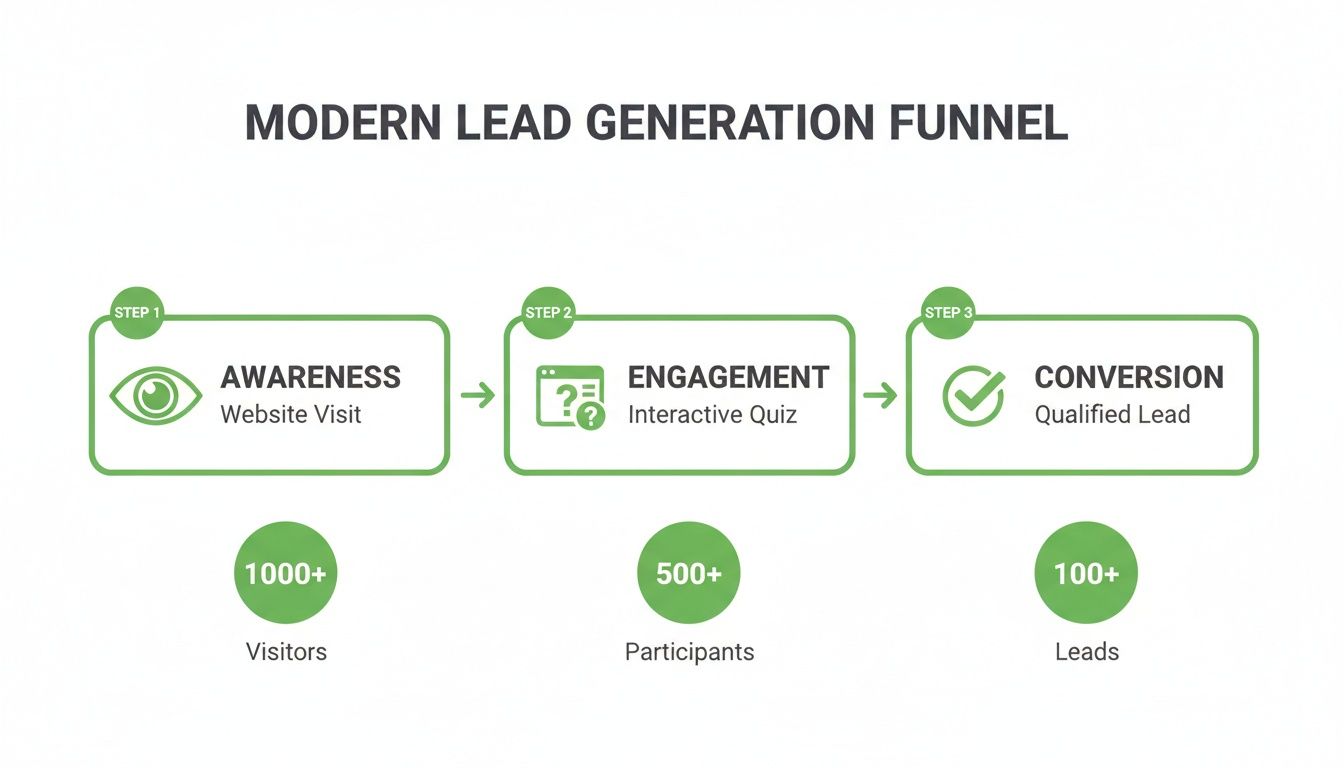
It’s a simple visualisation of how the journey moves from grabbing attention (Awareness) to delivering value (Engagement) before asking for any kind of commitment (Conversion).
Design a Frictionless User Experience
Your blueprint has to prioritise a dead-simple user experience (UX) to keep people engaged from the first click to the final result. High drop-off rates are almost always caused by bad design, not bad content. Let's look at a few simple UX principles that can make a huge difference in your completion rates.
First, use conversational language. Write your questions like you’re talking to a real person, not filling out some corporate form. Ditch the jargon and keep your sentences short and to the point.
Next, always include a progress bar. This little visual cue is brilliant for managing expectations and motivating users to finish. Just knowing you're "80% complete" is a powerful psychological nudge to see it through to the end.
Finally, make sure your funnel is perfectly optimised for mobile. A huge chunk of your traffic will come from smartphones, and a clunky, hard-to-use interface will absolutely murder your conversion rates. The experience has to be just as smooth on a phone as it is on a desktop. No excuses.
Crafting Questions That Qualify And Convert
The real magic of an interactive funnel isn't just the flashy format. It's the conversation you start. The questions you ask are your single biggest chance to gather mission-critical data while giving the user something genuinely valuable in return. This is the moment you transform a generic marketing asset into a powerful qualification machine.
Think about it. A well-crafted question does two things at once: it forces the user to reflect on their own problems, and it hands you the exact information you need to know if you can solve them. It’s a value exchange, not an interrogation.
From Features To Outcomes
Here's where most marketers get it wrong. They ask feature-based questions that feel like a thinly veiled sales pitch. "Are you interested in our project management features?" This kind of question immediately puts people on the defensive. They know they're being sold to.
You have to flip the script. Frame your questions around outcomes and pain points. This psychological shift changes the entire vibe of the interaction. You’re no longer a vendor pushing a product; you’re a helpful expert diagnosing a problem.
Here’s how this plays out in practice:
| Feature-Based Question (Avoid This) | Outcome-Focused Question (Use This) | What You Actually Learn |
|---|---|---|
| "Do you need a better CRM?" | "How much time do you spend on manual data entry each week?" | The real, tangible cost of their current mess. |
| "Interested in our SEO services?" | "What is your biggest obstacle to hitting your organic traffic goals?" | Their specific pain point and how urgently they feel it. |
| "Want to try our new software?" | "Which of these results would have the biggest impact on your business this quarter?" | Their primary business driver and true motivation. |
When you ask about outcomes, you make people feel understood. They stop thinking about your product and start thinking about their problems—which is exactly where their focus should be.
Building Simple Scoring Logic
Okay, so you're asking the right questions. What's next? You need to use those answers to automatically segment your audience. This is where a simple scoring logic comes into play. You just assign points to specific answers based on how strongly they signal a good fit for what you offer.
This isn't some complex algorithm. It's just about assigning value to the data you're collecting.
For example, imagine a marketing agency using a quiz. One question might be, "What is your current monthly marketing budget?"
- Under $1,000: +0 points (Probably not a fit)
- 5,000: +5 points (Potential for a smaller project)
- 10,000: +10 points (Looks like an ideal client)
- Over $10,000: +15 points (High-value prospect, get on the phone!)
By applying this logic across several questions, you can calculate a total score for every single lead. This score then lets you automatically sort them into different buckets. For anyone looking to do this, plenty of powerful online quiz makers have this kind of scoring and logic built right in, so you don't need to code anything yourself.
Segmenting Leads For Personalised Follow-Up
That final lead score is the trigger for everything that happens next. It dictates the entire journey after someone completes your quiz, making sure your sales team’s time is spent on the best opportunities while every lead gets a relevant experience.
The goal isn't just to collect data. It's to create a dynamic experience where the payoff—the results page—feels like a truly personalised and valuable reward for the user's time.
Your segmentation buckets could be structured something like this:
- Hot Leads (Score: 25+): These are the people you want to talk to now. They have the right budget, the right problems, and clear intent. The system should fire these leads straight into your CRM, flag them as high-priority, and send an alert to your sales team for immediate follow-up.
- Nurture Leads (Score: 10-24): This group has potential but probably isn't ready to buy today. Maybe the budget is smaller or the problem isn't urgent enough yet. These leads should be added to a long-term email nurture sequence that keeps providing value and keeps your brand top-of-mind.
- Not a Good Fit (Score: 0-9): Identifying these leads is just as important. It stops you from wasting sales resources on people who will never buy. Pop them onto a general newsletter list to maintain brand awareness, but don't spend active sales time chasing them.
This kind of automated segmentation is the engine of an efficient lead gen funnel. It guarantees every single person who engages gets a tailored response, maximising the value of your inbound traffic and making your entire sales process smarter.
100% Free Lead Magnet Audit
Our AI analyzes your website and delivers custom growth strategies in seconds.
Connecting Your Data And Automating Lead Flow
An interactive funnel is a data-gathering beast, but all that rich data is worthless if it just rots in a spreadsheet. The real magic happens when you connect it to your other systems and get the information flowing automatically. This is what turns a simple quiz or calculator into an intelligent, responsive marketing machine.
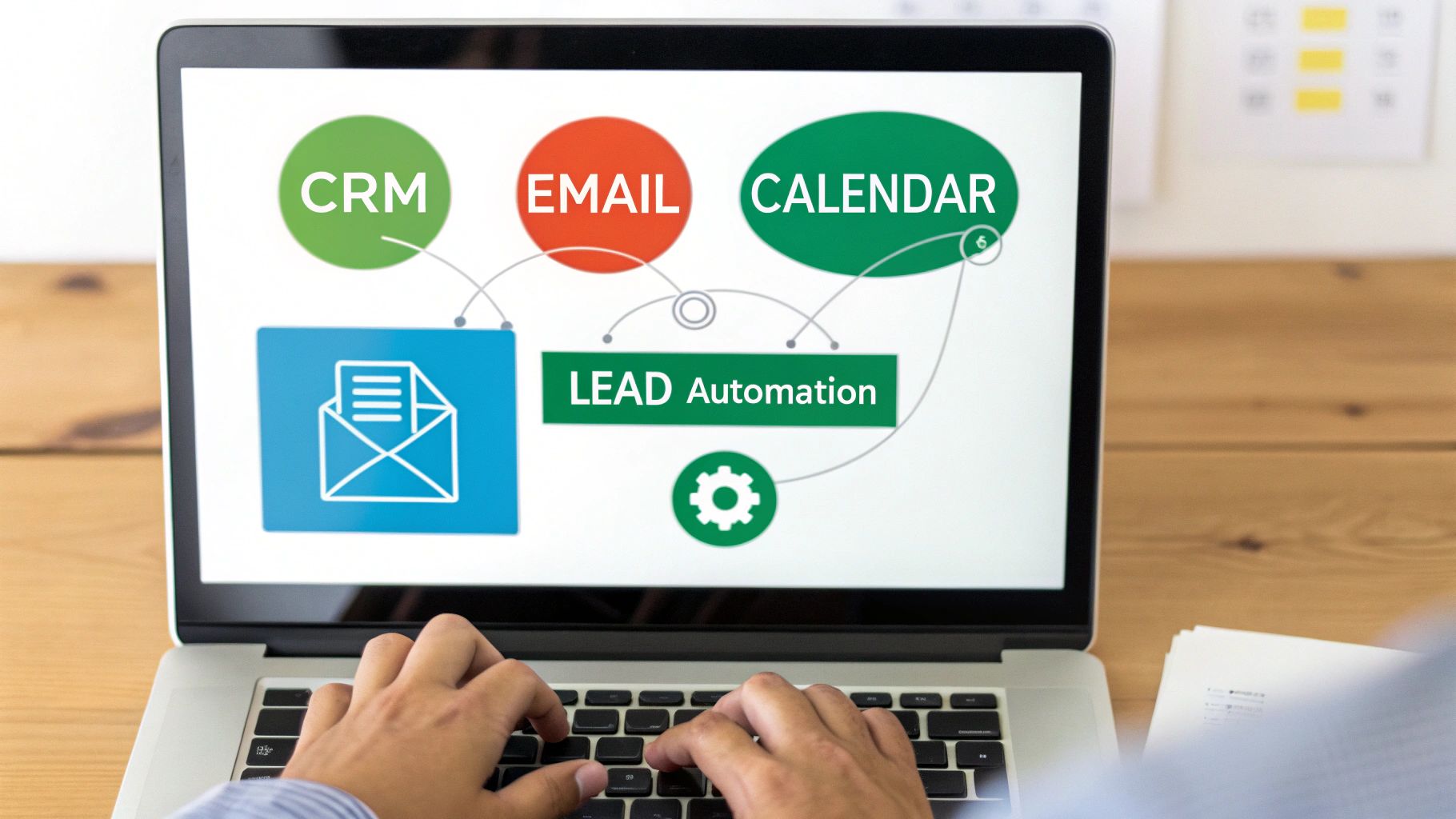
This whole process is about turning raw answers into actionable intelligence, making sure the right people get the right follow-up at precisely the right time.
The Great Gate Debate: When To Ask For The Email
One of the biggest decisions you'll make is when to ask for someone’s email. This is the classic "gate" dilemma, and honestly, there are two main schools of thought. The right answer for you depends entirely on a simple question: are you chasing lead volume or lead quality?
Gate Before Results: If you put the lead form before the user sees their personalised results, you’ll almost always get more leads. A lot more. Curiosity is at its peak; they’ve invested time and want their payoff. The downside? You'll get some lower-quality leads, as people might punch in a fake email just to see their score.
Gate After Results: Showing the user their valuable results first and then asking for their email to get a more detailed report builds massive trust. This tactic usually brings in fewer leads, but boy, are they higher quality. They're giving you their real email because you've already proven your value.
The best way to settle this for your audience? A simple A/B test. Run both versions and look beyond the conversion rate. Track the lead-to-customer rate for each. The data will tell you which strategy is actually more profitable for your business.
Setting Up Intelligent Automation Workflows
The second you capture a lead, the clock is ticking. The data from your interactive tool—especially that calculated score—needs to immediately trigger a chain of automated actions. This is where you plug your funnel into your marketing automation platform or CRM, creating a seamless handover from marketing to sales. You can dive deeper into these critical connections in our guide to integrating marketing automation and your CRM.
The goal is to design workflows that react to a lead's specific score and profile. A high-scoring lead from a target company should get the white-glove treatment, while a low-scoring lead from a student… not so much.
Here’s a practical example of an automated workflow based on a lead's score:
- A user completes your "Marketing Maturity Assessment" and nails a 35/40.
- The system instantly tags this person as a "Hot Lead" in your CRM.
- A notification pings the assigned sales rep on Slack.
- The lead is dropped into a short, punchy email sequence designed to book a demo within 48 hours.
- At the same time, another user scores an 8/40. They get tagged as "Nurture" and added to a 6-month educational email sequence, receiving helpful content with zero sales pressure.
This setup ensures no high-value lead ever goes cold, and your sales team's precious time is spent only on prospects who've shown they're a great fit. To really level up, look into automated PPC funnels with AI to move beyond manual data wrangling.
Enriching Data For Hyper-Personalisation
Automation can also kick off data enrichment. Once you have a business email, you can use services to automatically pull in firmographic data like company size, industry, and the person's job title. This extra context makes your follow-up exponentially more powerful.
In fact, for B2B companies, lead enrichment is becoming a non-negotiable. Enriched leads have been shown to convert 20-30% better than standard ones. They generate 25% more sales-qualified opportunities and can slash customer acquisition costs by up to 15%.
This data allows you to craft hyper-personalised outreach that speaks directly to a lead’s specific role and industry pain points, dramatically boosting your odds of starting a real conversation.
Measuring Your Funnel and Tuning It for Growth
Getting your interactive funnel live is the starting line, not the finish. If you just set it and forget it, you're leaving a ton of money on the table. The real wins come from treating your funnel like a living, breathing asset that you constantly improve based on cold, hard data.
This is where you stop guessing and start knowing. A data-first approach lets you find the exact friction points and make small tweaks that can double or triple your lead quality and conversion rates over time.
The KPIs That Actually Move the Needle
Forget vanity metrics. For an interactive funnel, you need to get surgical and look at the numbers that tell you what users are really doing at each step. These are the metrics you should be absolutely obsessed with.
Here’s what to put on your dashboard:
- Start Rate: What percentage of people who see your quiz or calculator actually answer the first question? If this number is low, your headline is probably weak or your call-to-action is confusing people. It's the first and biggest hurdle.
- Completion Rate: Of all the people who start, how many actually make it to the end? This is your engagement canary in the coal mine. A high start rate but a low completion rate screams that a specific question is too hard, too personal, or just plain boring.
- Lead Quality Score: Based on the scoring logic you built, what’s the average score of the leads you're generating? If it's consistently low, you might be attracting the wrong crowd with your ads, or your scoring system needs a major rethink.
- Cost Per Qualified Lead (CPQL): This is the metric that matters most to your bottom line. Take your total ad spend and divide it by the number of high-quality leads—your "hot" or "A-grade" segments. This tells you exactly what it costs to get a real prospect in front of your sales team.
Tracking these KPIs gives you a crystal-clear view of your funnel's health. You can instantly see where the leaks are and prioritise what to fix first.
A No-Nonsense Framework for A/B Testing
Once you have your core metrics, you can start optimising with a simple, structured approach to A/B testing. The golden rule is to change only one thing at a time. Test a new version against your current one and let the numbers tell you which one won. If you change five things at once, you’ll never know which change actually made the difference.
For instance, your data might show a massive drop-off on question three. Your job is to form a hypothesis. Is the wording confusing? Are you asking for their email too soon? Is it just a boring question?
The point of testing isn't just to get more leads; it's to build a smoother, more intuitive experience for your user. Every test should be designed to answer a specific question about what makes your audience tick.
Here are a few practical A/B tests you can run, tied directly to your KPIs:
| If This Metric Sucks... | Try Testing This... | Your Hypothesis Might Be... |
|---|---|---|
| Start Rate | Your landing page headline or primary call-to-action. | "A headline focused on the immediate benefit will get more people to start the quiz." |
| Completion Rate | The number of questions, or the wording of one problem question. | "Cutting the quiz from 10 questions to 7 will reduce fatigue and boost completion." |
| Lead Quality Score | The scoring logic assigned to each answer. | "Giving more points for budget-related answers will better filter for high-intent leads." |
This cycle of hypothesising, testing, and measuring is what transforms your funnel from a static landing page into a dynamic growth engine.
How AI Is Changing the Optimisation Game
Artificial intelligence is also becoming a massive ally in making these funnels smarter. AI can spot patterns in user behaviour at a scale no human ever could, pointing out optimisation opportunities you'd likely miss.
This is especially true in competitive international markets. Recent reports show businesses are seeing 3-15% revenue growth and 10-20% sales ROI directly from their AI initiatives. For example, AI-driven nurturing is hitting 4.6% conversion rates for professional services—a huge jump from the 1.8% seen in B2B e-commerce. You can dive into the full research on these lead generation trends to see the impact for yourself.
If you’re staring at your data and have no clue where to even start, modern tools can give you a massive head start. For instance, if your current lead magnets are falling flat, a tool like the free lead magnet audit from Magnethive can run an AI-powered analysis to show you exactly where the weaknesses are. It generates a comprehensive report with 3 AI-powered lead magnet ideas, analysis of your current lead magnet, and shows ROI impact, giving you a data-backed roadmap instead of just a gut feeling.
Your Top Questions About Lead Gen Funnels, Answered
Jumping into interactive funnels brings up a ton of questions. I get it. You're ready to ditch the static PDFs and build something that actually pulls in leads, but you want to get it right. Here are the straightforward answers to the questions I hear most often.
How Many Questions Should I Actually Ask?
The sweet spot is usually between 5 and 10 questions. That's enough to gather some seriously useful data for segmentation, but not so long that people get bored and bail. If your quiz feels like a marathon, they'll be gone before you can say "conversion rate."
Now, if you're in B2B and diagnosing a complex business problem, you might be able to push it to 12, maybe even 15 questions. But this only works if every single question builds logically on the last one. You need to create momentum that pulls them toward a highly personalised, super valuable result.
A progress bar isn't a "nice-to-have"—it's essential. Seeing "You're 75% of the way there!" is a powerful psychological nudge. It turns a vague time commitment into a clear, manageable task they can finish.
What Tech Do I Need to Build This Thing?
Good news: you don’t need a team of developers. There are plenty of fantastic, user-friendly tools out there designed specifically for this. Your main criteria should be ease of use and, even more importantly, how well it plays with your existing tech.
Here’s the essential toolkit you'll need:
- An Interactive Content Platform: This is your builder. Tools like Typeform, Outgrow, or LeadQuizzes are brilliant for creating calculators, assessments, and quizzes without touching a line of code. They handle all the logic, design, and data capture for you.
- Email Marketing Software: Your funnel has to feed into something. Whether you use Mailchimp, ConvertKit, or ActiveCampaign, this connection is what lets you automatically drop new leads into the right nurture sequence based on how they answered.
- A Customer Relationship Manager (CRM): For B2B folks, a seamless link to your CRM (like HubSpot or Salesforce) is non-negotiable. It's how you get hot leads straight to your sales team for immediate follow-up while they're still engaged.
The most critical part is making sure these systems talk to each other. A brilliant quiz that doesn't automatically pipe data into your CRM is just a silo. It's a fun distraction, not a lead generation machine.
How Do I Prove This Funnel Is Actually Making Money?
Measuring the ROI of your funnel means looking past simple lead counts. You’ve got to connect your marketing spend directly to revenue to see the real financial impact.
First, calculate your Cost Per Qualified Lead (CPQL). Just divide your total campaign spend (ads, tools, etc.) by the number of high-quality, sales-ready leads you generated. This tells you exactly what it costs to acquire a genuinely valuable prospect.
Next, you need to track those leads in your CRM. You absolutely must know:
- What percentage of these leads actually become paying customers?
- What's the average lifetime value (LTV) of a customer who came through this funnel?
Once you have those numbers, the ROI calculation is simple: ((Total Revenue from Funnel - Total Campaign Cost) / Total Campaign Cost) * 100. This gives you a hard percentage that proves the financial worth of your interactive funnel to anyone who asks.
What Are the Classic Mistakes I Should Avoid?
I’ve seen a lot of well-intentioned funnels fall flat because of a few common, totally avoidable mistakes. Knowing them upfront will save you a ton of time and wasted ad budget. The number one killer? No automated follow-up. You let a qualified, interested lead go completely cold.
Here are a few other classic blunders:
- Asking confusing or ridiculously long questions. This is the fastest way to kill momentum and get people to drop off.
- Putting up the email gate too early. Asking for an email before you've delivered any real value just screams "I want to spam you." It breaks trust instantly.
- Delivering generic, useless results. If the payoff feels like a waste of time, you've not only lost a lead, but you've also damaged your brand's credibility.
- Failing to test and optimise. Your funnel isn't a "set it and forget it" asset. Treat it like a living thing that you constantly tweak and improve over time.