Your Guide to Marketing Automation E Mail
Tired of robotic campaigns? Learn to build marketing automation e mail workflows that nurture leads, feel personal, and drive real business growth.
Let’s be honest. You’ve probably heard that marketing automation is some magical ‘set it and forget it’ solution. But the reality? It often feels like you're wrestling with clunky software to create generic campaigns that fall flat.
You're trying to connect with real people, but those robotic sequences feel totally disconnected from your audience—and frankly, they probably are. This isn’t going to be another guide promising a quick fix for instant success.
Instead, we’re going to get real about what works. The trick is to stop thinking like a marketer and start thinking like a builder—someone who thoughtfully pieces together a system that genuinely helps people. It all starts with one crucial shift in perspective: focus on your customer’s journey, not your sales funnel. That simple change makes all the difference.
The Problem with "Set It and Forget It"
The biggest myth in marketing automation is that you can just switch it on and walk away. This mindset is a trap that leads to stale, impersonal emails that do more to annoy your subscribers than to convert them.
Real success comes from building simple, effective workflows that feel personal and genuinely help people. I've found that when you get this right, automation transforms from a chore into your most powerful communication tool. It’s about creating systems that work for you, not making you work for them.
The goal isn't just to automate tasks; it's to create a responsive, helpful experience that you can scale. Your subscribers should feel like they're having a one-on-one conversation, even when they're one of thousands.
This all hinges on understanding how your automation tools talk to your customer relationship management systems. Properly integrating your marketing automation and CRM is the foundation. It's what allows you to send the right messages based on real, up-to-date customer data.
Here’s a quick overview of the essential building blocks for any effective marketing automation e mail sequence.
Essential Automation Workflow Components
| Component | Purpose | Example |
|---|---|---|
| Trigger | The event that starts the automation. | A new user signs up for my newsletter via an interactive quiz. |
| Action | The task the system performs. | Send a welcome e mail tailored to their quiz results. |
| Delay | A waiting period between actions. | Wait 2 days before sending the next e mail. |
| Condition | A check that splits the path based on user data. | Did the user click the link in the first e mail? |
Think of these as your LEGO bricks. You can combine them in countless ways to build almost any automated experience you can imagine.
Focusing on the Customer Journey First
Let’s reframe the whole goal here.
Stop asking, "How can I automate my sales emails?"
Start asking, "How can I automate a helpful experience for someone who just joined my list?"
This subtle shift puts the user front and centre, which naturally leads to better engagement and, ultimately, better results. To truly get past robotic email automation, you have to get familiar with the latest top email marketing automation strategies.
The industry is clearly moving in this direction, with massive investments being funnelled into smarter, more personalised tech. This isn’t just a passing trend; it's the new standard for communicating effectively.
How to Build Your First High-Impact Workflow
Forget those overwhelming 50-step sequences you see plastered all over marketing blogs. Your first marketing automation workflow doesn't need to be a complex masterpiece. It just needs to solve one specific problem for one specific person.
That’s how you get real results and build momentum.
The goal isn’t to create a tangled mess of logic. It’s to build a clear, direct path that gives your new contact exactly what they need, guiding them from point A to point B in the most helpful way possible.
Start With a Single, Clear Goal
Before you write a single email or even log into your automation software, you need to know your objective. Trying to do too much at once is the fastest way to get absolutely nowhere.
Pick one of these common, high-impact goals to start:
- Welcome New Subscribers: Your job here is to deliver what you promised, build trust, and give them a feel for your brand's personality and best resources.
- Re-engage Dormant Contacts: The goal is to gently remind inactive subscribers why they joined your list and give them a compelling reason to stick around.
- Follow Up After a Content Download: You want to make sure they actually use the resource they downloaded, then guide them to the next logical step in their journey with you.
This infographic breaks down the core process of building a thoughtful email automation workflow.
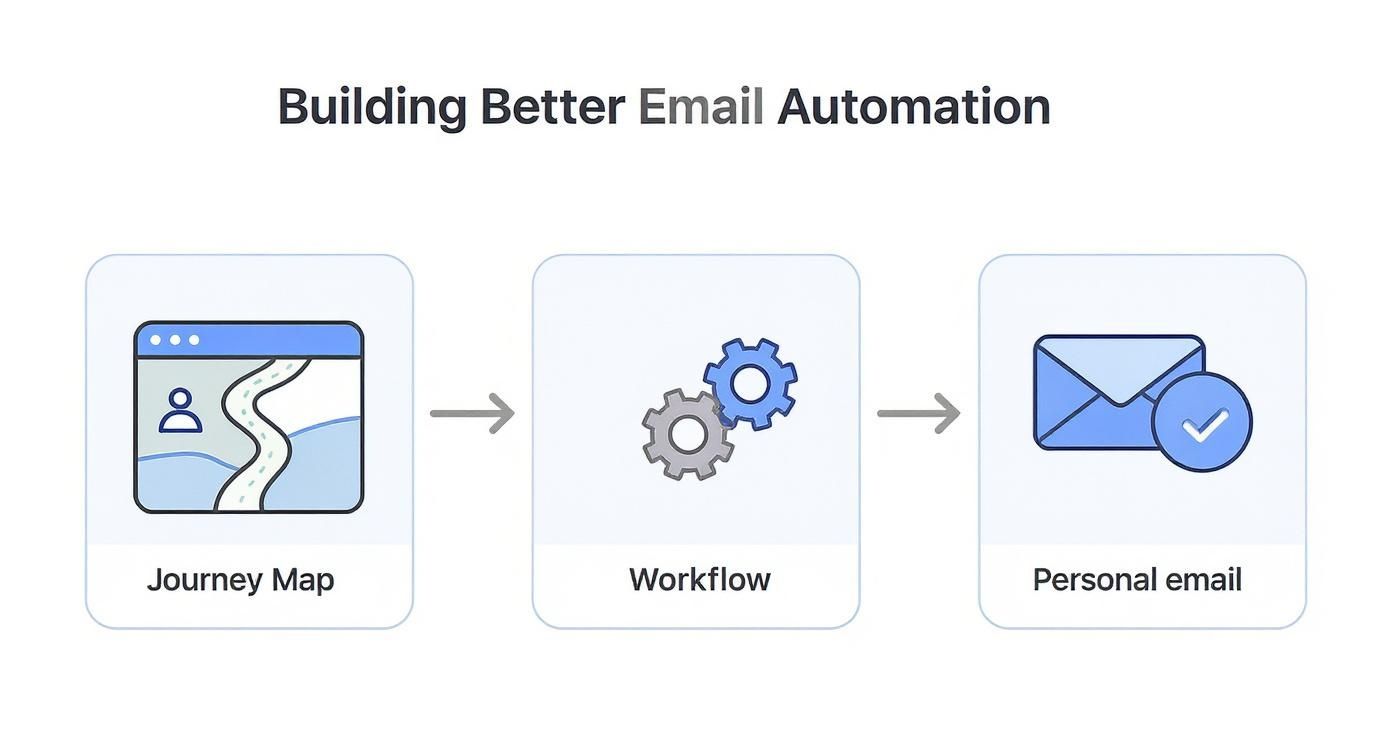
As you can see, it all starts with understanding the customer's path. That understanding is what shapes the workflow's structure and the personal feel of each email.
Mapping Out a Simple Welcome Series
Let’s use a welcome series as a real-world example. Imagine someone just signed up for your newsletter to get a free guide.
Here’s what the workflow logic could look like:
- Trigger: A new contact is added to your "Newsletter Subscribers" list.
- Immediate Action: Send Email #1. This email delivers the guide instantly. It's a warm welcome that sets expectations for what’s next. Keep it short and to the point.
- Delay: Wait 2 days. This gives them time to breathe and actually check out the guide you sent. Don't rush it.
- Action: Send Email #2. This follow-up could share a related, high-value blog post or a quick tip that complements the guide they downloaded. You're just providing more value, no strings attached.
- Delay: Wait 3 days.
- Action: Send Email #3. Now you can share a customer success story or a case study that subtly shows the value of your product or service.
The power of this simple sequence is all in the timing and relevance. By focusing on value first, you build a relationship before you ever even think about asking for a sale.
The data backs this up. Automated welcome emails have been shown to crush standard campaigns, with open rates consistently higher than bulk newsletters.
The key is to write emails that sound like they came from a real person, not a robot. Use a conversational tone, ask questions, and focus on being genuinely helpful. This is how you build a solid lead generation system that nurtures interest without being pushy.
Your first workflow is your chance to prove there's a real, caring human behind the brand.
Why Your PDF Lead Magnet Is Holding You Back
I’m going to say something that might sound a little controversial: your static PDF lead magnet is probably killing your automation’s potential before it even has a chance.
Think about it. We’re all drowning in static content. How many “Ultimate Guides” have you downloaded that are now just collecting digital dust in some forgotten folder on your computer? Your readers are no different.
The secret to powerful marketing automation isn’t just about having clever follow-up sequences. It’s about fuelling that system with highly engaged leads from the very first click. And honestly, static PDFs just don't create that initial spark.
The Shift to Interactive Engagement
This is where interactive content completely changes the game. Forget offering another downloadable checklist. Imagine instead using a quick quiz that segments new leads by their biggest challenges, or a calculator that delivers instant, personalised value. Even a simple, well-crafted tool can generate incredible leads and traffic.
These aren't just fancy gadgets. They're powerful conversation starters.
- Quizzes: A simple quiz can tell you a new lead’s pain points, industry, or experience level. That data is absolute gold for personalising their welcome sequence. You can even check out how a free personality assessment can be structured to gather these kinds of insights.
- Calculators: An ROI or savings calculator gives someone an immediate, tangible result tied to their specific situation. They get instant value, and you get a lead who has already pictured your solution in action.
- Audit Tools: A tool that analyses a person's website or current setup provides massive value upfront. It positions you as an expert from the very first interaction, not just another voice in their inbox.
These tools don't just capture an email address; they start a dialogue. They provide you with powerful zero-party data—information your leads willingly hand over—which you can use to make the very first email they receive feel incredibly personal and relevant.
100% Free Lead Magnet Audit
Our AI analyzes your website and delivers custom growth strategies in seconds.
Why Better Leads Matter More Than More Leads
I've seen it firsthand. A simple interactive tool generates not just more leads, but much, much better ones. These are people who are already invested and curious to hear from you because you've already helped them in a small but meaningful way.
When a new subscriber's first experience with you is interactive and value-driven, they're not just a passive name on a list. They're an active participant in a conversation you've already started.
This fundamentally changes the entire dynamic of your email automation. You’re no longer sending messages into the void to a cold lead. You're continuing a conversation with someone who has already raised their hand and told you exactly what they need help with.
Your automation becomes a natural next step in that value exchange, making it far more likely to actually work.
How to Personalise Emails That Feel Authentic
Everyone talks about personalisation, but most marketers are still stuck in 2005. Dropping a first name into a subject line isn't personalisation; it’s a mail merge. True personalisation is about using real data and behaviour to deliver the right message at the perfect moment.
This is the fine line where your marketing automation e mail strategy can feel either genuinely helpful or just plain creepy. The goal is to make thousands of people feel like you're speaking directly to them, one-on-one. And you don't get there with generic demographic data, but with real, actionable insights.

Go Beyond Basic Segmentation
Forget segmenting by job title or company size for a second. That stuff is a decent start, but it’s not where the magic happens. The most powerful segmentation comes from what people do, not just who they are.
Think about segmenting your audience based on these kinds of actions:
- How they signed up: Someone who came from an interactive quiz about "scaling your business" has completely different needs than someone who downloaded a "beginner's guide to marketing."
- Links they've clicked: Pay close attention to the topics in your emails that get their attention. This is a direct signal of their immediate interests and pain points.
- Pages they've viewed: If a user keeps coming back to your pricing page or a specific product feature page, that's a massive indicator of intent.
This level of detail lets you tailor your automated follow-ups with incredible precision, making sure every message actually lands.
Setting Up Simple Behavioural Triggers
You don’t need some ridiculously complex system to get started with this. Most modern email platforms let you create simple branching logic based on triggers. A "trigger" is nothing more than a specific action a user takes.
For instance, say you send an email with links to two different articles: one on "beginner strategies" and another on "advanced techniques."
Your automation can be set up with a simple if/then rule. If a user clicks the "beginner" link, they get tagged as a novice and moved into a follow-up sequence that nurtures them with foundational content. But if they click the "advanced" link, they get a totally different sequence packed with expert-level insights and case studies.
This isn't just theory; it's a practical way to let your subscribers self-segment. You're not guessing what they need—they are telling you with every single click.
By building these simple branches into your automations, you create a responsive system that adapts to each person's journey. For a deeper dive into crafting emails that truly connect, you might want to explore these effective personalization strategies. This is how you build an email list that not only sticks around but actually looks forward to hearing from you.
Analysing and Optimising Your Email Automations
Getting your automation live isn't the finish line. It's the starting gun.
The real work—the part that turns a decent sequence into a growth engine—starts when you get your hands dirty with the data. It's easy to get excited about high open rates, but honestly, they’re mostly a vanity metric. They don't tell you much about what’s actually driving results.
True growth comes from obsessing over engagement and conversion. I’ve learned the hard way to ignore the fluff and dig into the performance of every single workflow I build.
Metrics That Actually Move the Needle
For every automation, I keep a close eye on a handful of KPIs that paint a clear picture of its health. Forget the surface-level numbers; these are the metrics that give you actionable insights and tell the real story of your marketing automation e mail performance.
Here’s what you should be watching:
- Click-Through Rate (CTR) on Specific Links: Don't just look at the overall CTR. Which specific links are people actually clicking? This tells you exactly what’s resonating with your audience right now.
- Unsubscribe Rate at Each Stage: Seeing a big drop-off after email #3? That email is almost certainly the problem child. Tracking this helps you pinpoint weak links in your chain with surgical precision.
- Final Conversion Rate: This is it. The ultimate measure of success. Did the workflow do the one thing you built it for? Whether it’s a sale, a demo booking, or a consultation call, this is the number that ties your effort to revenue.
Turning Guesswork Into a Data-Driven Process
Systematic A/B testing is your best friend here. Instead of throwing a bunch of changes at the wall and seeing what sticks, test one element at a time. This is how you get clear, undeniable insights. You could test a different subject line, a new call-to-action, or even just a slight tweak in your email’s tone.
The point of optimisation isn't just to make numbers go up. It's to understand what your audience truly wants and needs. Every test is a chance to listen.
But here's a part people often miss: auditing your entry point.
If a workflow is underperforming, the problem might not be the emails themselves. It might be the lead magnet that’s feeding the entire machine. Is it attracting the right kind of people? A weak entry point will always lead to a weak automation. Before you spend weeks tweaking copy, it pays to analyze your initial offer. A resource like Magnethive’s free lead magnet audit tool can generate a comprehensive report, providing AI-powered ideas and ROI analysis, which helps ensure your automations are fuelled by high-quality, engaged leads from the get-go.
This data-driven approach turns optimisation from a guessing game into a predictable process for improvement, and it's a critical piece of the puzzle in a market that's only getting bigger.
Your Top Marketing Automation Questions, Answered
Diving into email automation can feel like you're trying to solve a puzzle where the pieces keep changing shape. As you get your hands dirty building, testing, and tweaking your workflows, you’re going to have questions.
I’ve been there. So, I’ve pulled together a few of the most common ones I hear (and have asked myself). Think of this less as a rulebook and more as a field guide to help you navigate your own setup.
How Many Emails Should I Put in a Welcome Sequence?
There's no golden rule here, but a solid starting point is three to five emails sent over the first week or two. The goal isn't to bombard them; it's to build a connection and deliver on your promise without making them hit the unsubscribe button.
Your first email needs to go out instantly. Its one and only job is to deliver whatever you promised them (the PDF, the quiz result, the discount code) and give a genuine welcome. From there, your next emails can tell your brand's story, share some of your most helpful content, or tackle a problem you know they have. Only then should you think about a soft call-to-action.
Stop obsessing over the number of emails and focus on the job of each one. Every single email should have a clear purpose that moves your new subscriber one step closer to becoming a fan.
What Is the Biggest Mistake in Email Automation?
I might get some heat for this, but the biggest mistake isn't a technical glitch. It's making your automation all about you. It's trying to hard-sell from the very first email.
People have a finely tuned radar for a sales pitch. It’s an immediate turn-off.
Truly effective automation focuses entirely on the customer. It's about their challenges, their goals, and where they are in their journey. So many marketers get stuck trying to engineer some massive, 30-step workflow before they've even confirmed a simple one works. That’s a fast track to burnout and crummy results.
Start small. Focus on giving real value. See what the data tells you. Then you can start adding more layers.
Can Automated Emails Actually Feel Personal?
Absolutely. But you have to change how you think about your tools. If you see your email platform as just a machine for blasting out messages, they will always feel cold and robotic.
The secret is to use it as a tool for listening.
This is why the data you collect upfront is so critical. Say someone signs up through an interactive quiz you built. You don't just have their email; you know their biggest pain point right from the start. That lets you segment them immediately and send a follow-up that speaks directly to that problem.
The best automation doesn't feel automated. It feels like a timely, helpful conversation that proves you were paying attention from their very first click.