Your Guide to a High-Converting Lead Magnet Funnel
Build a lead magnet funnel that actually converts. Learn how to replace static PDFs with interactive experiences that capture high-quality leads.

A lead magnet funnel isn't just a fancy term for a download page. You know the feeling—you need leads, but the old methods just aren't cutting it. A real lead magnet funnel is a deliberate journey you create, guiding someone from their very first click on your freebie to becoming a genuinely qualified lead. It uses a valuable, interactive resource—like a quiz or calculator—to capture an email, sure, but more importantly, to kick off a relationship with smart, targeted follow-ups.
Why Your Static PDF Is Quietly Killing Your Lead Generation
You’ve been there. You poured your soul into creating the perfect PDF, a killer checklist, or a comprehensive e-book. You were convinced this was the thing that would finally open the lead floodgates.
Instead? Crickets. Or worse, a list of junk emails from people who vanish the second they get your download. They never open another email, never click another link.
Look, this isn't on you. You're just stuck in a broken model. It’s the classic "download and ghost" trap that so many marketers fall into. The old way of just handing over a static PDF doesn't work anymore.
The Problem with Passive Downloads
Think about it. A PDF download is a dead end. It’s a one-way transaction that’s over the moment they grab your file. There's no conversation. No real data exchange. You're left with an email address but no clue about their challenges, their budget, or what they actually need.
This passive approach is failing you in a few critical ways:
- It Attracts Hoarders, Not Buyers: You’re building a list of digital collectors who love free stuff but have zero intent to ever buy.
- It Gives You Zero Qualification Data: You learn absolutely nothing about the lead. Are they a student? A CEO? A perfect fit? You have no idea, so everyone gets the same generic, ineffective follow-up.
- It Kills Engagement Instantly: The conversation ends before it even has a chance to start. The lead is left to read your PDF on their own time… if they ever open it at all.
Here's the hard truth: A static lead magnet fills your CRM with noise, not potential customers. It makes it almost impossible to find the real buyers hidden in a list of disengaged contacts.
If you’re still banking on this strategy, you’re leaving a massive amount of opportunity on the table. In fact, you can read more about why so many businesses are ditching traditional PDF lead magnets for something far more powerful. The good news? There’s a much smarter way to build your lead magnet funnel.
Instead of a one-off download, imagine starting an active conversation from the very first click. That’s the magic of interactive content—a simple quiz, an assessment, or an audit tool. It transforms your monologue into a dialogue, delivering immediate, personalised value to your visitor while giving you the rich data you need to qualify and nurture them into actual customers.
Mapping an Interactive Lead Funnel That Converts
Before you build anything, you need a blueprint. But let's ditch the complicated flowcharts that look like a tangled circuit board. This isn’t about mapping a rigid path of clicks; it’s about mapping a conversation. You’ve got to design a journey that feels natural to your visitor, not a maze you're forcing them through.
The single biggest mistake I see? People start at the beginning—with the ad or the landing page. Wrong. You have to work backwards.
What’s the one action you want a truly qualified lead to take? Book a demo? Start a trial? Buy something?
Start with that end goal firmly in mind. Everything you build before that moment is purely to guide the right person toward it. This simple shift in perspective changes everything about how you build your funnel.
Designing a Value-First Journey
Once you know the final destination, you can map out the stops along the way. Each step in your funnel needs to deliver a micro-dose of value. You're building trust and momentum with every single interaction, not just throwing up a gate in front of your content.
This is exactly where static PDFs fall apart. The journey is abrupt: they land, they download, they vanish into thin air. There's no conversation, no segmentation, and definitely no qualification. You’ve just traded a file for an email address with zero context.
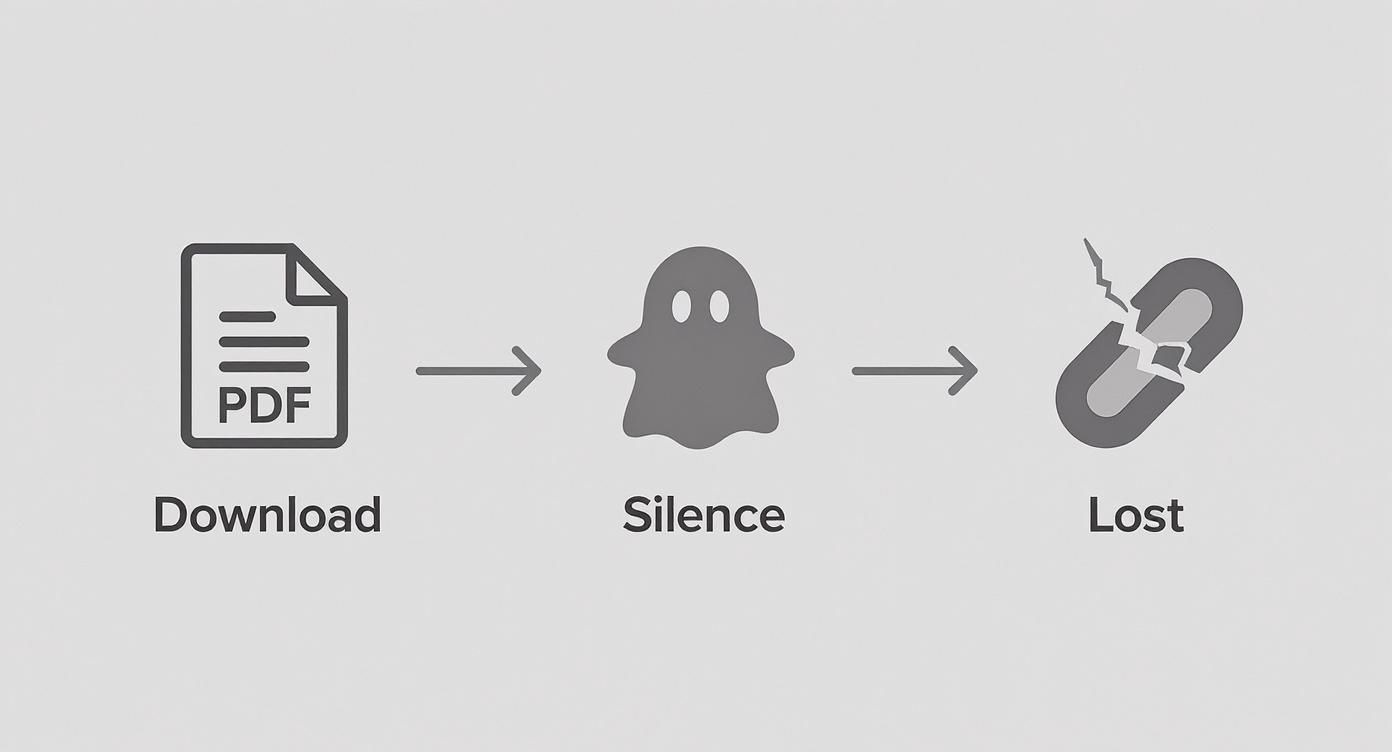
This image nails the core problem: the path dies right after the download. You're left with a cold contact and no meaningful data.
An interactive funnel, on the other hand, builds the path as the user walks it. Each question answered is a stepping stone that provides you with crucial data while giving the user an immediate, personalised insight. It’s a genuine exchange of value.
Key Milestones in an Interactive Funnel
Let's break down what this conversational journey actually looks like. Instead of one big ask ("Give me your email for this huge guide"), you create a series of smaller, low-friction steps.
- The Hook (The First Interaction): Don't lead with an email form. Ever. Start with a single, compelling question. For a marketing agency, it might be: "What's your biggest marketing challenge right now?" It's low-commitment and gets the user thinking immediately.
- The Diagnostic (The Core Tool): Based on their answer, you roll out the main event—a short quiz, a calculator, or an assessment. If they chose "Lead Generation," your tool could be a "Lead Quality Score Calculator." This is where you gather the critical data for segmentation.
- The Reveal (The Results Page): This is the moment of truth. You deliver the personalised result they’ve been waiting for. The results page must provide genuine value and a clear interpretation of their score. No fluff.
- The Next Step (The Call-to-Action): With trust established, this is where you present your main CTA. It's no longer a cold ask; it's the logical next step based on the insights they just got. For example: "Book a free strategy call to improve your 42/100 lead score."
Mapping your funnel this way transforms it from a lead capture mechanism into a lead qualification engine. You’re not just collecting contacts; you’re identifying problems and guiding prospects toward a solution they now realise they need.
If you’re struggling to visualise this for your own business or don’t know where the gaps are, a helpful first step can be getting an objective analysis. For instance, the free lead magnet audit tool from Magnethive generates a comprehensive report on your current lead magnet, provides AI-powered ideas for interactive tools, and shows you the potential ROI impact of making a change.
Crafting Your Irresistible Interactive Lead Magnet
It’s time to stop making things your audience has to read and start building experiences they actually want to use. This is where we ditch the generic PDF downloads and create something that feels less like a marketing gate and more like a genuinely helpful tool.
The psychology here is dead simple, but powerful. A quiz titled ‘What’s Your Marketing Blind Spot?’ is infinitely more compelling than a PDF guide on the same topic. One is passive consumption; the other is an active, personalised journey of discovery.

This shift changes the entire dynamic of your funnel. Instead of a transaction (email for a file), you’re kicking off a conversation that provides instant, tangible value right from the first click.
Focus on Personalisation and Instant Wins
The real magic of an interactive lead magnet is its ability to deliver a personalised result. It's a unique insight that makes the user feel seen and understood, solving a tiny piece of their problem on the spot. Static content just can't compete.
Think about these practical examples:
- An ROI Calculator: A SaaS company builds a simple tool that estimates a user’s potential savings by using their software. The user plugs in their own numbers and gets a custom report.
- A Diagnostic Assessment: An agency offers an assessment to help a business pinpoint its biggest operational bottleneck. The result isn't a generic list of problems; it's their specific problem, now clearly identified.
- A Configuration Tool: An e-commerce brand selling custom furniture builds a tool that helps users design their ideal setup, capturing their exact preferences as valuable lead data.
The secret is to deliver a "mirror" effect. Your tool should reflect the user's own situation back to them with newfound clarity. This is the moment trust is born.
Of course, the success of your tool still hinges on your ability to build a high-converting lead capture form, but the dynamic is different. With interactive tools, you gate the result, not the experience. This gets the user far more invested and willing to hand over their details to see what they've uncovered.
Interactive vs Static Lead Magnet Comparison
To really drive the point home, here's a side-by-side comparison. The difference isn't just in the format; it's in the entire user experience and the quality of the data you receive.
| Feature | Static Lead Magnet (e.g., PDF) | Interactive Lead Magnet (e.g., Quiz/Calculator) |
|---|---|---|
| User Engagement | Passive (Reading) | Active (Participating) |
| Personalisation | General, one-size-fits-all | Highly personalised, custom results |
| Value Delivery | Delayed (Must read to find it) | Instant (Immediate feedback/results) |
| Data Collection | Basic (Email, maybe name) | Rich (Problems, goals, budget, needs) |
| Lead Qualification | Low (Indicates curiosity only) | High (Indicates specific intent and pain) |
| Follow-up Potential | Generic | Hyper-relevant and segmented |
As you can see, interactive tools don't just generate a lead; they generate an intelligent, qualified lead that you can have a meaningful conversation with.
The Problem with Most Lead Magnets Today
Most lead magnets are built for the company, not the customer. They’re designed to harvest emails, with the user's actual needs being a total afterthought. This is why so many of them fail to turn leads into actual customers.
An AI-generated PDF, slapped together in an afternoon, just screams low value. It's a box-ticking exercise that tells your audience you're willing to cut corners. Interactive tools, even simple ones, show you've invested real thought into solving their problems and can generate leads and traffic far more effectively.
And think about the data. A PDF download tells you one thing: someone was curious enough to click a button. An assessment tells you their biggest challenges, their current setup, and their goals. Which lead is more valuable? It’s not even a contest.
Turning Interaction into a Conversion Machine
Capturing the lead is just the starting line. The rich data you get from your interactive tool is pure fuel for a hyper-relevant follow-up system. You've just learned something specific about your lead—use it.
- Segment Based on Outcomes: Did the user get a "low score" on your assessment? Their automated follow-up sequence should focus on foundational education. A "high score" lead might be ready for a more advanced, solution-focused message.
- Personalise the First Email: Your first email shouldn't just deliver the results. It should reference their specific outcome. For example, "Your results showed 'lead generation' is your biggest bottleneck. Here are three quick tips to fix that..."
- Route High-Intent Leads: If a user’s answers flag them as a perfect-fit customer (e.g., they have the right budget, the right problem, and high urgency), your system should route them directly to sales for immediate, personal outreach.
This approach creates a seamless bridge from the first interaction to a deeper conversation. The lead feels understood because your follow-up is directly tied to the information they just willingly shared. It's this systematic process that transforms your lead magnet funnel from a simple list-builder into a powerful conversion machine. A great place to start is by understanding the mechanics of a powerful lead magnet generator and the tools behind it.
How to Build Your Funnel Without Writing Any Code
The idea of 'building' a funnel sounds technical and expensive, right? It brings up images of developers, complex code, and a budget that makes your eyes water. I've been there. I know that feeling of intimidation is what stops most people dead in their tracks.
But I'm going to say something that might sound a little controversial: if you still think you need a developer to create a high-converting funnel, you're working with a seriously outdated playbook.
The game has completely changed.
Modern tools have made this whole process accessible to everyone. You can now build incredibly powerful and slick quizzes, calculators, and assessments using simple drag-and-drop interfaces. You don’t need to write a single line of code to create an experience that feels custom-built and delivers massive value.
The Three Essential No-Code Components
At its heart, a killer no-code interactive funnel really only has three parts. Nail these three, and you've won 80% of the battle. And you can assemble them all without any technical skills whatsoever.
- The Compelling Landing Page: Think of this as your digital storefront. Its only job is to get someone curious enough to start your interactive tool. Keep it clean. It just needs a killer headline, a quick sentence on the value they'll get, and one big, obvious button to kick things off.
- The Interactive Tool Itself: This is where the magic happens—the quiz, calculator, or assessment. Your goal is to make this part feel smooth, engaging, almost like a game. The user should feel like they're on a journey of discovery, not just filling out a boring form.
- The High-Value Results Page: This is the payoff. After they've given you their email to see their results, this page has to deliver. It must provide an instant, clear, and valuable insight based on their answers. And just as importantly, it needs to guide them to the next logical step with a strong call-to-action.
100% Free Lead Magnet Audit
Our AI analyzes your website and delivers custom growth strategies in seconds.
Proven UX Patterns That Actually Drive Conversions
Building the funnel is one thing; getting it to convert is another entirely. The beauty of modern no-code builders is that many have proven user experience (UX) patterns baked right in. You just need to know which ones to switch on.
The best funnels don't feel like funnels at all. They feel like a helpful conversation. Your user should be so engaged in the process that they forget they're being 'marketed to'.
Focus on these simple but powerful UX elements:
- Progress Bars: This is non-negotiable. A visual progress bar shows people exactly how close they are to the finish line, and it dramatically increases completion rates. It gamifies the whole thing and stops people from bailing halfway through.
- One Question Per Screen: Never, ever overwhelm your user with a long list of questions. Serving up one clear question at a time keeps them focused and moving. It feels less like an interrogation and more like a simple chat.
- Mobile-First Design: It's 2024. Most people are going to find your tool on their phone. Make sure every button, every bit of text, and every input field is big, clear, and easy to tap on a small screen. Test it on your own phone before it goes live.
Seamlessly Automating Your Follow-Up
The final piece of this no-code puzzle is hooking your shiny new tool up to your email marketing platform. This is what turns a one-off interaction into an automated lead nurturing machine that works while you sleep.
Pretty much every reputable interactive content builder out there offers direct integrations with platforms like Mailchimp, ConvertKit, and HubSpot. Setting this up usually just means copying and pasting an API key. It’s a five-minute job.
Once you’re connected, you can set up rules that automatically sort your new leads. For example, anyone who scores as a "Beginner" in your assessment can be automatically dropped into an educational email sequence. This simple automation is proof you don’t need to be a developer to build a truly intelligent and effective lead gen engine.
You can see just how powerful this can be by checking out our guide on building a no-code SEO audit tool for lead generation.
Turning Captured Leads Into Valued Customers
Getting a new lead is just the starting gun—it’s not the finish line. The real magic of an interactive lead magnet funnel isn't just snagging an email address; it's the rich, contextual data you get alongside it. This is what lets you follow up in a way that’s actually relevant.
Think about it. A generic PDF download tells you next to nothing about a person's real problems. A quiz, on the other hand, can reveal their biggest challenges, their skill level, or what they want to achieve right now. This is the zero-party data that turns your marketing from a shot in the dark into a precision strike.
This part is all about putting that data to work.

It’s about evolving that first click into a genuine, long-term relationship that naturally guides them toward becoming a customer.
From Data Points to Meaningful Conversations
Most lead nurturing is just spam with a prettier name. Why? Because it’s one-size-fits-all. Everyone who grabs your PDF gets the exact same five-part email sequence, no matter who they are or what they need. It’s lazy marketing, and your audience can smell it from a mile away.
Interactive tools flip this script entirely. The data you gather lets you segment your audience with surgical precision from the very first touchpoint.
The goal isn't just to follow up; it's to continue the conversation your interactive tool started. The lead has already told you what they care about—all you have to do is listen and respond.
Imagine you run a financial advisory firm. Your quiz might sort leads into three distinct buckets:
- "Novice Investors": These folks get an educational email sequence breaking down core concepts like diversification and risk management.
- "Experienced Traders": This group receives more advanced content, like case studies on complex trading strategies or invites to webinars with market analysts.
- "Retirement Planners": Their follow-up is all about long-term wealth preservation, estate planning, and tax efficiency.
This isn’t just good marketing. It's proof that you actually understand their unique situation.
Building Automated, Hyper-Relevant Email Sequences
So, how do you actually set this up? It's simpler than it sounds. Your objective is to create automated email sequences for each outcome or segment your tool identifies. That first email is absolutely critical.
It needs to nail three things right away:
- Deliver the Goods: Give them a link back to their personalised results.
- Reinforce the Value: Briefly remind them of the key insight they just uncovered (e.g., "Your 'Marketing Blind Spot' results showed...").
- Set the Stage: Tell them what’s coming next ("Over the next few days, I'll share a few tips to help you fix that.").
Every email after that should build on this foundation, offering content that directly tackles the problem your tool helped them diagnose. A user tagged as a 'beginner' should get a completely different nurture track than someone flagged as an 'expert'. This is the kind of relevance that keeps people opening your emails instead of hitting unsubscribe.
When to Escalate to Sales
Not all leads are created equal. An interactive funnel is brilliant at separating the tyre-kickers from the people who are ready to buy. This is where you build rules that automatically route high-value leads straight to your sales team for immediate, personal follow-up.
So, what makes a lead "high-value"? It depends on your business, but here are some common triggers:
- Specific Answers: A lead indicates their budget is over a certain amount or they plan to make a decision in the next 30 days.
- High "Pain" Score: Their assessment results highlight a critical business problem that your service solves perfectly.
- Company Profile: Their email address belongs to a company on your ideal customer profile (ICP) list.
When a lead trips one of these wires, the system should fire off an instant notification to a sales rep, complete with all the quiz data. The rep can then reach out with a message that feels anything but cold: "Hi [Name], I saw your assessment results and noticed you're struggling with [Specific Problem]. We helped a similar company in your industry solve that exact issue. Do you have 15 minutes to chat this week?"
This isn’t a cold call; it’s a perfectly timed, helpful intervention.
This strategic blend of automation and data transforms your funnel from a passive list-builder into an active sales-generation machine. It’s a reflection of a much larger trend, with businesses increasingly directing their digital ad spend—projected to hit €118.9 billion in Europe by 2025—toward smarter lead generation that prioritises data-driven nurturing. Discover more insights about 2025 digital marketing trends in Europe on cable.so. When you do this right, you're not just collecting leads; you're building a pipeline of genuinely interested customers.
How to Measure and Optimise Your Funnel Performance
Once your funnel is live, the real work begins. It’s no longer about building; it's about tweaking, refining, and optimising. This isn't about chasing vanity metrics. It’s about getting under the hood to see how real people behave so you can make smart, impactful improvements.
Think of your funnel as a living system, one that you can constantly tune for better and better results. You have to go way beyond just counting downloads. The KPIs that actually tell the full story of your interactive lead magnet funnel are much deeper.
Key Metrics That Actually Matter
Forget about simple traffic numbers for a second. To get a true read on performance, you need to obsess over metrics that reveal user engagement and, more importantly, the quality of the leads you're generating.
- Completion Rate: What percentage of people who start your quiz or assessment actually see it through to the end? A low number here is a massive red flag. It could mean your tool is too long, the questions are confusing, or it's just plain boring.
- Lead-to-Qualified-Lead Ratio: This is the big one. Of all the leads you captured, how many actually meet the qualification criteria you set up based on their answers? This metric tells you if your tool is hitting the bullseye or just attracting window shoppers.
- Results Page CTA Conversion Rate: So, they finished the quiz and got their results. Great. Now what? This number shows you how many of those qualified leads are clicking the call-to-action on their results page. It's a direct measure of how compelling your "next step" is.
The most dangerous thing you can do is build a funnel, let it run, and never look at the data again. Consistent, small tweaks based on real user behaviour are what separate a decent funnel from a lead generation powerhouse.
Simple A/B Tests to Boost Conversions
Optimisation doesn't have to be some overly complex, soul-crushing project. Simple A/B tests can deliver huge wins without needing a complete rebuild. The key is to start with one change at a time so you can clearly see what's actually moving the needle.
Consider testing these elements first:
- Landing Page Headline: Pit a benefit-driven headline against a question-based one. See which one grabs more attention.
- Quiz Questions: Try tweaking the wording of a question or even just changing the order. You'd be surprised how much this can impact completion rates.
- Results Page Design: Experiment with a different call-to-action button colour or text. Does "Get Your Demo" work better than "See a Personalised Plan"? Test it.
If you want to bring in the big guns for a more comprehensive analysis, you might consider consulting with top funnel optimization design agencies.
Don't forget that performance can vary wildly across different sectors. We've seen some businesses using systematic follow-up processes report conversion rates 25–35% above their industry benchmark. This just proves that what happens after the lead capture is just as critical as the tool itself. You can read the full research about these industry-specific conversion rates to see how you stack up.
And if you're struggling to figure out where the leaks are in your current setup, our free tool, Magnethive, generates a comprehensive audit of your lead magnet. It spits out an ROI analysis and gives you AI-powered ideas to find the biggest opportunities for improvement. This kind of data-driven approach takes the guesswork out of the equation, letting you make changes that directly impact your bottom line.
Got Questions? I’ve Got Answers.
When you’re building these funnels, the same questions always seem to pop up. Trust me, I’ve seen them all. Let's clear up the big ones that trip people up so you can get back to building.
How Many Questions Should My Quiz Have?
The magic number is usually between 5 and 10 questions.
Go with less than five, and your quiz feels a bit cheap—like it can't possibly deliver real insight or give you any useful data. But push it past ten, and you'll see people start to drop off. Attention spans are short.
Think of each question as a small ask. You need to ask just enough to deliver a personalised, genuinely helpful result, but not so much that it starts to feel like homework. Make sure the payoff at the end is worth their time.
Should I Ask for the Email Before or After the Results?
This one’s a deal-breaker. You absolutely have to ask for the email before you show them the results.
By the time someone has answered all your questions, their curiosity is at an all-time high. They've invested their time and are dying to see what it all means.
This is your moment of maximum leverage. Gating the results here isn’t a barrier; it’s a natural next step. They’ve already gotten value from the experience itself, and now they’re more than willing to trade an email for that final, personalised payoff.
What’s the Best Tool for My First Funnel?
Don't overthink this. For your very first interactive funnel, keep it simple and solve one specific problem. I always recommend starting with either a diagnostic quiz or a basic calculator.
Why? Because they deliver an immediate "aha!" moment.
A quiz like, "What's Your Biggest Marketing Bottleneck?" gets a visitor to self-diagnose a problem—which, conveniently, your product or service can solve. Or, a simple calculator that spits out potential cost savings or ROI gives them a hard number that instantly builds the business case for what you offer.
The goal is a quick, clear win for the user. Nail that, and you've nailed your first funnel.