Create an Imposter Syndrome Test That Actually Converts
Learn how to build a high-converting imposter syndrome test. This guide covers psychometric principles, question design, and lead nurturing.

An imposter syndrome test is more than just a quiz. It’s an interactive tool designed to measure how often and how intensely someone feels like a fraud, even when they’re clearly successful.
For coaches, therapists, and corporate trainers, it’s a powerful way to attract and qualify leads. Why? Because it offers people immediate, personalised insight into a struggle they often can't put into words, positioning you as the authority who understands them.
Why an Imposter Syndrome Test Is Your Ultimate Lead Magnet

That nagging feeling of being a fraud is almost universal in the professional world. And that's exactly why a well-designed imposter syndrome test works so well. It’s not just another PDF download; it’s a powerhouse lead magnet that speaks directly to a deep-seated need for self-understanding.
Unlike a generic ebook, an assessment delivers instant, personalised value. It puts a name to a feeling many people struggle with alone, creating a powerful moment of connection. That’s the core of great interactive marketing: solve a small problem for them right now, and you build the trust needed to solve their bigger problems later.
Tapping into a Widespread Need
This isn't some niche issue. It's a massive, shared experience. For example, studies consistently show high prevalence across demanding professions, from tech to medicine.
This is why assessments like the Clance Impostor Phenomenon Scale (CIPS) are so resonant—they tap directly into common workplace anxieties, like constant negative self-talk or the need to overwork just to feel competent. By offering a structured way to explore these feelings, you’re not just giving people content to read; you’re inviting them to actively participate in their own self-discovery.
Building Trust Through Insight
A great imposter syndrome test doesn't just pull in traffic. It captures high-intent leads for your coaching, therapy, or training services.
Here’s the simple-but-powerful sequence:
- It diagnoses a real pain point. The test validates the user's feelings, making them feel seen and understood. No more guessing.
- It demonstrates your expertise. By providing insightful, logical results, you immediately establish yourself as someone who knows what they're talking about.
- It creates a natural next step. The personalised results page becomes the perfect launchpad to offer a relevant solution, whether that’s a free consultation, a webinar, or a detailed guide.
This strategy is exactly why a free personality assessment can be such a game-changer for lead generation. The magic happens when you blend genuine psychometric insight with a smooth, engaging user experience. You're not just collecting emails; you're starting a meaningful conversation with your next client.
Building Your Test on a Solid Psychometric Foundation
If you want to create an imposter syndrome test that people actually trust, it can't just be a random list of questions. It needs a real foundation in psychometrics—the science of measuring mental traits. Now, I know that sounds complicated, but the core ideas are pretty simple and they're the secret to building a tool that feels authoritative and genuinely useful.
Your goal isn't to create a clinical diagnostic tool. Let's be clear about that. The goal is to borrow its credibility. This really boils down to two key concepts: reliability (your test gives consistent results) and validity (it actually measures what you say it measures—in this case, feelings tied to imposter syndrome).
Start with a Proven Framework
There's no need to reinvent the wheel here. The smartest and fastest way to build something credible is to base your test on an established, respected framework. For imposter syndrome, the gold standard is the Clance Impostor Phenomenon Scale (CIPS). Dr. Pauline Rose Clance, one of the original researchers on the topic, developed it back in 1985.
Using a model like the CIPS as your blueprint gives your quiz instant credibility. It’s the difference between a flimsy BuzzFeed quiz and a valuable self-assessment. You’re tapping into a structured set of dimensions that have been tested and validated for decades.
It helps to draw inspiration from how real clinical testing is done. Creating things like proper tests for ADHD involves a comprehensive, structured process that goes way beyond a quick online form. Your imposter syndrome test should aim for that same sense of thoroughness to build user trust.
Defining Your Test's Core Dimensions
The CIPS breaks down the whole imposter experience into specific, measurable themes. Your job, in a marketing context, is to pick the dimensions most relevant to your audience and rephrase them in simple, accessible language.
You could focus on a few core dimensions like these:
- Perfectionism: That intense pressure for everything to be flawless, where even a tiny mistake feels like a catastrophe.
- Discounting Praise: The habit of brushing off positive feedback and chalking up success to pure luck instead of your own skill.
- Fear of Failure: The crippling anxiety that you’ll be “found out” as a fraud, which often leads to either procrastination or obsessive over-preparation.
- The Need to be an Expert: The belief you have to know everything before you can start, making you hesitant to ask for help or jump into new challenges.
Picking three to five of these dimensions is usually the sweet spot. It gives you enough depth for a meaningful result without completely overwhelming the person taking the test. Each dimension becomes a "category" for your questions, helping you build a balanced and insightful assessment.
Key Takeaway: The strength of your imposter syndrome test comes from its structure. By grounding it in a validated framework like the CIPS, you stop guessing what to ask and start confidently measuring specific, recognised facets of the imposter experience.
This screenshot shows a piece of the original Clance Impostor Phenomenon Scale, giving you a feel for its Likert-scale format.
See how the questions are statements with scaled answers ("Not at all true" to "Very true")? This is so important. It captures the nuance and frequency of these feelings in a way a simple yes/no question just can't.
The power of using a validated scale like this is backed by research. For instance, a European survey of young neurosurgeons found that almost 94% showed signs of imposter syndrome. The study used the CIPS to get specific, finding that 36.21% had moderate symptoms and 40.52% had frequent symptoms. This shows how a structured test gives you rich, actionable data—not just a binary answer—making the results far more valuable for both the user and your follow-up marketing. You can check out the full study on neurosurgeons and imposter syndrome on research.regionh.dk.
How to Write Questions That Actually Reveal Something
The heart of your imposter syndrome quiz isn't the scoring or the fancy results page. It's the questions. This is where you earn your user's trust and give them a genuine "aha!" moment. Good questions feel like you're reading their mind, putting words to feelings they've struggled to articulate.
Writing them is part art, part science. You need to be empathetic but also incredibly precise. The goal is to get past the surface-level stuff and tap into the subtle, nagging thoughts that define the imposter experience.
Stop Asking Yes/No Questions
First, a hard rule: absolutely no yes/no questions. Imposter syndrome isn't a switch you flip on or off. It’s a spectrum. It’s a feeling that ebbs and flows, showing up with different intensities on different days. A simple "yes" or "no" completely misses that nuance.
The gold standard for any half-decent assessment is the Likert scale. You’ve seen these everywhere. Instead of a binary choice, you ask people to rate their agreement on a scale, usually with five or seven points.
Common scales look like this:
- Never → Rarely → Sometimes → Often → Always
- Strongly Disagree → Disagree → Neutral → Agree → Strongly Agree
This is just flat-out better. It lets you measure not just if someone feels something, but how strongly and how often. Someone who sometimes dismisses compliments has a very different experience from someone who always does. The Likert scale lets you score that difference, which is the key to giving people results that feel truly personal and accurate.
From Vague to Insightful: A Quick Makeover
The gap between a useless question and a great one is all in the phrasing. Bad questions are often broad, leading, or ask people to slap a label on themselves. Great questions paint a specific, relatable picture and just ask, "how often does this happen to you?"
Let's look at some examples.
Bad Question: Are you a perfectionist?
- Why it sucks: It's a direct label. Lots of people who obsess over every detail wouldn't call themselves a "perfectionist." It just doesn't resonate.
Great Question: I feel disappointed if my work isn't 100% flawless.
- Why it works: It ditches the label and describes the feeling behind perfectionism. It lets the user reflect on an internal experience, which is far more revealing.
Bad Question: Do you have a fear of failure?
- Why it sucks: This feels like a therapy session. "Fear" is a big, scary word, and the question is too direct. It lacks any real nuance.
Great Question: I worry that people will discover I'm not as capable as they think I am.
- Why it works: This is the classic "imposter" thought. It reframes a vague concept like "fear of failure" into a concrete worry about being exposed as a fraud. That hits home.
Getting the wording right is everything. Little tweaks can make a massive difference in the quality of the insights you uncover. If you want to see this in action, check out these essential survey questions examples to see how pros craft questions that dig deep.
Sample Questions Based on Imposter Syndrome Dimensions
To make your assessment feel comprehensive and credible, it helps to anchor your questions in the established "dimensions" or archetypes of imposter syndrome. This ensures you cover all the bases and aren't just asking random questions. It’s the same principle behind a well-designed attachment style quiz, where each question is carefully mapped to a specific pattern of behaviour.
Here are a few examples of well-crafted Likert scale questions, designed to be answered on a 'Never' to 'Always' scale.
Sample Questions Based on Imposter Syndrome Dimensions
| Dimension | Sample Question | Scoring Logic (Example) |
|---|---|---|
| The Perfectionist | Even a minor mistake in my work makes me question my overall competence. | Always = 5 pts, Never = 1 pt |
| The Expert | I'm hesitant to apply for a role unless I meet every single requirement listed. | Always = 5 pts, Never = 1 pt |
| The Soloist | I feel that asking for help is a sign of failure. | Always = 5 pts, Never = 1 pt |
| The Natural Genius | If I have to work hard at something, I feel like I'm not good enough at it. | Always = 5 pts, Never = 1 pt |
| The Superperson | I feel stressed when I'm not succeeding in every aspect of my life. | Always = 5 pts, Never = 1 pt |
By building out a set of 20-25 questions like these, you can create a robust assessment that provides a genuinely insightful and balanced picture of someone's experience.
Don't just take my word for it. This isn't just fluffy marketing advice; there's real data behind why nuanced questions matter. One study of Swedish university students found that a staggering 64.0% scored high enough on the Clance Impostor Phenomenon Scale (CIPS) to indicate significant imposter feelings. The researchers directly linked these scores to higher stress and anxiety, proving that precisely worded questions are critical for accurately capturing what's really going on inside someone's head. You can read more about the connection between test scores and wellbeing yourself.
Designing Personalised Results That Drive Action
The results page is your moment of truth. Someone just spent their valuable time answering your questions, and now they're waiting for the payoff. This is where your assessment stops being a quiz and starts being a powerful conversion tool.
A generic, one-size-fits-all outcome will fall flat. The magic is in delivering personalised, insightful feedback that makes them feel seen, validates their experience, and then shows them a clear path forward.
This is your chance to turn a raw score into a meaningful story. A vague result like "You might have imposter syndrome" is completely useless. Instead, you need to create specific scoring bands that map to different levels of the imposter experience.
From a Score to a Story
First things first, you need to set some clear thresholds. Based on the scoring logic you've already defined (e.g., assigning 1 to 5 points for each answer), you'll calculate a total score for each user. From there, you just need to map those totals to distinct categories.
A simple and highly effective structure uses three tiers:
- Mild Imposter Feelings: For users with lower scores.
- Moderate Imposter Feelings: For those sitting in the middle range.
- Significant Imposter Feelings: For users with the highest scores.
This segmentation is everything. It lets you write specific, empathetic copy for each group, which makes the results feel incredibly personal and accurate. Someone who only occasionally doubts their abilities needs a very different message than someone who is constantly crushed by feelings of being a fraud.
This decision tree gives you a simple mental model for how to craft questions that lead to these kinds of nuanced results.
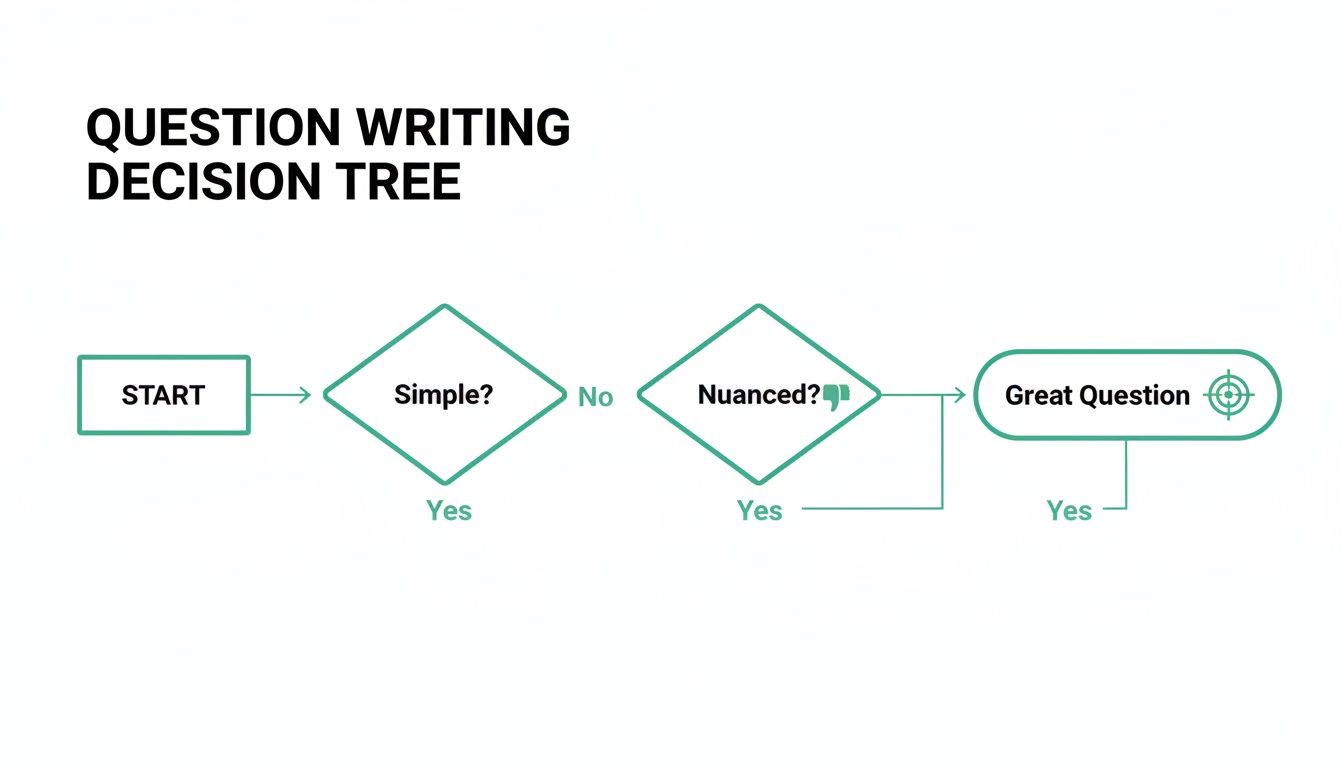
As the flowchart shows, truly insightful questions move beyond simple labels to get at the user's real internal experience. This is the bedrock of generating genuinely personalised results.
100% Free Lead Magnet Audit
Our AI analyzes your website and delivers custom growth strategies in seconds.
Crafting Compelling Result Descriptions
With your scoring bands locked in, it's time to write the actual copy. The goal here isn't just to inform; it's to connect and motivate. I've found that every great results page follows a simple, three-part structure to guide the user from insight to action.
1. Validate Their Experience Start by simply acknowledging what they're feeling. Use language that shows you get it. For someone in the "Significant" band, you might say: "Your results suggest that feelings of self-doubt and the fear of being 'found out' are a frequent and challenging part of your professional life. It's so important to know you are not alone in this."
2. Briefly Explain What It Means Next, offer a concise interpretation of their score. Tie it back to the specific dimensions you measured, like perfectionism or discounting praise. For the "Moderate" group, you could say: "This score often indicates that while you are highly capable, a persistent inner critic may be holding you back from fully owning your successes, especially during times of high pressure."
3. Provide a Clear Next Step This is the pivot. After delivering real value, you present a logical next step. This is where your call-to-action (CTA) comes in, but it must feel like a natural extension of the results, not a jarring sales pitch. Your offer should feel like the perfect solution to the problem you've just helped them define.
A great results page makes the user feel understood first, then offers them a tool for progress. It’s a sequence of "We see you, we understand you, and here’s how we can help." This builds trust and makes the conversion feel like a natural, helpful next step.
Engineering a Seamless Call-to-Action
Your CTA is the bridge connecting the user's moment of self-discovery to your business solution. The key is perfect alignment between their result and your offer. A user scoring high for imposter feelings isn't looking for a generic newsletter; they need a specific, relevant solution.
Here are a few practical examples of well-aligned CTAs:
For High Scorers (Significant Feelings): Offer something high-touch and immediate.
- CTA: "Book a Free 15-Minute Clarity Call"
- Why it works: It directly addresses the urgency and severity of their feelings by offering personalised support right away.
For Mid-Range Scorers (Moderate Feelings): Provide a tool for deeper understanding.
- CTA: "Download Your Free Guide: '5 Strategies to Overcome Self-Doubt'"
- Why it works: It gives them actionable tactics they can use themselves, which is perfect for someone who is aware of the problem but maybe not in crisis mode yet.
For Low Scorers (Mild Feelings): Offer content that helps them maintain confidence.
- CTA: "Join Our Weekly Newsletter for Confidence-Building Tips"
- Why it works: It’s a low-commitment offer that keeps them engaged and provides ongoing value, nurturing them for the future.
By tailoring your CTA to the user's specific result from the imposter syndrome test, you increase the likelihood of conversion dramatically. It shows you aren't just selling something; you're providing a thoughtful solution based on their unique needs.
Connecting Your Tech for Seamless Lead Nurturing
A brilliant imposter syndrome test with personalised results is only half the battle. Seriously. If you don't have a smart, automated engine running behind the scenes, you’re leaving most of the value on the table.
This is where your technology stack comes into play. The goal is to create a seamless journey from the moment someone finishes your test to the point where they’re ready to engage with you—all without any manual work.
This section breaks down how to actually build this.
Choosing Your Quiz-Building Platform
First things first, you need the right tool to build the test itself. While you could code one from scratch, dedicated platforms are faster and already know how to talk to your other marketing tools. The two I see most often are Typeform and Interact, and they serve slightly different needs.
| Feature | Typeform | Interact |
|---|---|---|
| User Experience | Famous for its sleek, one-question-at-a-time interface. It feels more like a conversation than a quiz. | Offers more traditional quiz layouts but packs a punch with branching logic and deep design customisation. |
| Logic & Scoring | Uses a "Logic Jump" system and score variables. It's powerful, but can get a bit tangled if your scoring is complex. | Built specifically for quizzes, so assigning points and mapping results to different outcomes feels really intuitive. |
| Integrations | Excellent native integrations with hundreds of apps like Mailchimp, HubSpot, and of course, Zapier. | Also has a strong integration library, with a clear focus on email marketing and CRM platforms. |
| Best For | Marketers who prioritise a beautiful, minimalist user experience and don't mind a slightly more technical logic setup. | Businesses that need powerful, straightforward quiz logic and deep segmentation capabilities right out of the box. |
For an imposter syndrome test specifically, Interact often has a slight edge. Its focus on quiz mechanics makes the segmentation part—which is critical here—much simpler. But if your brand aesthetic is all about that polished, conversational feel, Typeform is a fantastic choice.
Integrating Your Test with Your CRM
Once someone completes your test, their data needs to go somewhere useful. Manually exporting CSV files is a recipe for disaster and missed opportunities. This is where a direct integration with your Customer Relationship Management (CRM) or email marketing platform becomes absolutely critical.
The process is usually pretty simple: you connect your quiz tool to your CRM (like HubSpot or Mailchimp) using an API key. Then, inside your quiz tool, you'll map the quiz fields—name, email, and the final result category—to the right fields in your CRM.
This step is non-negotiable. Passing the result category (e.g., "Moderate Imposter Feelings") into a custom field in your CRM is the key that unlocks everything. It allows you to automatically segment new leads and send hyper-relevant follow-up emails.
A Sample 3-Part Nurture Sequence
With your leads now neatly segmented by their test results, you can deliver a targeted email sequence that speaks directly to their experience. A generic "welcome" email is a complete waste of this opportunity. If you want to go deeper on this, exploring the relationship between marketing automation and your CRM will show you how these systems really work together.
Here’s a simple but effective 3-part sequence for someone who scored in the "Significant Imposter Feelings" category:
Email 1: The Validation Email (Send Immediately)
- Subject: Your Imposter Syndrome Test Results + a Quick Note
- Body: Start by reminding them of their result and immediately validating their feelings. Say something like, "The feelings you described are incredibly common among high-achievers." Reiterate that the test is a starting point and offer one quick, actionable tip they can use today to counter a moment of self-doubt.
Email 2: The Story Email (Send 2 Days Later)
- Subject: I used to feel that way, too
- Body: Share a brief, relatable story—your own or a client's (with permission)—that mirrors their struggle. This builds a powerful, empathetic connection and shows them they aren't alone. End by hinting at a framework or method that helped create a breakthrough.
Email 3: The Solution Email (Send 4 Days Later)
- Subject: A path forward
- Body: This is where you connect their pain point to your solution. Clearly explain how your service (coaching, a course, etc.) directly addresses the challenges identified in their test results. Frame your offer not as a sale, but as the logical next step to overcoming what they're feeling. Make your call-to-action crystal clear.
Of course, this whole automated funnel leans on having a compelling offer. If you're not sure your lead magnet is strong enough to grab attention, a tool like the free Magnethive audit can generate a comprehensive report with 3 AI-powered lead magnet ideas, analyse your current lead magnet, and even show potential ROI impact.
How to Optimise Your Test for Maximum Conversions
Launching your imposter syndrome test is the starting line, not the finish. Think of it as a living part of your marketing that needs constant attention and fine-tuning. If you're not tracking performance, you’re just guessing.
Your real job begins now: figuring out what’s working and what’s not. A few key numbers will tell you the whole story, showing you exactly where people are engaging and, more importantly, where they’re dropping off. This is your roadmap for improvement.
Key Metrics to Actually Monitor
To really get what's going on, you have to look past the total number of leads. The metrics that actually matter are:
Completion Rate: What percentage of people who start the test actually see it through to the end? A low rate—say, below 70%—is a massive red flag. It probably means your questions are too long, confusing, or just plain boring.
Lead Conversion Rate: Of those who finish the test, how many hand over their email to see their results? This is the gut check for your lead magnet. Is the promised payoff worth their contact info?
Lead-to-Customer Rate: This is the big one. Of all the leads you generate, how many eventually pull out their credit card and become paying customers? This tells you if you're attracting the right crowd or just tyre-kickers.
Keep a close eye on these figures. They let you make decisions based on cold, hard data instead of just a hunch.
Actionable Tips for Boosting Performance
Once you’ve got your baseline data, the fun begins. It’s time to start experimenting. You'd be amazed how small, iterative tweaks can lead to huge gains over time.
For example, don't just stick with your first landing page headline. A/B test it. Pit a benefit-driven headline like "Finally Understand Your Self-Doubt" against a more direct one like "Take the 2-Minute Imposter Syndrome Test." A simple wording change can have a dramatic effect on your opt-in rate.
The same goes for your questions. If you notice a ton of people dropping off on one specific question, that's your cue. It’s likely too complex or poorly phrased. Rework it until it’s crystal clear.
The real goal here is to create a feedback loop. Use the data you gather not just to make the test better, but to understand your audience on a much deeper level. This data is absolute gold for shaping future content, products, and services.
Got Questions? I've Got Answers.
Here are a few things people always ask when they're thinking about building an imposter syndrome test.
"Do I Need to Be a Psychologist for This?"
Absolutely not. Let's get that out of the way right now.
You’re not building a clinical diagnostic tool. Your goal is to create a powerful marketing and educational experience, not something for medical use. The trick is to ground your test in established frameworks, like the Clance Impostor Phenomenon Scale (CIPS), to give it real credibility and substance.
Just be sure to include a clear disclaimer. A simple line stating the test is for self-reflection and not a substitute for professional advice is all you need.
"How Many Questions Should I Ask?"
The sweet spot is somewhere between 10 and 20 questions.
This range feels substantial enough to deliver a genuinely personalised and insightful result, but it’s short enough that you won't see people dropping off halfway through.
Fewer than 10 questions can feel a bit flimsy and might undermine the credibility of your results. Go over 20, and you'll see your completion rates nosedive as people lose patience. Focus on short, sharp questions that cut right to the heart of what your user is feeling.
"Okay, I've Built It. How Do I Get People to Take It?"
Don't just build it and hope they come. You need a multi-channel game plan.
First thing's first: create a dedicated, high-converting landing page just for the test. This is your home base.
Then, you need to drive traffic to that page. Here's what works:
- Social Media: Get it out on professional networks like LinkedIn. Frame it as a tool for self-discovery and career growth.
- Content Marketing: Weave it into your existing content. Write a blog post about imposter syndrome and embed a strong call-to-action that points straight to the test.
- Email Newsletter: Announce it to your list. These are your warmest leads, and they're often the most likely to not only take the test but also share it with their own networks.
- Collaborations: This is a big one. Team up with influencers, coaches, or other businesses in the personal development or career space. You get to tap into their ready-made, highly relevant audience.