Create a Find Your Style Quiz That Converts
Learn how to build a find your style quiz that captivates your audience and drives conversions. Get actionable steps from a builder who's done it.
We all know them: those fun, quick quizzes that promise to reveal your personal style. Whether it's for fashion, home décor, or even branding, a find your style quiz is an interactive experience that asks a few simple questions to pin down someone's unique preferences.
But don't let the simplicity fool you. This isn't just a fun gimmick; it's an incredibly effective lead magnet. Why? Because it offers personalised results that feel like a moment of self-discovery, not a sales pitch. That genuine value exchange is what drives sky-high engagement and conversion rates.
Why a Find Your Style Quiz Just Works
Think about most lead magnets. An ebook, a whitepaper, a checklist—they’re all a one-way street. They push information at your audience, essentially saying, "Here is something we think you should know." This model makes a huge assumption: that you already know what your audience wants or needs. It rarely invites them into a real conversation.
A find your style quiz completely flips the script. Instead of pushing content, it pulls people in by focusing on the one topic everyone finds endlessly fascinating: themselves. We’re all the main characters in our own stories. A quiz that promises to reveal something unique about our identity taps directly into that fundamental human desire for self-discovery.
It's All About the Psychology of "Me"
The real magic here is how this quiz format speaks to our ego in a positive, affirming way. When someone gets a result like "You're a Modern Minimalist" or "Your brand style is Eclectic Visionary," it’s more than just a label. It provides a sense of belonging and clarity.
This isn’t about trickery; it’s about connection. You’re giving people the vocabulary to describe who they are, which feels incredibly validating. That experience builds an immediate and powerful emotional link between them and your brand, because you’re the one who helped them have that "aha!" moment.
The core difference is simple: A static lead magnet says, "Here's our expertise." An interactive quiz says, "Let's discover your potential together." The second approach builds relationships, not just email lists.
This is exactly why these quizzes smoke static content. Most marketing feels impersonal and generic. A quiz, on the other hand, is a personalised journey that ends with a bespoke insight. It makes your audience feel seen and heard before you even think about asking for an email address. If you want to dig deeper into this dynamic, understanding the principles of interactivity on websites makes it clear why people crave these kinds of engaging experiences.
Let's break down how different the user experience and outcomes are.
Interactive Quiz vs. Static Lead Magnet
| Attribute | Find Your Style Quiz (Interactive) | Ebook/Checklist (Static) |
|---|---|---|
| User Experience | Active participation, personalised journey | Passive consumption, one-size-fits-all |
| Value Proposition | Instant, personalised insight about you | Generalised information about a topic |
| Engagement | High; users are invested in the outcome | Low; often downloaded and forgotten |
| Lead Quality | High; data reveals specific user needs | Varies; intent is often unclear |
| Emotional Connection | Strong; creates a feeling of being understood | Weak; purely transactional |
| Data Collection | Rich; gathers nuanced preference data | Minimal; captures only contact information |
| Shareability | High; people love sharing their results | Low; rarely shared on social media |
The table makes it pretty obvious. One is a conversation, the other is a lecture. In today's market, conversations win every time.
A Quick Story on Insane Conversion Rates
I'm not just talking theory here; I've built these and seen the results firsthand. A while back, when I was creating content on Medium, I put together a simple quiz called "What's Your Entrepreneur Type?" It wasn't flashy—just a handful of questions about work habits, risk tolerance, and vision.
The results were wild. The quiz hit a 55% lead conversion rate and brought in hundreds of genuinely qualified leads.
Why did it work so well? Because it didn't just offer generic business advice. It gave entrepreneurs a label they could identify with—"The Disruptor," "The Builder," "The Visionary." People were proud to share their results because it affirmed their professional identity.
That experience taught me a crucial lesson: even simple interactive tools can drive incredible results when they help people understand themselves better. You're not just generating a lead; you're providing a valuable, personal experience. That's why the "find your style quiz" is arguably the most powerful type of quiz you can build.
Designing Your Quiz Blueprint Before You Write

A quiz that actually converts isn't just a bunch of clever questions thrown together. It’s built on a rock-solid foundation. Jumping straight into writing is like trying to build a house without a blueprint—it might look okay from a distance, but it’ll fall apart as soon as someone tries to use it.
So, before you write a single word, you need to answer one crucial question: what do you really want someone to do after they get their result? That single decision shapes everything that follows.
Is your main goal to:
- Drive sales? Then your call-to-action (CTA) needs to point directly to a curated product collection that matches their style.
- Book appointments? The result page should seamlessly guide them into your consultation scheduler.
- Grow a segmented email list? Each outcome should trigger a specific, tailored welcome sequence that speaks their language.
Without this clarity, your quiz is just a fun distraction, not a strategic asset. You have to define the destination before you even start thinking about the journey.
Defining Your Style Archetypes
Once you know your goal, it’s time for the creative part: defining the quiz outcomes. I like to call these "style archetypes." These are the distinct personality buckets your audience will fall into.
Resist the urge to create a dozen different results. Simplicity is your friend here.
Aim for three to five distinct archetypes. This gives you enough variety to feel personal without overwhelming the user (or you). Think of these archetypes as the core pillars of your entire quiz.
For a home décor business, for example, your archetypes could be:
- The Modern Minimalist
- The Eclectic Visionary
- The Timeless Classic
- The Cosy Rustic
Notice how each name is aspirational and positive. You want people to feel excited and proud of their result. You’re giving them a label that validates their taste and makes them feel seen.
Mapping the Journey Backwards
The secret to making your quiz feel genuinely insightful and not just a random series of questions: work backwards from your archetypes. For each result, brainstorm the key traits, preferences, and attitudes that define it.
A "Modern Minimalist," for instance, probably values clean lines, neutral colour palettes, and functionality over ornamentation. Every single question you write must be a tool to measure these specific preferences.
This reverse-engineering process is what ensures every question has a clear purpose. You’re not just asking questions for the sake of it; you’re gathering specific data points that logically guide a user to their most authentic result. This thoughtful structure is what separates a forgettable quiz from one that converts like crazy.
Just like with chatbots, the success of your style quiz hinges on thoughtful design. This guide on design principles for engaging interactive tools explains how a purpose-driven approach is critical for any interactive experience. The user has to feel like the journey was designed specifically for them.
The final piece of your blueprint is connecting the questions to the outcomes. A simple scoring system works wonders—each answer choice adds a point to one or more of your archetypes. While there are plenty of fantastic online quiz makers that handle the tech, having this foundational map planned out first is what will make your find your style quiz a powerful and effective tool for your business.
Crafting Questions That Build Real Connection

This is where the magic happens. The questions are the heart of your quiz—the place where a simple web form becomes an engaging, personal experience. Forget dry, technical questions that feel like an interrogation. We’re aiming for a conversation that makes your audience feel seen.
The trick is to ditch the text-only, logical prompts. People respond with their gut, especially when it's about something as personal as style. So instead of asking, "Do you prefer bold or neutral colours?" you frame it as a mini-daydream.
Try something like this: "You're styling your ideal workspace. Which of these palettes sparks your creativity?" Then, show them compelling, high-quality images. Suddenly, it’s not a quiz; it’s a fun, creative exercise. This little switch ignites their imagination and gets them invested.
Designing Questions for Engagement
The best questions in a find your style quiz are visual and situational. They’re designed to tap into feelings and immediate preferences, not force someone to overthink their answers. This makes the quiz faster, way more enjoyable, and honestly, more accurate at capturing someone's real aesthetic.
I've found a mix of formats works best to keep the momentum going:
- Image Grids: Present four distinct images and ask, "Which of these living rooms feels most like home?" This is the fastest way to get a read on their preferences.
- "This or That": Keep it simple with a binary choice between two concepts. Think: "Cosy nights in or glamorous nights out?"
- Scenario-Based Questions: Paint a picture. "You've been given a gift voucher for one piece of furniture. What do you buy?" Then offer answers like "A sleek, modern armchair" or "A vintage, ornate mirror."
The power of a good quiz question is its ability to make someone feel understood. When a user thinks, "Wow, they get me," you've built a level of trust that a static PDF download could never dream of achieving.
This is exactly why interactive content crushes passive lead magnets. An ebook forces your perspective onto the reader. A well-designed quiz flips that around and focuses entirely on the individual. We all love talking about ourselves, and a quiz gives people a structured, fun way to do just that.
Striking the Perfect Balance in Length
So, how many questions should you ask? This is a critical balancing act. Too few, and the result feels cheap and unearned. Too many, and you’ll see people dropping off before they ever finish.
The sweet spot is usually between seven and ten questions. It’s substantial enough to feel insightful but short enough that someone can finish it in a couple of minutes. You're respecting their time while still gathering enough data to give them a genuinely personalised result.
And remember, every single question needs to earn its spot. It has to clearly map back to one or more of your style archetypes. If a question is confusing or doesn't actually help differentiate between the outcomes, cut it. Ruthless editing is your best friend here.
Maintaining a Conversational Tone
Finally, let's talk about language. Write your questions as if you're chatting with a friend over coffee. Keep it light, encouraging, and completely free of industry jargon.
Instead of something stuffy like, "Please select the option that best represents your interior design preference," try a more casual approach. "What's your home's vibe?" or "Let's talk textures. Which one are you drawn to?" This simple shift in tone makes the whole experience feel more approachable and human.
By the time they reach the results page, they don't feel like they've just filled out a form for a faceless company. They feel like they’ve had a fun conversation with someone who actually gets their style. That connection is the foundation for turning a curious visitor into a loyal lead.
100% Free Lead Magnet Audit
Our AI analyzes your website and delivers custom growth strategies in seconds.
Building a High-Impact Quiz Results Page
The results page is the moment of truth. After all that clicking and reflecting, your user is expecting a payoff. A flat, one-line result like "You are a Minimalist" is a total buzzkill. It kills all the momentum you just built.
This page needs to feel like a genuine reward for their time, the satisfying end to their little journey of self-discovery.
This is where you stop asking questions and start delivering real value. The whole point is to make your user feel seen, validated, and completely understood. A killer results page doesn't just slap on a label; it gives them an identity they're genuinely excited to own and share.
Naming Your Style Archetypes
The names you choose for each result are everything. They need to sound positive, aspirational, and frankly, cool. You're not writing a technical manual; you're creating a persona people want to step into.
Good archetype names just have a certain ring to them. Think about it:
- The Modern Minimalist: It’s clear, descriptive, and has a classic feel.
- The Eclectic Visionary: This sounds intriguing, creative, and a little bit bold.
- The Timeless Classic: Instantly brings to mind elegance, sophistication, and reliability.
- The Cosy Rustic: You can almost feel the warmth. It’s inviting and down-to-earth.
Each name should spark a positive mental image instantly. You want them to read it and have that "Yes, that's me!" moment. That simple act of identification is a powerful psychological trigger that creates an immediate bond with your brand.
Crafting a Rich and Affirming Description
Once the name has them hooked, the description has to deliver on the promise. This is your chance to prove you were actually paying attention to their answers. The description should be a rich, positive summary that makes them feel good about their choices.
Break down what makes their style unique. Talk about the specific colours, textures, shapes, and feelings that define their archetype. If someone gets "The Eclectic Visionary," you could talk about their love for mixing patterns, their fearlessness with bold colours, and their talent for blending vintage treasures with modern pieces.
Your results page isn't just a summary; it's a mirror. It should reflect the user's best and most authentic self back at them, using the data they just gave you. When done right, it makes them feel brilliant for their taste—and brilliant for finding you.
This is where you really cement the connection. By describing their style in a way they might not have been able to put into words themselves, you position your brand as a true expert and a helpful guide. The results page is where you really show the power of personalized marketing in a way that truly connects with your audience.
The Seamless Call-to-Action
Alright, now for the most important part: turning that warm, fuzzy feeling of validation into actual action. Your call-to-action (CTA) can't feel like a sleazy sales pitch. It has to feel like the natural, obvious next step on their newly discovered style path.
The secret is to make the CTA a direct extension of their result. Ditch the generic "Shop Now" and offer something hyper-relevant and personalised.
- For The Modern Minimalist: "Shop Your Curated Minimalist Edit"
- For The Eclectic Visionary: "Download Your Visionary Style Guide"
- For The Timeless Classic: "Book a Consultation to Perfect Your Classic Look"
See the difference? Each CTA promises to solve their next problem. They know their style now, and your CTA gives them the direct path to making it a reality. This is how you turn a moment of personal insight into a smooth conversion, making your find your style quiz a genuine engine for growth.
Of course, the design of the page is critical, too. To make sure it converts, it needs to follow proven design principles. You can dive deeper into building pages that drive action in our guide covering the best practices for landing page design. A strong results page is the perfect mix of psychological validation and clear, compelling design that guides the user exactly where you want them to go.
Integrating Your Quiz Into Your Marketing Funnel
Your quiz isn't finished when someone gets their result. That's just the start of the conversation.
A find your style quiz can't just float in a void on your website. To turn it into a lead generation engine, you have to wire it directly into your marketing ecosystem. The real goal here is to turn that "aha!" moment into a long-term relationship.
Think about it. What happens after someone discovers they're a "Modern Minimalist"? If the answer is "nothing," you’ve just thrown away a golden opportunity. The real magic is in the follow-up, and that means connecting your quiz to your email service provider (ESP) or CRM from the second you launch.
This connection lets you do something incredibly powerful: automatically segment new leads based on their quiz outcome. Someone who gets "Eclectic Visionary" should never, ever see the same welcome email as a "Timeless Classic."
That level of deep personalisation is how you nurture curious quiz-takers into actual, loyal customers.
Connecting and Segmenting Your Leads
Pretty much every quiz-building tool out there offers direct integrations with the big players like Mailchimp, ConvertKit, or HubSpot. Setting this up is usually a quick job—just authorise the connection and then tell it what to do.
You'll create a simple rule that looks something like this:
- IF quiz result is "Modern Minimalist"
- THEN add the contact to the "Minimalist" audience segment and kick off the "Minimalist Welcome Sequence."
This automated workflow is the absolute backbone of your funnel. Each segment needs its own email sequence that speaks their language, referencing their newly discovered style. This small touch reinforces that you get them and their specific needs.
A quiz without automated segmentation is like having a great conversation but never following up. It’s a nice memory, but it doesn't lead anywhere. True ROI comes from continuing the personalised dialogue you started.
That first follow-up email is critical. It should celebrate their result, give them a quick summary of their style, and then deliver on whatever you promised on the results page. Maybe it’s a link to a curated product collection or a download for their personal style guide. The key is delivering immediate, relevant value.
Promoting Your Quiz for Continuous Traffic
Okay, your funnel is built. Now you need to get people into it. A quiz won't promote itself; you need a steady stream of the right people taking it.
Here are a few promotional strategies I've seen work time and time again:
- Website Pop-ups and Banners: Ditch the generic "subscribe to our newsletter" pop-up. Instead, use a non-intrusive pop-up or a "hello bar" on relevant pages. A call-out on your homepage that says, "Unsure of your style? Take our 2-minute quiz to find out!" is way more compelling.
- Social Media Campaigns: Quizzes are social media gold. Run targeted ads on visually-driven platforms like Instagram or Pinterest, using slick graphics that hint at the different style outcomes. People love sharing their results, so build that in—make them easily shareable with custom graphics.
- Email Signature and Broadcasts: This is an easy win. Just pop a link to the quiz in your email signature. You can also send a dedicated broadcast to your existing list, inviting them to discover their style. It's a fantastic way to re-engage your audience and learn more about their preferences.
This infographic breaks down the simple but effective structure for a results page that moves people seamlessly into your funnel.
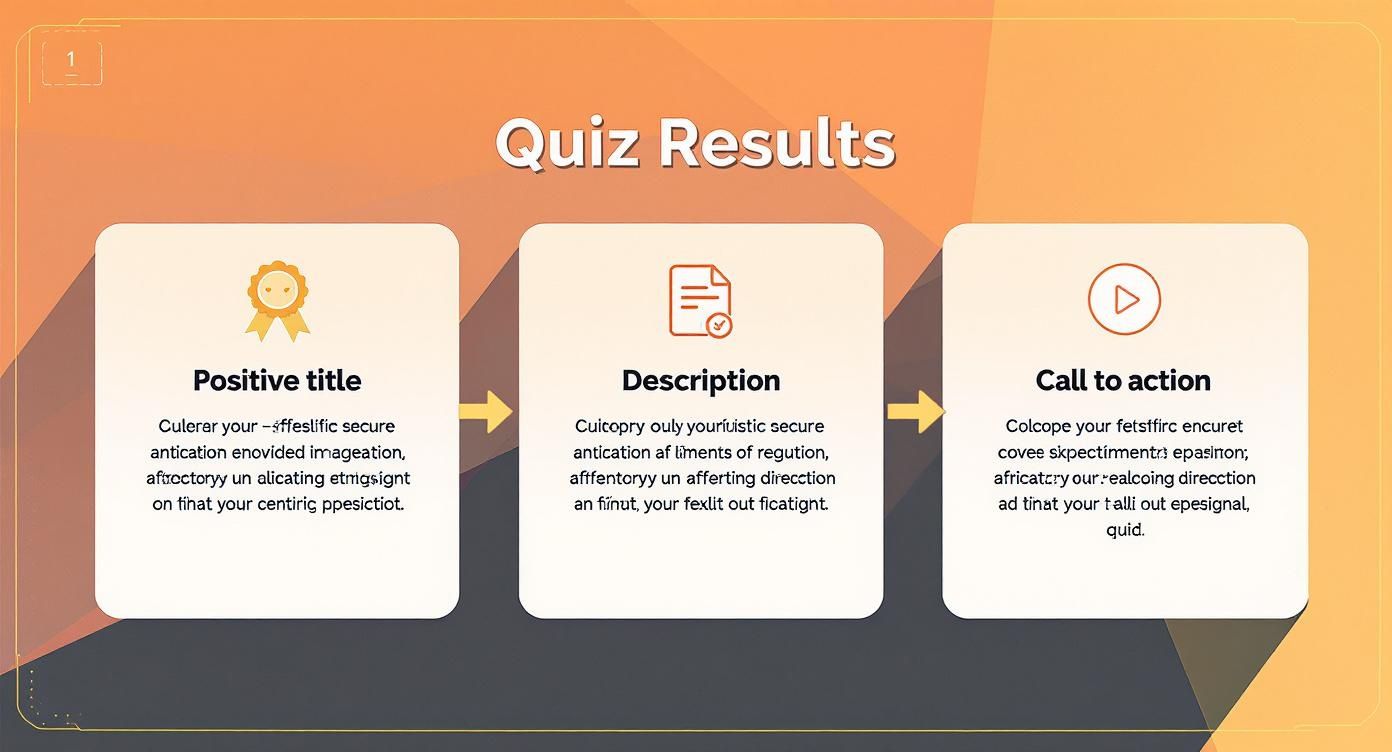
The flow is logical and built around the user, starting with positive validation and ending with a clear, personalised next step.
Your find your style quiz should become an evergreen asset, a core part of your marketing toolkit. By integrating it properly and promoting it consistently, you build a system that doesn't just collect emails. It actively sorts and nurtures leads based on their genuine interests. This is how you stop basic lead capture and start building a sophisticated, scalable marketing machine that delivers qualified prospects day in and day out.
Analysing and Optimising Your Quiz Performance
Launching your ‘find your style’ quiz isn't the finish line. It's the starting block.
Too many people build a quiz, put it out there, and just… hope. Real growth comes from obsessively digging into the data and making small, smart tweaks over time. Your launch is just the baseline.
You need to know exactly which question makes people lose interest and close the tab. You need to see which of your style results actually drives the best conversions and where your highest-quality leads are really coming from.
Without this data, you're flying blind.
Identifying Key Performance Metrics
First things first, you need to track the right numbers. Don't get lost in vanity metrics. Focus on the data that tells you how the quiz is performing as a business tool. Your quiz software's analytics dashboard should be your new best friend.
Here are the critical metrics to keep a close eye on:
- Completion Rate: This is the big one. What percentage of people who start the quiz actually finish it? A low rate—say, below 70%—is a huge red flag that something is wrong. Maybe a question is confusing, it’s too long, or the images are slow to load.
- Lead Conversion Rate by Outcome: Don't just look at the overall conversion rate. Dig deeper. You might find that your "Modern Minimalist" result converts at 60%, while the "Eclectic Visionary" only converts at 25%. This insight is pure gold. It tells you which audience segment resonates most with your offer.
- Question Drop-off Points: Pinpoint the exact question where most people abandon your quiz. This is often the point of highest friction. Is the question unclear? Is it too personal? Rewording or replacing this single question can often give your overall completion rate a massive lift.
The Power of A/B Testing
Once you have your baseline data, it's time to start experimenting.
A/B testing, or split testing, is just a methodical way to boost your quiz performance without guesswork. You show two different versions of something to your audience and see which one performs better. Simple.
Start with the highest-impact elements first. The headline is a great place to begin. A simple test could compare "Find Your Interior Design Style" against a more benefit-driven headline like "What's Your Home's True Personality? Take the Quiz." You'd be shocked at how much a small wording change can affect click-through rates.
Optimisation isn't a one-time task; it's a continuous process of asking "what if?" and letting the data give you the answer. Every test, whether it wins or loses, teaches you something valuable about your audience.
Next, test your call-to-action (CTA) on the results pages. Try changing the button text, the colour, or even the offer itself. Maybe a "Download Your Style Guide" CTA works better for one archetype, while "Book a Free Consultation" is more effective for another.
Only testing will reveal the truth.
Honing Your Overall Lead Magnet Strategy
Sometimes, the issue isn't just a single question or CTA. I've seen many businesses struggle because their entire lead magnet strategy is off, feeling unsure if their quiz idea will even connect with their audience in the first place.
If you're feeling that uncertainty, it’s worth getting an objective analysis before you invest too much time. A tool like the free lead magnet audit from Magnethive, for instance, can give you a clear path forward. It generates a comprehensive report with AI-powered ideas and a full ROI breakdown, helping you validate your approach so you can build with confidence.
Ultimately, your quiz is a living asset. It's not a set-it-and-forget-it tool.
By consistently tracking your metrics, testing new ideas, and refining your approach based on real user behaviour, you transform a fun interactive gimmick into a predictable, high-performance engine for generating qualified leads. This iterative process is what separates the quizzes that get forgotten from the ones that drive a business forward.